

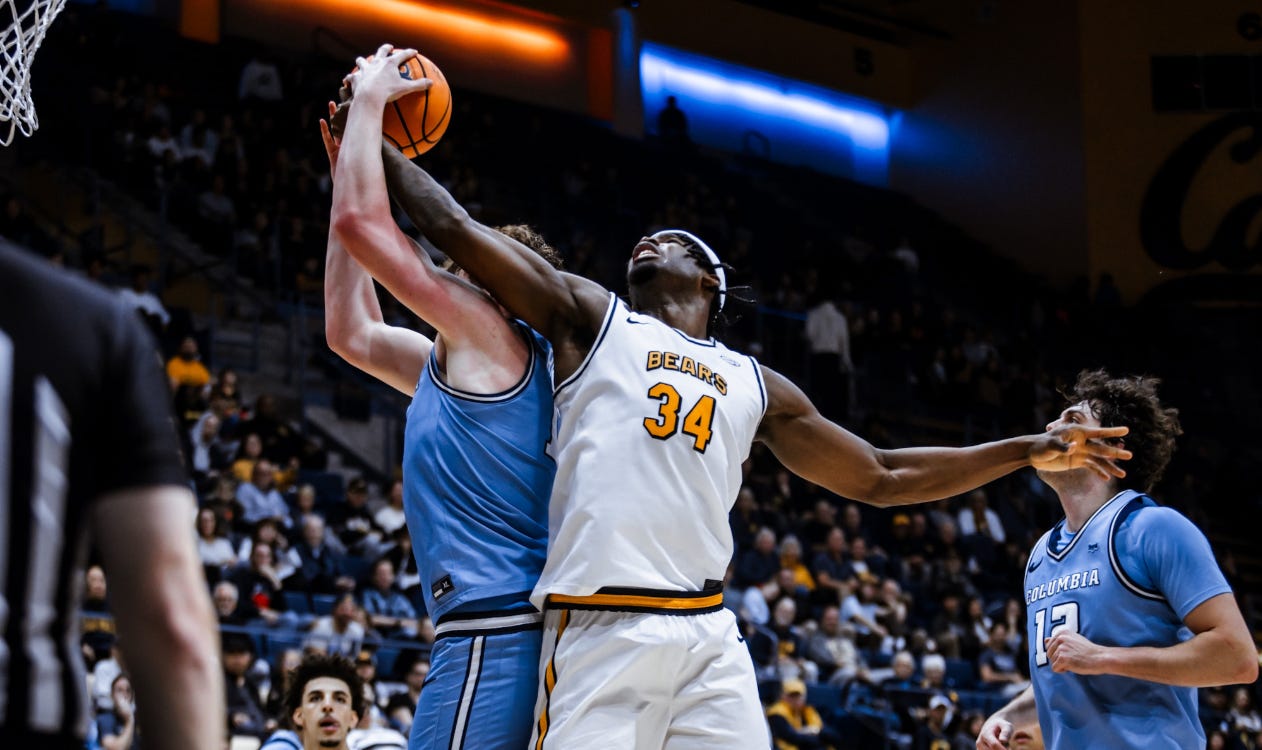
photo via @calmbball twitter
We’re here, at the official turning of the season. Yesterday, Cal men’s and women’s basketball more or less* wrapped up their non-conference season. Two days from now, Cal football will wrap up their season in Hawaii. It’s poetic that as football season finally comes to an end, basketball season gets real.
Which means now is the perfect time to take stock. What have we learned about each team during non-conference play, and what does ACC play have in store?
*If you insist on being technical, the Cal women play Cal Poly next weekend before they start ACC play on New Year’s Day. But Cal Poly is 0-9 against D-1 competition, and lost to UCLA 115-28 a week ago. The outcome is a foregone conclusion and whatever happens is not a useful piece of data for projecting the rest of the season.
Cal MBB ACC Preview
Non-conference summary
Cal’s 12-1 non-conference record is defined by two features: A massive win over UCLA, and taking care of business against the rest of a very weak schedule.
A neutral site game against UCLA and a road game against Kansas State were the only high level games on Cal’s schedule; Cal’s 3rd toughest game came against a Utah team that is firmly outside of the top 100 by every efficiency metric and is by a pretty wide margin the worst team in the Big-12 this year.
As a result, splitting the two tough games and winning every other game Cal was ‘expected’ to win represents about as strong a performance as we could reasonably expect.
State of the ACC
Last year represented something of a nadir for ACC basketball. The conference only got 4 teams into the tournament, the lowest since 2013, when the conference had six fewer members. Three of those teams failed to survive the first round, and really the entire season was a tale of Duke-and-17-other-teams-also-playing-basketball. Eight teams finished outside of the top 100 per Kenpom
This year? Duke is still the best team in the conference, but down a bit compared to last year. Meanwhile, the conference has fewer bad teams (though Boston College, Pitt, Georgia Tech, and Florida State are pretty rough) and more teams are on the fringes of the top 25.
While the ACC isn’t quite as good as the SEC, the Big-12, or the Big 10, the gap has narrowed, and teams that finish .500 or better in conference play are likely to at least be on the bubble for the tournament, if not solidly in.
What are Cal’s biggest strengths and weaknesses?
Cal’s biggest strength has been shooting, on both ends of the court. Led by the sharp shooting of Dai Dai Ames, Chris Bell, and John Camden, Cal is 14th in the country in three point percentage, and while the Bears aren’t quite as good inside the arc they’re still a very efficient shooting team more or less across the board.
That strength extends to the defensive side of the ball, where Cal is holding teams to 30% shooting from three and 46% shooting from 2. Lee Dort has taken a big step forward as a rim protector, Cal is playing more perimeter ball pressure, and the overall result has been poor shooting from the majority of Cal’s opponents (let’s agree to not talk about the Kansas State game).
Cal’s primary weakness has been rebounding. Again, Dort has done excellent work inside and has been particularly excellent on the defensive glass. But Cal doesn’t really pull down offensive boards, and they miss Rytis Petraitis’ efforts on the defensive glass. When Dort is on the bench, Cal is vulnerable to giving up 2nd chances.
Is a tournament spot in play? If so, what would it take?
Right now, Cal is on the fringes of the bubble. A Quad 1 win over UCLA and no bad losses puts Cal in a solid position, but also means that a lot of work needs to be done.
Here is Cal’s schedule, with the current NET (through 12/20) status of each game noted:
vs. Louisville (Quad 1)
vs. Notre Dame (Quad 2)
at Virginia (Quad 1)
at Virginia Tech (Quad 1)
vs. Duke (Quad 1)
vs. North Carolina (Quad 1)
at Stanford (Quad 2)
at Florida St. (Quad 3)
at Miami (Quad 1)
vs. Georgia Tech (Quad 4)
vs. Clemson (Quad 2)
at Syracuse (Quad 2)
at Boston College (Quad 3)
vs. Stanford (Quad 3)
vs. SMU (Quad 2)
vs. Pitt (Quad 3)
at Georgia Tech (Quad 3)
at Wake Forest (Quad 1)
(For the record, I have no clue why Cal plays Georgia Tech twice and NC State zero times.)
For those counting, in ACC play Cal is projected to play seven Quad 1 games, five Quad 2 games, and six Quad 3/Quad 4 games. You will note that Cal’s conference schedule is heavily front-loaded, with eight of Cal’s 12 toughest games coming between now and January 31st. If Cal can get through the first half with 4 wins or more they’ll be in spectacular shape, and even a 3-6 start to ACC play wouldn’t end Cal’s shot at making the NCAA tournament.
It’s impossible in late December to predict what the bubble will look like in early March. Still, something like 2-5 in Quad 1 games, 3-2 in Quad 2 games, and 5-1 in all other games (10-8 overall) would at a minimum likely result in Cal playing for their NCAA tournament spot in the ACC tournament.
What do our computer overlords predict?
Kenpom sez: 9-9
Torvik sez: 9-9
Cal’s adjusted efficiency is 9 out of 17 per Kenpom and 10 of 17 per Torvik, so eeeeever so slightly below average. But since Cal gets to play Stanford and Georgia Tech twice and avoids NC State, the computers predict a .500 conference record.
This establishes a good baseline: playing .500 or better basketball is at least meeting projections AND getting Cal into NCAA tournament discussion.
Cal WBB ACC Preview
Non-conference summary
Close but no cigar was the story for Cal women’s basketball. The Bears are a perfect 8-0 against teams from non-power conferences, and an imperfect 0-5 against peer competition, but with every loss coming by single digit deficits.
Just to give you a sense of how frustrating each loss has been, consider:
17:06 remaining, Cal 37, Vanderbilt 35
2:30 remaining, Auburn 51 Cal 49
0:39 remaining, Cal 67, Missouri 66
9:16 remaining, Cal 57, Stanford 52
5:58 remaining, Cal 49, USC 46
Cal led or tied the game in the 2nd half in all five of their losses, and usually very late into the 2nd half. Alas, close only counts in horseshoes and hand grenades.
State of the ACC
The conference is down this year. Louisville, North Carolina, and NC State are all top 25 level teams, but Notre Dame and Duke have taken steps back, and Florida State and Georgia Tech have both taken plunges after losing their best players in the transfer portal.
It’s still a conference that will get teams into the NCAA tournament, but after getting eight teams last year (all 9 seeds or better), there are probably only 4 teams that feel good about their resume entering conference play.
What are Cal’s biggest strengths and weaknesses?
Cal’s biggest strength has been defending without fouling. The Bears don’t give up easy shots, and they don’t send teams to the line. Sakima Walker has provided excellent rim protection, Mjracle Sheppard’s perimeter defense has been as advertised, and Cal’s younger players don’t look out of place on the defensive end. Cal is tough to score against, and that’s what kept Cal close against teams like Stanford and USC.
On the other hand, shooting is a challenge. One year after arguably the greatest shooting season in program history, the Bears really struggle outside of the paint. Cal is 192nd in the country from three, 253rd from the free throw line, and they shoot just 27% on shots classified as ‘Far 2s.’ This isn’t necessarily a huge shock after losing so many shooters last year, but even Lulu Twidale has been in a slump, as nobody on the team with more than 2 attempts is shooting 30% or better as an individual from deep. As a result, Cal is deeply dependent on their ability to get shots inside.
Is a tournament spot in play? If so, what would it take?
I’m not going to say it’s impossible, but Cal is in a tough spot and they are not on the bubble right now. Losses to Auburn and Missouri currently qualify as Quad 3 losses, and Cal has no good wins to offset them. ACC play offers plenty of opportunities for good wins, but also more opportunities for damaging losses. And right now Cal hasn’t shown the ability to close out wins against good teams, or to regularly pull away from lower end power conference opponents.
Ultimately, I think this season is much more about building up experience for Cal’s younger players. Get a year of point guard experience under Puff Morris. Let Taylor Barnes learn what it takes to compete in the ACC. Come back stronger next year, when every player on the roster with the exception of Sakima Walker and Claudia Langarita are eligible to return.
What do our computer overlords predict?
Torvik sez: 8-10
Cal starts ACC play with a brutally tough road trip, and the Bears will be heavy underdogs at North Carolina and at NC State. But after that there aren’t really any games on the schedule that strike me as out of reach, though home games against Louisville and Notre Dame in late January/early February will be tough.
And there are enough winnable games against struggling teams like Wake Forest, Boston College, and Pitt that Cal should find wins and move towards the middle of the conference standings.
Cal would likely need to get to get to at least 12 or 13 wins in conference play to start making up for their weak non-conference resume. But in a rebuilding year, holding steady in the middle of the conference would be a reasonably solid season.
The fact that we are even talking about Cal MBB is meaningful progress in itself! I haven’t looked forward to any game in years so this state of being even potentially relevant is a good feeling.
The level of skepticism about MBB by some commenters is sad but understandable given past futility. However, I think many folks are under-estimating this team. The non-conference results are not equivalent to the football non-conference hooplah. I could see during the first game that this team is much improved and, actullay, one of the best we've had in ages. A more difficult non-conference schedule would have been stupid given the difficulty of the conference lineup. Some of the teams we played were actually pretty good (or, at the least, played exceptionally well in Berkeley); only a couple of teams were ostensibly weak.
Bold prediction: Lousiville loses at Haas. It will be like the Christmas spirit at the end of Elf. People will finally believe. Go Bears.