

First of all, my apologies: I’ve been on vacation out of the country for a few weeks, as is frequently the case in June when my wife’s school year ends. For Cal blogging purposes, this is usually a good time to be away, the absolute height of the boring off-season. But for a change, June was packed with critical change for Cal athletics.
Important developments include:
Jim Knowlton has retired. Cal has presented this in a straightforward manner, as if Knowlton’s decision to retire is entirely personal and unrelated to either the various legal/administrative scandals trailing behind Knowlton OR the structural developments that removed huge chunks of Cal athletics from the purview of the athletic director. Maybe that’s the case, but color me skeptical that Knowlton voluntarily walked away from million dollars. Regardless of the exact reason why, good riddance.
The House Settlement was finally approved after months of negotiation and delay, finalizing the (likely short term) financial and regulatory landscape of college athletics. For Cal’s purposes, critical terms of the settlement include:
Moving forward, each school can pay its athletes up to a certain limit. The annual cap is expected to start at roughly $20.5 million per school in 2025-26 and increase every year during the decade-long deal.
The settlement gives the schools power to create new rules designed to limit the influence of boosters and collectives. Starting this summer, any endorsement deal between a booster and an athlete will be vetted to ensure it is for a "valid business purpose" rather than a recruiting incentive.
In theory, any salary going to an athlete should be coming directly from the school, and NIL should go back to how it was originally intended - actual legitimate endorsements and work from 3rd parties, rather than thinly disguised payments from boosters solely for coming and staying at a specific school.
Following the finalization of the House settlement, Cal announces their approach to revenue sharing (emphasis mine):
The campus is finalizing a distribution model that will be guided by the revenue currently produced by Cal's athletic programs - primarily football, men's basketball and women's basketball. UC Berkeley Chancellor Rich Lyons aims to further motivate and inspire the Cal family through a match of contributions of up to $6 million for football, up to $1.5 million for men's basketball, and up to $500,000 for women's basketball from campus resources.
Cal football has a gangbusters month of high school(!) football recruiting.
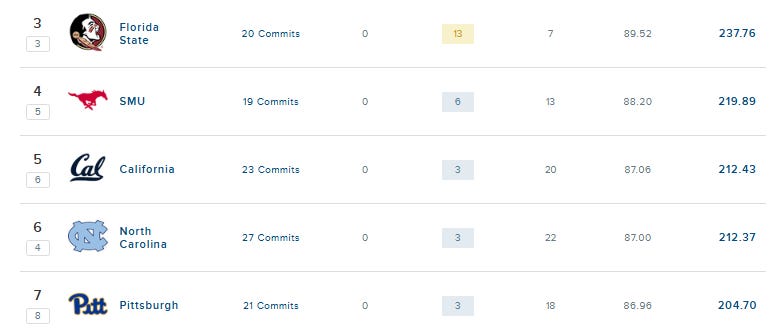
I mean, you’ve seen all the commitment posts that have flooded this very website, but holy smokes we haven’t seen Cal hold a place in the top 25 of the national recruiting rankings since . . . the Tedford days? I’m too lazy to look back year-by-year but you get the idea. The ACC rankings look even better, where Cal sits comfortably just below the actual powers of the ACC:
The upshot of all of this news? For the first time in ages, Cal appears to be taking major athletics seriously, and Cal’s collective action has already borne tangible fruit.
The departure of Knowlton, the elevation of Ron Rivera, and the announcement that Cal would be contributing up to $8 million in campus resources are all huge signs that Cal’s administration has made a major pivot towards embracing the modern reality of college sports. For that, we have chancellor Rich Lyons and all of those involved in California Legends NIL to thank for recognizing the direction Cal athletics had to head, and winning the internal argument within Cal’s larger administration to make it happen.
Cal has not publicly said so, but it is our understanding here at Write For California that Cal intends to pay out the full maximum of the $20.5 million in revenue sharing for 2025-26. It’s not clear to me if those funds have been fully raised already or if that’s still a work in progress, but I cannot overstate how seismic a change that is for the prospects of saving Cal athletics, short term and long term.
It will likely take time to survey the full landscape, but based on everything I’ve been reading and listening to, there aren’t going to be many teams outside of the SEC and the Big-10 expected to pay out the full maximum of revenue sharing dollars allowed this coming year, and in future years as well. It will require continued coordination and efforts from the Cal donor community to continually hit the max, but if Cal is able to do so, it will immediately mean that Cal’s football roster will be among the most well funded in the nation outside of the two most powerful conferences. Perhaps most relevantly, it will make Cal VERY competitive within the ACC, where perhaps more than half of the conference won’t hit the revenue sharing ceiling.
There are still massive questions facing college athletics generally, and Cal athletics specifically. Will Cal be able to afford long term revenue sharing payments? If so, are the non-salary resources in place to allow Cal to succeed? How long will the House Settlement landscape last until it is altered by future lawsuits and/or congressional action? How exactly is Cal splitting up revenue payments between football, men’s basketball, women’s basketball, and all other Olympic sports? What will the impacts of this change be on Cal’s non-revenue sports?
These are topics that are worthy of articles all their own, and we’ll get to them as time allows and as we learn more.
But for now, allow yourself to feel some optimism. The last few years have been defined by uncertainty. Cal’s past failures have led to massive set-backs and existential threats, and at times I’ve had reason to doubt the ability of Cal athletics to survive. But the stark challenges have also caused a real reckoning to take place, as the wider Cal community has taken seriously the threat that Cal sports as we know it could cease to exist. The same people who put in the effort to make Cal Legends such a success are the same people who have stepped up to ensure that Cal is maximizing their revenue sharing payments to athletes. Sometimes that effort was a quiet, behind the scenes effort to raise money and advocate for necessary structural changes. Sometimes that effort was public and messy and necessary to rid Cal of an administrator who did most everything wrong.
It was an effort that the Cal donor community won, in the end.
This victory may not mean a ton in the short term. Cal football’s 2025 roster still has all kinds of questions, both on the depth chart and on the coaching staff. Justin Wilcox has still not proven his ability to provide more than .500 football in seven seasons.
But this is about way more than one football season. It’s change that has a chance to create an actual foundation for consistency and success. The effort is far from over, but I think we’ll look back at June as the turning point in the push to save Cal sports.
Thank you so much for the kind words and, even more, for your well-founded optimism in our future. So great to see a new day dawning and a serious approach to competitive success taking hold. As you noted in the links, we are suspending California Legends in order to focus our efforts on helping Cal maximize its NIL revenue share with the students. Cal can spend up to $20.5m annually and has committed to do so. That's a major lift for Cal with donors and the fact that folks can now get a tax deduction for their contributions makes this a better place to have them direct their gifts.
To answer one of the questions you raise, Cal has committed to a 75/15/5/5 model in splitting up this $20.5m. This means that 75% of the money will go to football, 15% to Men's Basketball, 5% to WBB and 5% to the other sports (combined). This is the structure being followed by most P4 schools as it mirrors how the money is being allocated for the historical damages under the House settlement. 75% of that money is going to football players so most schools (including Cal) will spend 75% on football on a go forward basis. The idea is that football generated most of the revenue so it should get most of the revenue share.
While it seems obviously correct, it's worth noting that this 75/15/5/5 model wasn't an obvious or easy conclusion for Cal to reach. Huge credit to Rich Lyons for understanding the need to invest in football in order to save the entire athletic department. There is just zero chance our prior leadership would have made this choice, and Rich had to push back against some very powerful members of the bureaucracy who wanted Cal to do a 50/50 split between the men's and women's sports because of their interpretation of Title IX. The fact that no other school was following this 50/50 model and it would have doomed us all didn't matter in the least to these people because frankly "winning" has never mattered to them. And that has always been obvious in everything they do.
While my posts linked above thank many people for how they helped with the Collective, here I'd also like to say a special thank you to Write4California. You guys have always done an amazing job connecting with the broader Cal community. Also a special shout out to the Calgorithm. Whatever national "buzz" Cal achieved last year and our place in the zeitgeist was thanks to you. Hopefully you can work some magic and replicate your success again this year (and beyond).
Bittersweet to be moving on from the Collective, but I'll continue to try to find ways for Cal to reach the promised land. To paraphrase Galadriel in the Lord of the Rings, "I will diminish and go into the West . . . and remain Sebastabear."
Go Bears!
Great info as usual Nick. Structurally, Cal is finally organizing for success, and the commitment to NIL max is great. And the 2026 football commits, if they do actually show up in Berkeley, look very promising. BUT, big Qs for 2025 football... one other news item of note: Cal Rugby has been fully funded!!! GO BEARS!