


The Hawai’i Bowl represented many of the frustrations with the program in recent years that ultimately led to Wilcox’s firing. The Bears: 1) blew yet another three-touchdown lead, 2) were unable to adjust defensively to a Hawai’i offense that scored every time they touched the ball after the first 20 minutes, and 3) offensively stumbled through a nearly 40-minute span without a TD. Furthermore, our clustering algorithm reveals that this game continues another frustrating pattern across the later years of the Wilcox Era.
PFF Grades
As always, our friends at PFF evaluated every player on every snap, and assigned grades both at the player level and at the team level. The bowl’s grades are plotted below.
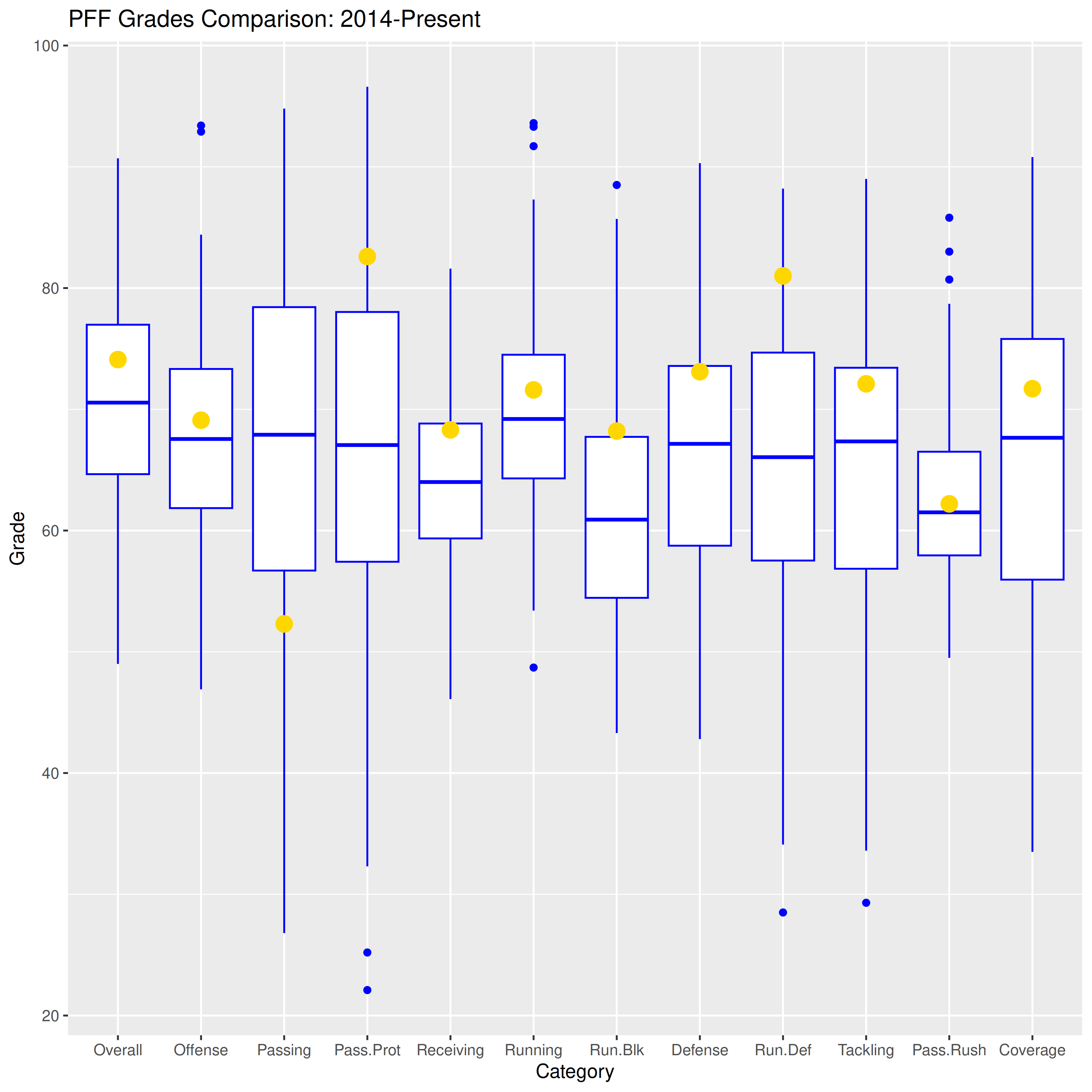
Everything earned grades above the median score (the horizontal line in the box), with one notable exception: passing. I thought JKS had a solid outing with 337 yards and no turnovers on 8.6 yards per attempt, but PFF was not impressed. Offensively, everything else fared well. Pass Protection and Run Blocking were both above the 75th percentile, strong outings for the much-maligned O-line. Receiving and Running were both solid. Defensively, grades were also strong. Run Defense was spectacular, while Tackling and Coverage were quite strong. Pass Rush was merely middling.
With good grades almost entirely across the board, this could be a candidate for The Good—could this be the first time we have seen a loss in The Good?
PFF Clusters
I fed the results into our clustering algorithm and…
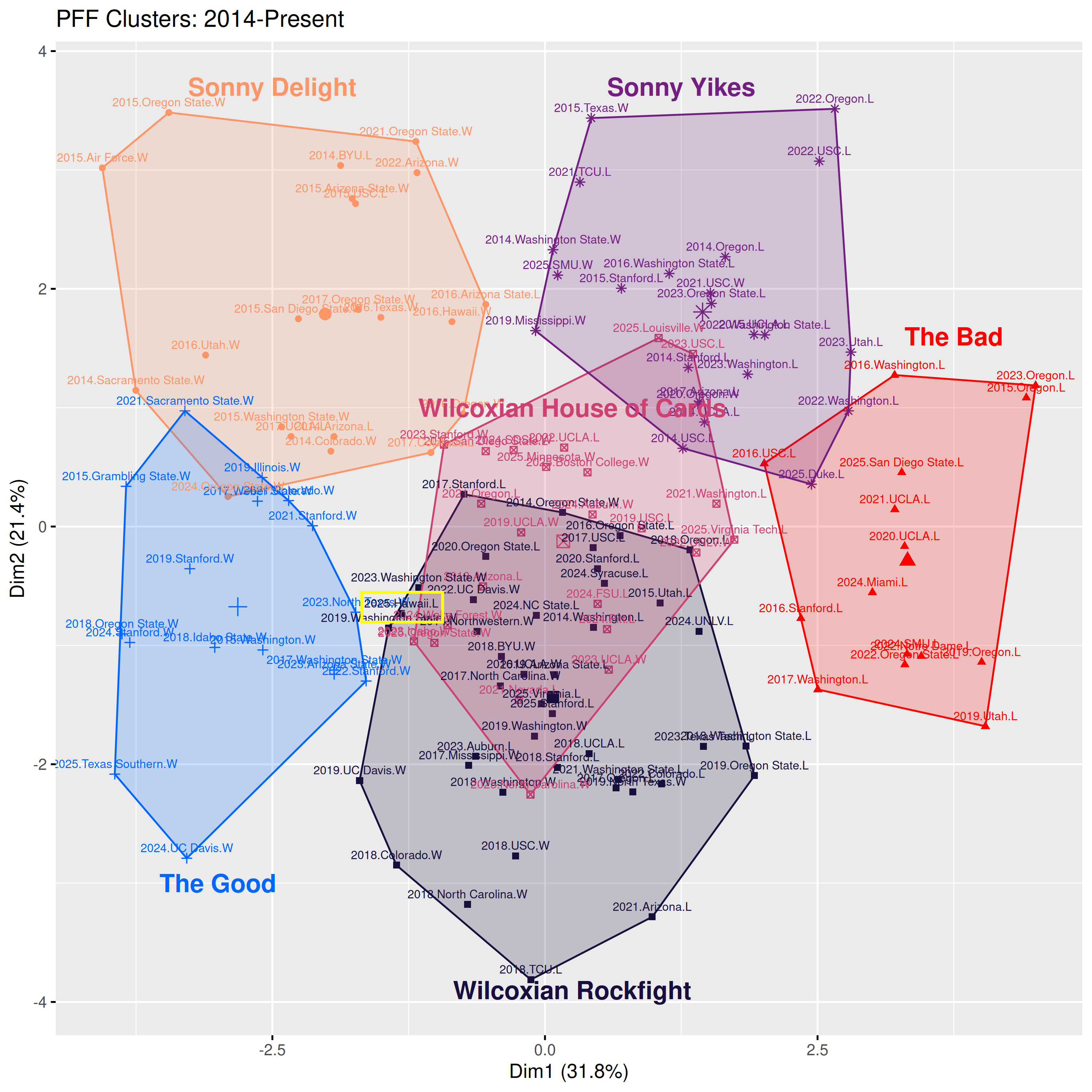
a Rockfight! This one is an odd-flavored Rockfight, as it’s on the perimeter of The Rockfights and is very close to both The Good and the House of Cards (reminder: that’s one of our new categories that captures a game with strong performances held back by broken fundamentals due to poor tackling and line play). These clusters evolve over time to maximize similarity within the clusters and maximize differences across clusters, so some of these peripheral games can jump from cluster to cluster over time. This one may be one of those cluster-jumping games in the future.
Because this is a Rockfight, it continues an ignominious streak from the later Wilcox years: the Rockfight losing streak. Repeatedly over the last two seasons I have highlighted the team’s losing streak in Rockfights, a type of game that early Wilcox teams used to upset teams like Washington. But Wilcox’s teams have been unable to win such games recently, as the Wilcox Era closed with a 6-game Rockfight losing streak (the streak had been longer before I added the 2014-2016 games from the PFF database and bumped the number of clusters to six—those changes transformed the shapes of several of these clusters, so some former Rockfights were reshuffled into other categories and vice versa).
Odds and Ends
Offensive Player of the Game: WR Jacob de Jesus, 76.4
Defensive Player of the Game: LB TJ Bush Jr, 77.7
Iron Men [played every snap]: QB Jaron-Keawe Sagapolutele, RT Braden Miller, RG Tyson Ruffins, C Bastian Swinney, LG Jordan Spasojevic-Moko, LT Nick Morrow, CB Paco Austin
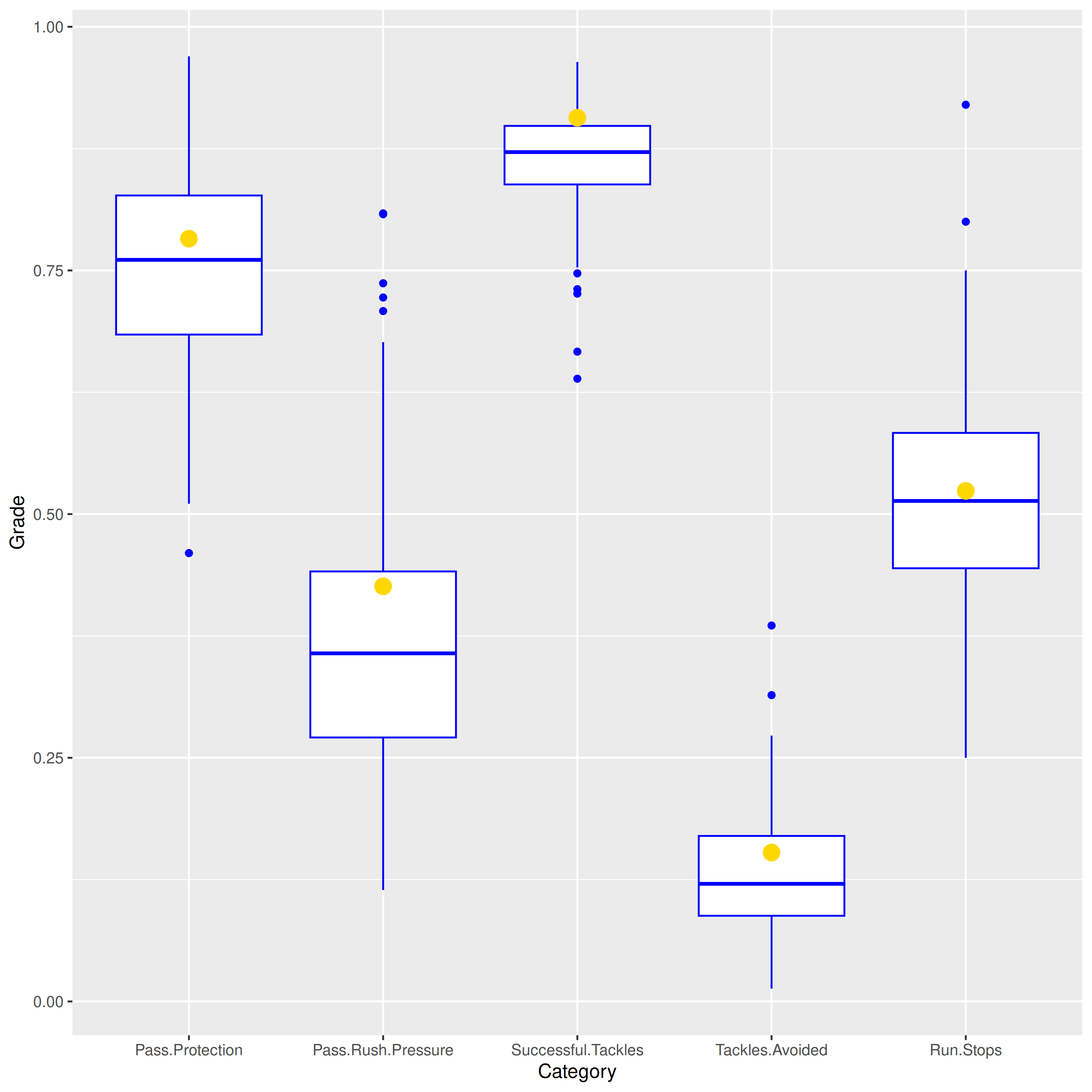
Pass Protection: Cal surrendered 10 pressures (1 sack, 5 hits, 4 hurries) on 46 pass attempts, for a slightly better-than-usual pass protection rate of 78.3%.
Pass Rush: Cal forced 23 pressures (0 sacks, 2 hits, 21 rushes [side note: that is a weird breakdown of pressure]) on 54 pass attempts, for a great pass rush rate of 42.6%.
Tackling: 7 missed tackles on 75 snaps, for an excellent tackling rate of 90.7%.
Shake and Bake: The Bears evaded 11 tackles on 72 snaps, for a good rate of 15.3%.
Run Stops: Cal stopped 11 of 21 runs, for a rather average rate of 52.4%.
With a new coaching staff and a new philosophy on offense and defense, it will be interesting to see where the 2026 games fit into these clusters. Figuring out how a post-Wilcox team will fit into historical data was the motivation for going back to include the 2014-16 seasons and expanding to six clusters. Unfortunately, we have eight months to wait until then. In the coming weeks I’ll do a retrospective to see what kind of team the 2025 team was when averaged across all 13 games. Until then, Happy New Year!
Your data aggregation warrants a high Expected Points Added (EPA) in terms of my personal edification. The Average Depth of Target (aDOT) of your statistical recap is exceptional, truly separating the "dink and dunk" analyses from a genuine vertical threat in formulaic efficiency.
Data distribution across all relevant metrics (Yards per Attempt, Completion Percentage Over Expectation, etc.) presented a robust and highly positive correlation with my enjoyment. The turnover margin in my previous, less-informed gridiron grasp is now significantly negative thanks to your superior input.
I am highly obliged and my gratitude has an approximate value (AV) that is off the charts.
Many thanks,
A statistically satisfied consumer of your content
Cal gonna Cal until Tosh changes the program's mindset. Up 21 points and a loss. Sadly, the 2024 Miami game was a preamble to heartbreaking 2025 losses... No new altitude without a "new step on their throat" attitude. Let's hope Tosh & staff bring this to CMS in a big hurry, as the realignment clock is ticking. Go Bears!