

Cal’s offense looked different against Virginia Tech. But how different was the playcalling?
Cal’s offense was already pass-heavy
Overall, the offensive scheme was not more pass-heavy than it had been. In Saturday’s matchup, passes accounted for roughly 62% of plays—almost exactly the same rate as through the first five games of the season.
But the raw pass rate is an ineffective (or at least incomplete) way to evaluate a play caller. Game situations may demand passing plays (e.g., facing third-and-long or running out of time). Or a play caller may prefer to be aggressive.
To distinguish between the two, I estimated a national pass-rate model using approximately 89,000 plays from the first 5 weeks of the 2026 season, excluding Cal. The model predicts the probability of a pass using play-level variables, including down, yards to go, field position, score margin, time remaining, quarter and whether the offense is at home. The difference between a team’s actual pass rate and that prediction is its pass rate over expected (PROE). A positive number means the offense threw more than other teams did in comparable situations.
By this measure, Cal’s offense was already pass-heavy. It’s PROE over the first 5 games was +11.1 percentage points and against Virginia Tech it was +9.7 points. So if anything, Cal’s situation-adjusted pass tendency was slightly less pronounced than its early-season average.
First-down performance improved (and passing was key)
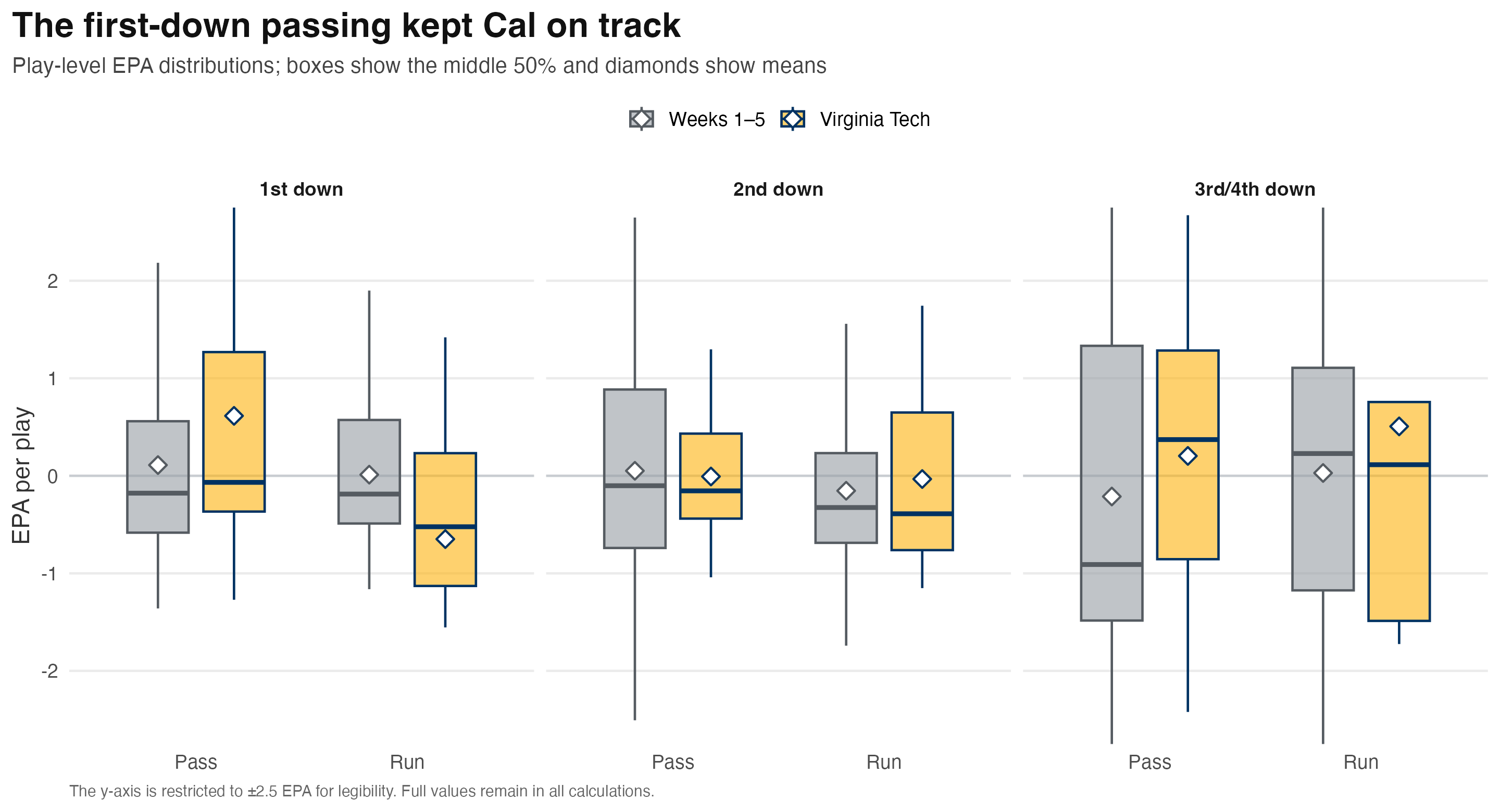
The difference was when Cal chose to pass. Against Virginia Tech, the Bears passed on 21 of 32 plays (65.6%) on first-down. Those throws produced 0.61 expected points added (EPA) per play, averaged 9.6 yards and gained at least 15 yards on 6 of 21 attempts. In contrast, the first-down pass rate over the first five games of the season was only 52.3%.
Other offenses facing Cal’s first-down situations would have been expected to pass about 45.6% of the time. Cal passed 65.6% of the time, producing a first-down PROE of +20 percentage points. Over weeks 1-5, Cal’s first-down PROE was only +8.8 points.
Against Virginia Tech, first-down passes generated:
0.61 EPA per play (compared with 0.11 over weeks 1-5)
9.6 yards per play (compared with 6.7)
a median gain of 4 yards compared to 2; and
a 28.6% explosive-play rate, compared with 13.8%.
This might be some of the strongest evidence that the playcalling improved! Cal did not just throw more on first-down, but it selected and executed first-down passes that yielded both a better floor and higher ceiling: Cal raised the median outcome while nearly doubling the probability of a gain of at least 15 yards.
Cal exploited the middle of the field
Another clear difference in the passing game was where Cal threw.
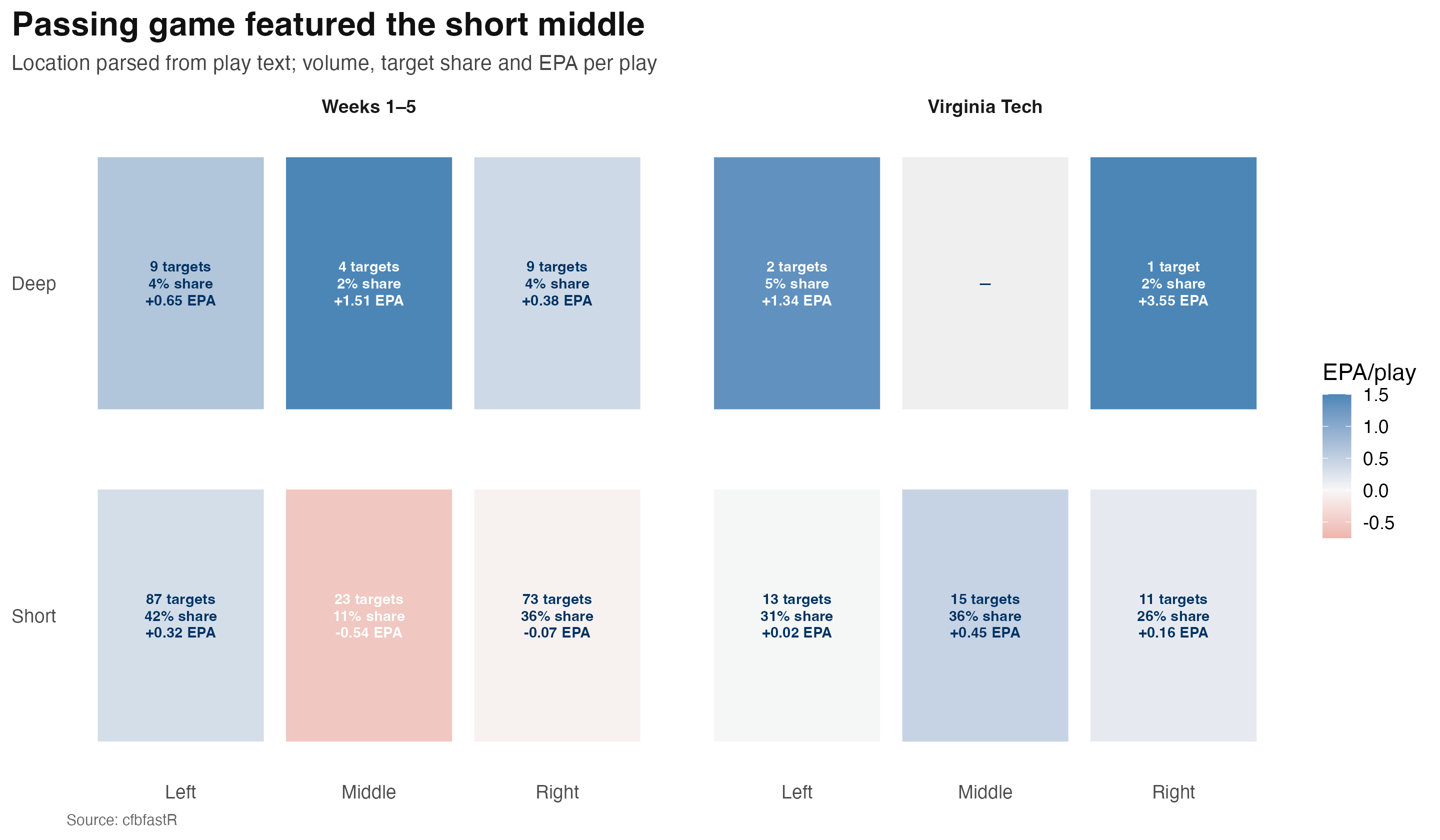
Among passes whose depth and direction could be parsed from the play description, 15 of 42 targets went to the short middle of the field (35.7%) in the game against Virginia Tech. Over the first five games, only 23 of 205 classified targets (11.2%) went to the same area.
Short-middle targets against Virginia Tech averaged 8.7 yards and 0.45 EPA, whereas earlier in the season, they averaged just 4.2 yards and -0.54 EPA.
Again, the location labels are parsed from the play descriptions…so take them with a big grain of salt. But it raises an important question going forward. Teams now have evidence that Cal can attack inside on early downs. If linebackers and safeties eliminate those windows, Cal needs a plan to counter. Hopefully, Cal can keep Wake Forest’s defense guessing and exploit the adjustment!
Were the calls better matched to the situation?
A second national model provides a rough way to evaluate situational playcalling. I estimated separate expected-EPA models for passes and runs using the same observable game and play conditions. This gives a way to construct counterfactual “gains” associated with passing and rushing.
Against Virginia Tech, Cal chose the call associated with the higher value play 56.3 percent of the time (vs. 48.7 percent weeks 1-5). The average estimated opportunity cost (the estimated gap between the chosen call and the higher-valued option) also declined from 0.075 to 0.060 EPA per play.
While those numbers suggest an improvement, there are lots of factors that the model does not include, so it is worth being more circumspect: Cal’s Virginia Tech calls were more often aligned with choices that had performed better, on average, in similar observable situations.
What to look for going forward…
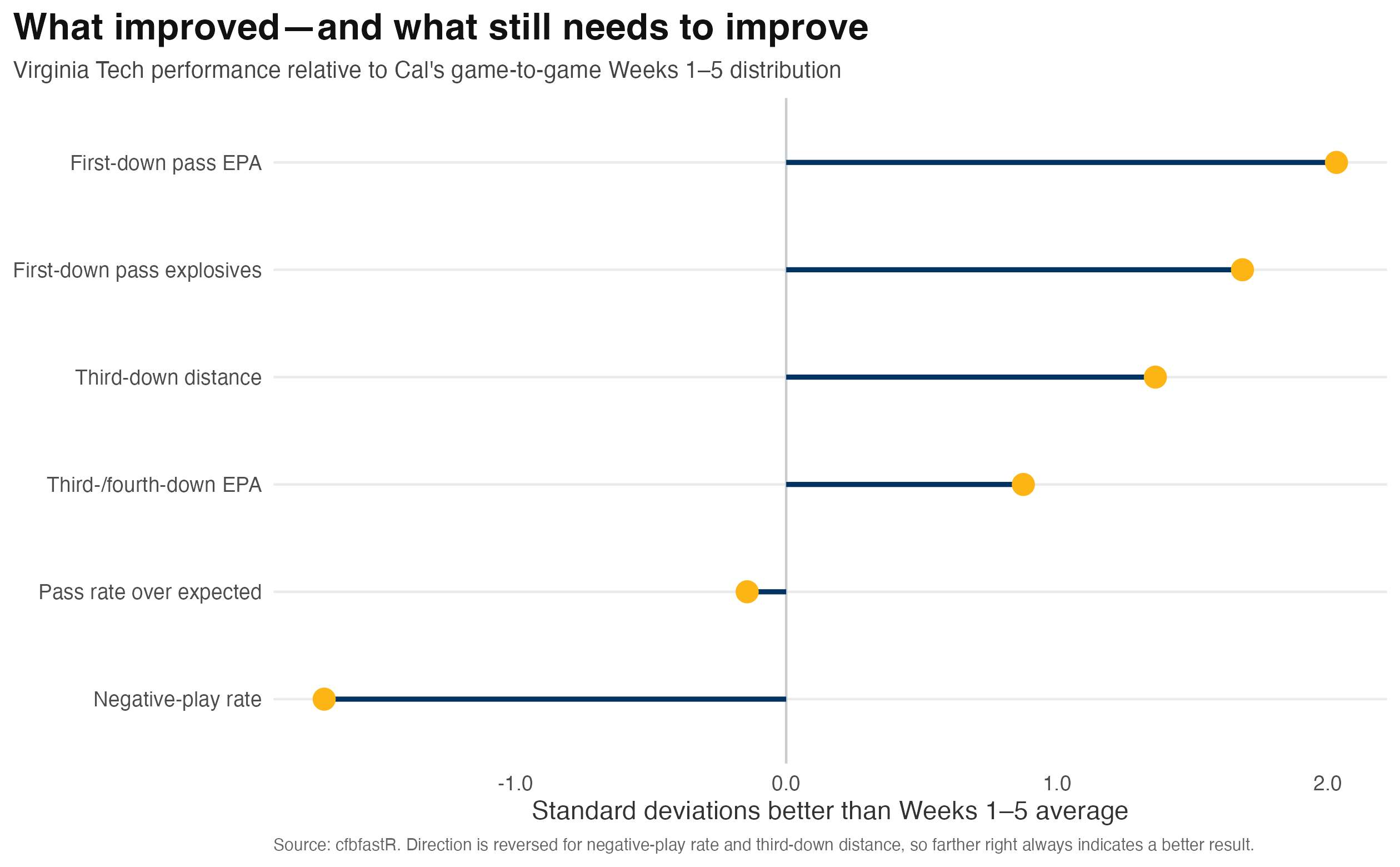
Will Cal continue to pass early? The purpose of early-down aggression is to avoid predictable third downs or make them manageable. So average third-down distance might be the best diagnostic of whether the sequencing is working.
More importantly, the next defense will have watched the same film. The real test of the play caller will be whether Cal already has an answer for the inevitable adjustments that will be necessary to keep the offense on track.
Circumspect? Pretty clear that the fine research and analysis you have done demonstrates that simplifying the schemes and calling the right play at the right time has improved efficiency and confidence. Combine that with using the rest of the darn playing field, and we score more points. And now a bunch of Cal football fans are not so pissed off all the time, which is another positive outcome. Wake Forest will be interesting and hopefully fun, looking forward to it.