

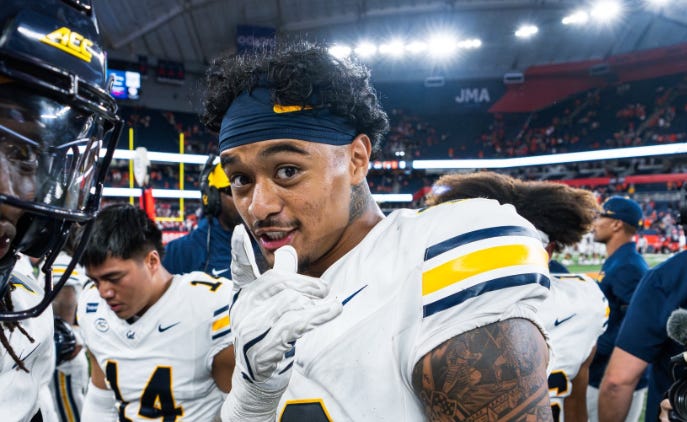
Aficionados are fond of calling football the ultimate team sport. Take this game as an example - there were 146 total plays from scrimmage and another 27 special teams plays, and the game had 116 total participants combined. Even the best players on each side are maybe going to play in about half of the game, and on many of those plays one individual won’t have a ton of impact. QBs who aren’t mobile and WRs often have no or minimal impact on a running play. A left outside linebacker is irrelevant when the offense throws a WR bubble screen to the opposite side. It is almost impossible for a non-QB to singlehandedly win games on their own, and when it happens it’s a landmark event.
Kingston Lopa pulled off the feat against Syracuse.
To be fair, Lopa didn’t have an obviously massive impact on 170 of the 173 total plays against Syracuse. He recorded five tackles, four of which were for short gains on runs and underneath passes. He certainly played a role in coverage, as Syracuse struggled to go deep and generally had an inefficient day throwing the ball.
But he made the three most important plays of the game for Cal, three plays that swung a likely loss into a win. Three interceptions that swung the game. Consider the 1st, 4th, and 6th plays listed in this graphic:
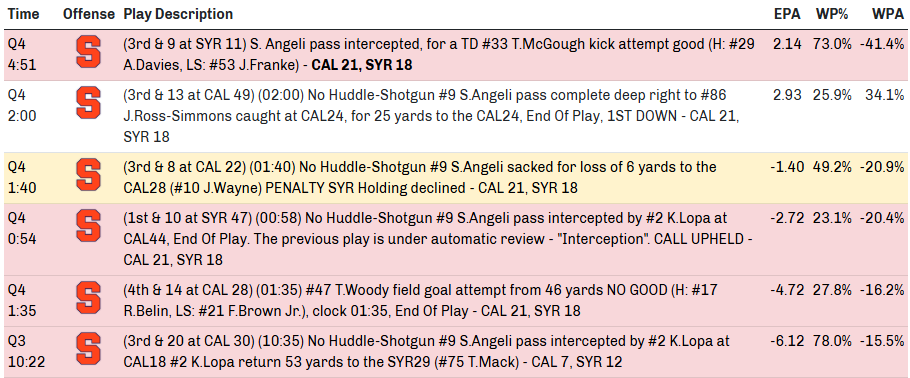
Lopa’s first interception increased Cal’s chances of winning by 15.5%. His second, resulting in a touchdown, increased Cal’s chances of winning the game by 41.4%. And his final interception increased Cal’s chances of winning by 20.4%, and ended the game.
You could look at the game like this . . .
Syracuse 18 (with two scoring opportunities taken away by Lopa)
Kingston Lopa 14
Cal 7
. . . and wouldn’t really be wrong
I don’t know how best to measure single-game impacts by non-QBs, but there have been few games where one player has been more directly responsible for a win than Kingston Lopa.
There’s the Herm Edwards 4 interception game in a 37-34 win over Washington State in 1974. There were a few games from Deltha O’Neal in 1999 when his interceptions and/or special teams play was the only thing Cal had going. There was Geoff McArthur’s 16 catch, 245 yard Big Game. Feel free to throw out more options in the comments. I don’t know how to rank them, I just know that what Lopa did was something special.
Offense
Efficiency Report
11 drives: 2 touchdowns, 1 field goal attempt (0-1), 7 punts, 1 turnovers (downs), 1.3 points/drive.
If you wanted to be kind to Cal’s offense, you could credit them for a made field goal and boost them to 1.5 points/drive. If you wanted to be unkind, you could detract credit for a short field touchdown set up by Lopa’s long return, and instead give them 0.7 points/drive. 1.3 feels like reasonable balance between the two.
And it kinda doesn’t matter because it is impossible to slice this up in any way that doesn’t look deeply concerning. Syracuse had a bottom 3 ACC defense last year, and while they returned a lot of production and are relatively experienced, it’s still not intimidating talent. I’m confident saying that UCLA’s defense is more talent, for just one example. And yet Cal had exactly one long touchdown drive, which was basically two nice throws by JKS plus a pass interference call.
Rushing the ball still isn’t going well
Last week, I argued that Cal needed to pass more and run less. That’s exactly what happened in this game, with a 60/40 pass/run ratio. And the running game didn’t exactly make an argument for more chances.
It’s basically the same story as last week. Cal isn’t explosive enough running the ball to make up for a lack of down to down efficiency. Alternatively, Cal isn’t efficient enough to make up for a lack of explosiveness. A long run of 13 yards just isn’t very good when you’re also gaining two yards or less on your runs about half the time.
I’d like to believe that there’s room for improvement here, but with four returning offensive linemen, I’m pretty inclined to think that Cal’s rushing attack is what it is, and the only way it would meaningfully improve is if Cal goes very pass heavy and only runs against light boxes as a counter punch.
And I would usually advocate for exactly that strategy, except . . .
Passing the ball also isn’t going well
There’s no way to dance around this subject: Jaron-Keawe Sagapolutele and the Cal passing attack had an alarmingly bad game.
The numbers - 23-34, 182 yards, 5.6 yards/attempt - tell plenty of the story, but JKS looked uncomfortable and out of sync nearly the entire game. There were multiple plays where I wondered if the QB and the WR were running the same play. Sure, he didn’t get a ton of help with some missed contest catch opportunities, but he only took one sack and wasn’t under a notable amount of pressure that might otherwise explain a bad day.
For me, the biggest concern is how unsuccessful Cal was going down field. There were only two explosive passing plays - a deep ball to Ian Strong for 43 yards, and a nice catch-and-run up the seam to Mason mini for 38 yards. When you have a quarterback who can throw accurately downfield, only getting two big plays downfield on 36 drop backs is concerning. It suggests that something is very off about an offense that, frankly, isn’t explained by talent - because this offense is objectively more talented than last year’s Cal offense, which just had its worst passing performance under JKS.
I have a ton of half-baked theories to explain what we’re seeing. Lack of depth at WR and TE (particularly with Dorian Thomas recovering from injury)? Too much underneath stuff and not enough downfield options? The lack of a safety outlet that JKS trusts like Jacob De Jesus? A new offense that hasn’t been well-installed? A new play caller who hasn’t figured out the strength and weaknesses of his personnel?
Whatever the reason, it needs to get fixed, and fast. You cannot have a quarterback this talented and have a passing offense that goes for 5.6 yards/attempt on 34 throws.
Defense
Efficiency Report
12 drives: 2 touchdowns, 4 field goal attempts (2-4), 3 punts, 3 turnovers (3 interceptions), 1.5 points/drive.
1.5 points per drive may flatter Cal slightly since a 31 yarder is typically a gimme . . . but that drive ALSO featured a very weak roughing-the-passer penalty on 3rd and 8 that would have ended the drive much sooner, which is an example of how this stuff tends to balance out in the wash.
Give Kingston his crown
The thing I loved the most about what Lopa did was that each interception was a little bit different and showed a very well rounded player.
The first pick is a combination of athleticism and smarts, reading the QB and using his size and hops to jump for a slightly underthrown ball before nearly housing it. The 2nd pick is a combination of instinct and reading the game/QB to step into the passing lane from a shallow zone assignment. And the 3rd pick was man coverage, running the receiver’s route for him and picking off a lame duck throw.
Getting all three of those picks from one player who happens to be a 3rd year player getting his first major snaps? What a gift.
Flashing talent
Last week, what scared me is that very rarely did a guy on defense make a play that made you take notice. That wasn’t the case against Syracuse.
Obviously, Kingston Lopa took over the game. But Daniel Harris had a great corner blitz, an instinctive pass break up, and 7 total tackles. AJ Tuitele forced a hold on a physical blitz up the middle. Quimari Shemwell had one interception taken away by the refs and dropped a near pick-6. Isaiah Crosby looked like a reliable vet in coverage all game long. Pretty much every guy along the line had a nice pass rush moment or two, particularly Nate Burrell from the inside.
In short, Cal’s defense looked significantly more talented than Syracuse’s offense. That isn’t some kind of big surprise, but after looking reactive last week, that talent won Cal the game on the road and that’s worth celebrating.
Mistakes of aggression, successes of aggression
When Cal gave something up, it was usually a big play that came in part from aggression. For example, Syracuse’s big run on the first series came in part because Cal called a defensive line stunt on what is generally a passing down, and Syracuse’s run attacked the space left behind by that stunt. Syracuse’s long touchdown pass came because multiple Cal defenders bit down on a jet sweep fake. There were a couple times where Angeli hit a hot route on a blitz and Cal bled yards.
But if that’s what Cal gives up in exchange for three interceptions and multiple other near-interceptions, plus three sacks, four QB hits, three QB hurries, two other TFLs, and other general disruption . . . well, that’s a trade I’ll make every Saturday.
Do I wish we had seen this kind of gameplan last week against another QB prone to downfield mistakes when forced into throwing downs? YES, he screamed, while grinding his molars into dust. But kudos to Cal’s defensive coaches for IDing what needed to be changed from last week, and kudos to Cal’s players for executing a more aggressive gameplan.
Special Teams
Moveable object vs resistible force
Anybody who is a fan of special teams would not recommend watching this game, as both teams traded damaging special teams errors in equal measure. Three missed field goals, five penalties, and multiple disasters and near-disasters for both teams.
Most concerningly for Cal were some serious . . .
Punt shield concerns
Syracuse nearly blocked TWO punts
The first was late in the 1st quarter and probably bothered Angus Davies, who only got a 32 yard punt off after dealing with a high snap before finding a dude in his face. This wasn’t a schematic error, it was a blocking miss when the Syracuse rusher did an impressive dodge around a block.
The 2nd punt . . . frankly, I don’t know how Angus Davies got the kick away. Here’s what Cal’s shield saw:

The outside blocker elected to let the inside man go by, instead blocking the outside rusher, probably because he expected the middle man in the shield to slide over to take the inside rusher? Regardless, nobody blocked the first man to nearly disastrous effect.
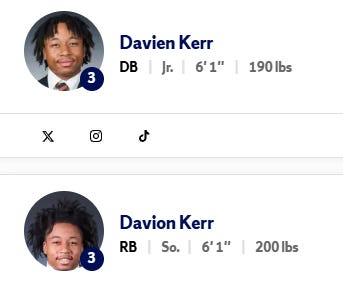
Both near blocks were by Syracuse’s #3, who is . . . well, one of these two guys:
Coaching/Game Theory/Misc.
Bad process, bad result
It’s 3rd and 5 from the Syracuse 29 yard line early in the 2nd quarter. Cal calls a run play (which looks like a zone read that would have been a clear QB keep if Cal had a running QB, but that’s a different problem) that only gains a yard.
I don’t hate calling a run in that situation - you might catch the defense off guard, and you can always go for it on 4th down. I DO hate the decision if you’re not prepared to actually go for it, but the Bears were evidently not prepared. Cal trotted out Towns McGough, who has a big leg but not a particularly accurate leg from distance. He missed by a couple yards, and Cal’s 35 yard drive nets nothing.
It was a generally terrible process for that area of the field and something that Tosh Lupoi and his staff need to sort out soon because this is not an offense that can currently afford to waste scoring opportunities.
Two odd penalty decisions
When Syracuse committed their running-into-the-kicker penalty, the result of the play was Syracuse ball on their own 19 yard line with 0:22 on the clock and no time outs. Why accept the penalty and punt again? What is there to gain? Field position with so little time on the clock is irrelevant, so the only thing that can happen is something bad like a punt block or a long return . . . which is almost what happened.
On Cal’s final drive, they took a delay of game penalty on 4th and 1 rather than calling a timeout, in situation where 5 yards might really have mattered. Luckily Angus Davies did a good job on his subsequent squib punt (44 yards, no return, some good time wasted) and Lopa sealed the game two plays later, but I don’t understand why you would give up 5 yards for no reason there.
Which team got it worse from the refs?
As noted above, I thought Cal’s roughing the passer penalty was very soft, and although Syracuse didn’t end up scoring on that drive it cost Cal an interception and thus 32 yards of eventual field position. On the other hand, Syracuse was the victim of two unsportsmanlike conduct calls that were iffy, though they didn’t have a huge impact on the game.
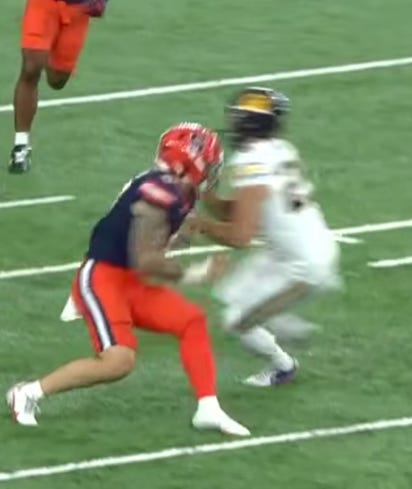
Probably the biggest and most controversial call was the illegal blindside block on Syracuse’s goofy punt return near the end of the 2nd quarter. Here’s the moment of (near) impact:
Per the NCCA rulebook, a blind-side block is:
An open field block against an opponent that is initiated from outside the opponent’s field of vision, or otherwise in such a manner that the opponent cannot reasonably defend themselves against the block.
I think we fans tend to interpret this as a particularly violent block made more from the side/behind a player, and so this one felt wrong in the moment. But by the letter of the law this is probably a correct call - Angus Davies never looked in the direction of Syracuse’s #6, and didn’t have a chance to reasonably defend himself.
Big Picture
Remember last year, when Cal needed a goal line interception at the end of the game to get the road win over Boston College? This felt similar. You don’t want to turn your nose up at a win, let alone an ACC road win nearly 3,000 miles away. But early in the season you’re looking for signs of improvement, and struggling (and perhaps getting lucky) to beat a bad team isn’t exactly a positive indicator that Cal is poised to be more than a team striving for bowl eligibility.
Pre-season, we talked about how Cal is poised to play a bunch of mediocre teams in games that are in coin-flip territory, but if Cal is improved this year, a lot of those coin flip games move into Cal-is-favored territory. Well, Cal just played a virtual coin flip against a Syracuse team coming off a 3-9 season:
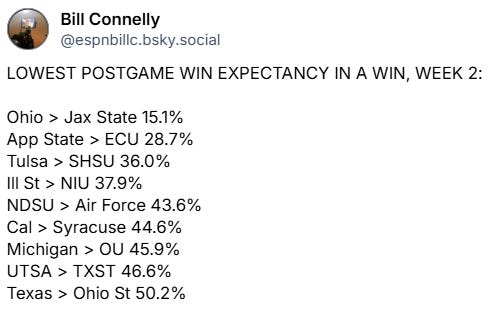
Would Cal have won if Syracuse’s RB1 didn’t pull a hammy, turning a likely touchdown into an eventual field goal? If Syracuse’s kicked doinked it off the upright and in rather than out? If Steve Angeli’s final pass hit the turf before Lopa got his hands under it? If the refs didn’t call the blindside block?
Those little things need to go your way if you’re not good enough to leave no doubt.
I’m not completely discouraged. As noted above, Cal’s defense looked significantly better from week 1 to week 2, and if your biggest problem is figuring out how to get production out of the passing game when your quarterback is JKS, then things are far from hopeless. The good news is that Cal has 13 days to prepare for a struggling Clemson team who will be busy worrying about Bill Belichick this week.
Yes, I am certainly looking past a Wagner team that just lost to James Madison 87-3. It is a game that Cal will win easily, and will have to be graded on a severe curve. If Cal’s offense is unable to throw the ball easily against a low-end FCS team, you have my permission to panic. If Cal throws the ball easily, then it’s time to wait and see if the Bears can put another nail in the Dabo Swinney era.
More than saving Cal from a likely road loss to Syracuse, Kingston Lopa may have turned around our season. Time will tell, of course, but I experienced something similar playing and coaching youth sports (football and baseball), where a single person's early season performance sparked an awakening and a rallying effect in their teammates. And haven't we all witnessed (or experienced) such a phenomenon not only in sports, but in all kinds of relationships that require effective communication, collaboration, cohesion, and chemistry? Our 2026 football Bears are in search of themselves and an identity, under the direction of a brand new head coach -- one who is long on experience as an assistant but also finding his way as the leader of a big family, a complex team. Growing pains, yes. A work in progress, absolutely. Go Bears!
Syracuse's #3s are twins. The punt was nearly blocked by Davien Kerr. He blocked a punt in the New Hampshire game and I went down the same rabbit hole. Play-by-play, media game recap, etc, plus mentioned of him being the #3 on ST from the year before.