

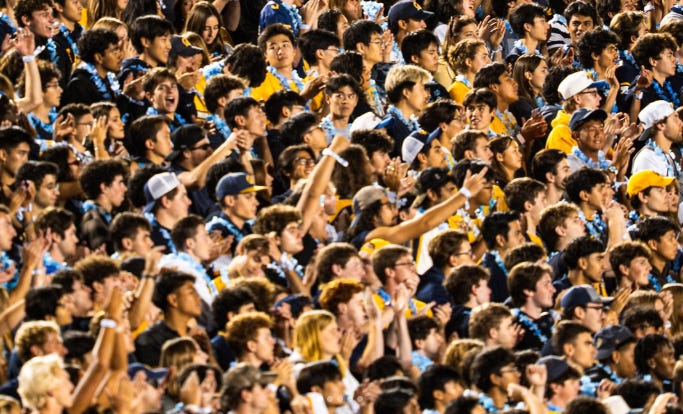
The desperation for Cal football to succeed was overwhelmingly palpable.
Friday night games are always challenging, and despite my best attempts, I felt a headache coming on while walking up to Memorial Stadium. Such is the price of a workday followed by a 90 minute drive before a long day of football.
Then came the game itself, where I was bombarded with all kinds of whizz-bang attempts to make Cal football fun for the fans. Flashing wrist bands! Drones! Constant noise and music and flashes, as my head pounded harder and harder, more painful with each passing second of stimuli.
Then there would be actual football, and my head would have moments of sweet relief because exactly one thing happened in 60 minutes to make the crowd feel any excitement or make any organic noise.
To be clear, I don’t begrudge Cal for doing anything and everything in an attempt to make football fun, to bring out families, to try to build loyalty and create memories for everybody involved. That stuff is not for me, a sicko who spent 3 hours watching every failed passing play against Syracuse because my brain is diseased, and that’s fine. (Well, the brain disease part isn’t fine, but the not-for-me part is.)
But all of the production values only served to underline how, in two highly anticipated home games, the fans have been given precious little actual football to get excited over. And no amount of game production will make the slightest bit of difference if Cal’s coaches create a situation where Stanford’s Davis Warren has a vastly more productive season that JKS.
Offense
Efficiency Report
9 drives: 2 field goal attempts (1-2), 4 punts, 3 turnovers (1 downs, 2 interceptions), 0.3 points/drive.
4.7 yards/play against UCLA
4.2 yards/play against Syracuse
4.1 yards/play against Clemson
Look man I could say plenty of things, but Avi covered most of it already and I think the best summary of Cal’s offense against Clemson is that the longest pass of the game was a 26 yard throw from tight end Mason Mini.
There’s just not much value in saying a ton and belaboring the point when . . .
Everything is broken
When an offense isn’t working, everybody tries to figure out why, and all kinds of broad theories are tested. Is it the offensive system? The talent level? Play calling? Execution? In game adjustments? Personnel usage?
For this Cal offense, the answer is “Yes.” Everything is wrong, everything is broken, nothing is working, and every explanation is partially correct. And to the extent that Cal did have something that was working, it was Adam Mohammed’s ability to break tackles and manufacture yards, but he left the game with an injury and his availability for the immediate future is in doubt.
Cal’s offense was roughly half as productive against UCLA at home as Purdue was on the road. Cal’s offense averaged two yards/play fewer against Syracuse than Pitt did in terrible weather. Cal’s offense was roughly as productive against Clemson as Georgia Southern was.
Every single data point says the same thing that anybody with eyes can see: this offense is a complete failure.
I have reached twin conclusions:
Cal has to consider drastic changes in-season to attempt to fix this.
I don’t have any idea how to fix this, but I do know that trying the same thing isn’t going to work.
What’s the right move here? Scrap a huge percentage of the play book and go a different direction? Give some playing time to other players further down the depth chart? Hand the reigns to Nick Rolovich? Find whatever commune in the woods Tony Franklin has retired to and try to convince him to take on one last job?
Any drastic change is almost certainly doomed to failure.
The offense is so broken that I am deeply skeptical that it can be fixed in season. That doesn’t mean Cal shouldn’t try, but as fans we get to be realistic about our chances here.
Defense
Efficiency Report
9 drives: 2 touchdowns, 2 field goal attempts (1-2), 3 punts, 2 turnovers (1 interception, 1 fumble), 1.9 points/drive.
For 55 minutes, Cal’s defense almost outscored Clemson.
The Tigers had scored 10 points on offense, and 7 of those points never would have happened if it weren’t for a special teams penalty that extended a Clemson drive. Now, Cal still had opportunities to keep them out of the endzone, but it still took another 12 plays, two 4th down conversions, and an iffy unnecessary roughness penalty to get Clemson all the way into the end zone.
That this defensive performance resulted in a 14 point loss is . . . demoralizing, among many other depressing adjectives.
As good as you can ask for until one play
Clemson’s 75 yard touchdown run to ice the game obviously stands out as the only meaningfully bad moment for Cal’s defense, but an important one because it outlines the only real flaw right now on this side of the ball: occasional run game breakdowns.
So let’s look at that play to try to figure out what went wrong. Here’s a link to the video if you prefer watching in higher definition, but I’ve got a GIF too:
As best I can tell, this is a combo of an unfortunate play call combination and not winning on a few blocks.
The main player to watch is #9 AJ Tuitele, who lines up in the gap between left tackle and left guard, before stunting around to the middle of the line . . . which is unfortunate, because he vacates the very gap that Clemson’s running back ends up sprinting through.
Tuitele’s stunt leaves #51 DE Jayden Williams defending two gaps, and Clemson’s RB does a great job of running right at his left guard until Williams commits himself to the C/G gap, leaving the G/T gap wide open.
Meanwhile, Clemson’s left tackle seals the edge on OLB #6 Emmanuel Okoye, CB #7 Daniel Harris is taken out of the play while he chases Clemson’s outside WR on a route away from the play side.
The only guy left with a prayer to make the play is backup safety #14 Aiden Manutai, but I don’t get the sense that he recognizes the danger and engages with a Clemson WR and is blocked out of the play.
My assumption here is that Cal made a defensive play call working under the assumption that Clemson would pass the ball on 3rd and 8. And while I get it, I think the threat of a run here, that Clemson would be conservative and try to protect a 7 point lead by running clock was a real one too. Either way, I’d have preferred just straight up defense here that would have maintained better gap integrity.
But that’s easy for me to say, and it’s unfair to nit-pick one play when Clemson averaged 4.2 yards/play (basically the same as Cal!) on the other 69 plays the ran.
Special Teams
I don’t understand the placekicker situation
I’ll admit, I’m perplexed here. Cal has Chase Meyer, who is generally pretty reliable from inside 40 yards, and Towns McGough, who isn’t very accurate but has a longer leg. They had a camp battle for field goal kicking that McGough evidently won, because he attempted Cal’s first three field goals, but then missed a longer kick and Cal pulled him for Meyer.
Then, facing a 4th and 11, Cal brings out Meyer for the longest kick attempt of his life, and the kick comes up short, and I am left wondering why Cal does not do the blindingly obvious thing and have Meyer attempt kicks from inside 45 and McGough attempt kicks longer than 45?
Probably the worst punt of Angus Davies’ life*?
Just last week, I catalogued how Cal was badly struggling in every phase of special teams but one: punting, because Angus Davies is a veteran with multiple years of successful punting under his belt. Then Davies hit a 39 yard punt with just about the least amount of hang time I’ve ever seen, allowing Clemson’s returner to get a running start towards the end zone well before Cal’s coverage team had a chance to get downfield.
Davies shook it off to come up with back-to-back punts downed at the 1 and 2 yard lines respectively, which kept Cal in the game, but it’s unfortunate that a misfire had such consequential repercussions.
*He did have 2 punt return touchdowns allowed against him while playing for Tulsa from 2023-25, but based on the highlights I don’t think either were Davies’ fault.
Big Picture
Cal has invested heavily in this football team, in every way. Cal paid to fire Justin Wilcox, paid to hire Tosh Lupoi, paid to bring in heavily recruited portal players, paid for a huge new staff. All with the idea that on-field success is less a goal and more a requirement.
And yet so far results have been not meaningfully different from Justin Wilcox, and arguably worse. Barring a truly unexpected change, this is just another year of struggling towards bowl eligibility.
We have already learned a bit about what kind of head coach Tosh Lupoi is. We will learn a great deal more in how he reacts to the current situation. Is he the kind of guy who tries to stay the course through crisis? Is he more the kind of guy to make decisive changes, for good or for ill? And if he is the latter, do those changes pay any kind of dividend, even if small and incremental? Can he be the kind of leader at head coach who can maintain morale and keep a team pushing in one direction?
The first four games have given us a really strong indication of what to expect for the rest of the 2026 season. The next few games will give us a really strong indication of what to expect from the rest of the Tosh Lupoi era . . . and maybe a strong indication of how long it will be.
In professional tennis the digital billboards and banners are shut off during play. My observation was the field eye level streaming popping banners must have been blinding. Not great neurologically. Lights so bright my friend had to put sunglasss on at night. Also the piercing electronic noise not ideal. Would be nice to have player have a field that isn’t streaming bright lights in their line of site. We should follow what professional tennis does. Shut em off during play. Lucky no one had a seizure
Nick, nice write up, again. My take is a bit different than yours. First of all, I hear players saying that offensive execution in practice is great, but it's quite obvious that it's really poor in our games. I believe the reason that our offensive execution in games is so poor is because we are actually playing against opponents that scheme to stop us, and thus are probably running different 'looks' against us. I also think that Somerville's offensive system is not as complex as many say because he has shown very little ability to keep opposing defenses off balance with his play calls. His play calling is vanilla at best and defensive coordinators know what is coming. It's not a recipe for success.
Second, when you cannot effectively run the ball then you can't effectively pass the ball. Our run game is terrible. Is it because of our personnel? I don't think so. I don't believe our OL personnel is that bad that they can't be successful. I really believe their lack of success is a combination of poor scheme and poor coaching. I see a breakdown in fundamentals on just about every play: guys losing their base and standing up, guys not finishing blocks, guys not going to the whistle. This is all on the coaching. Schemewise I need to watch more film but I am not a fan of our pass pro schemes.
Lastly, I have never been a fan of pro style offenses in college. They are complex and take a long time to learn and perfect. Heck, Tedfords's QB's typically needed 2 seasons to assimilate the playbook before succeeding. Remember Joe Ayoob? He was heralded as the best JC QB in the country, and not by a little bit, when he was recruited by Tedford. He did not have enough time in Tedfords system when he was forced into action and we all witnessed the result. I am a huge fan of a modified spread and I like Urban Meyer's spread where he utilizes tight ends, unlike Tony Franklin's Air Raid system.
What is clear is that Somerville is asking his kids to do things they can't do. I had to deal with a similar situation when I coached and we had a new OC come in. He had a playbook and wanted players to execute his plays. I looked at it and marked plays that I told him to dump, because my OL did not have the talent to successfully execute all of his plays. He wasn't happy about it but I told him I'd rather run plays that I know we can run successfully. A good coach doesn't make the players fit his playbook, he designs plays to maximize the strengths of his players. I'm not sure Somerville has done this.
Lastly, I would really like to see Somerville's play matrix where he lists plays that he can use for every down and distance situation. What I have seen thus far makes me think either that his list is not very diverse or that they install 20 plays a week, believing these plays will be effective against the opposing Defense, and then they stick to these plays for an 80 offensive play game. Neither situation is one built for success.
Lastly, I agree that it is too late to install a newer and simpler system and thus I think this year is going to be a big bust, unfortunately.