

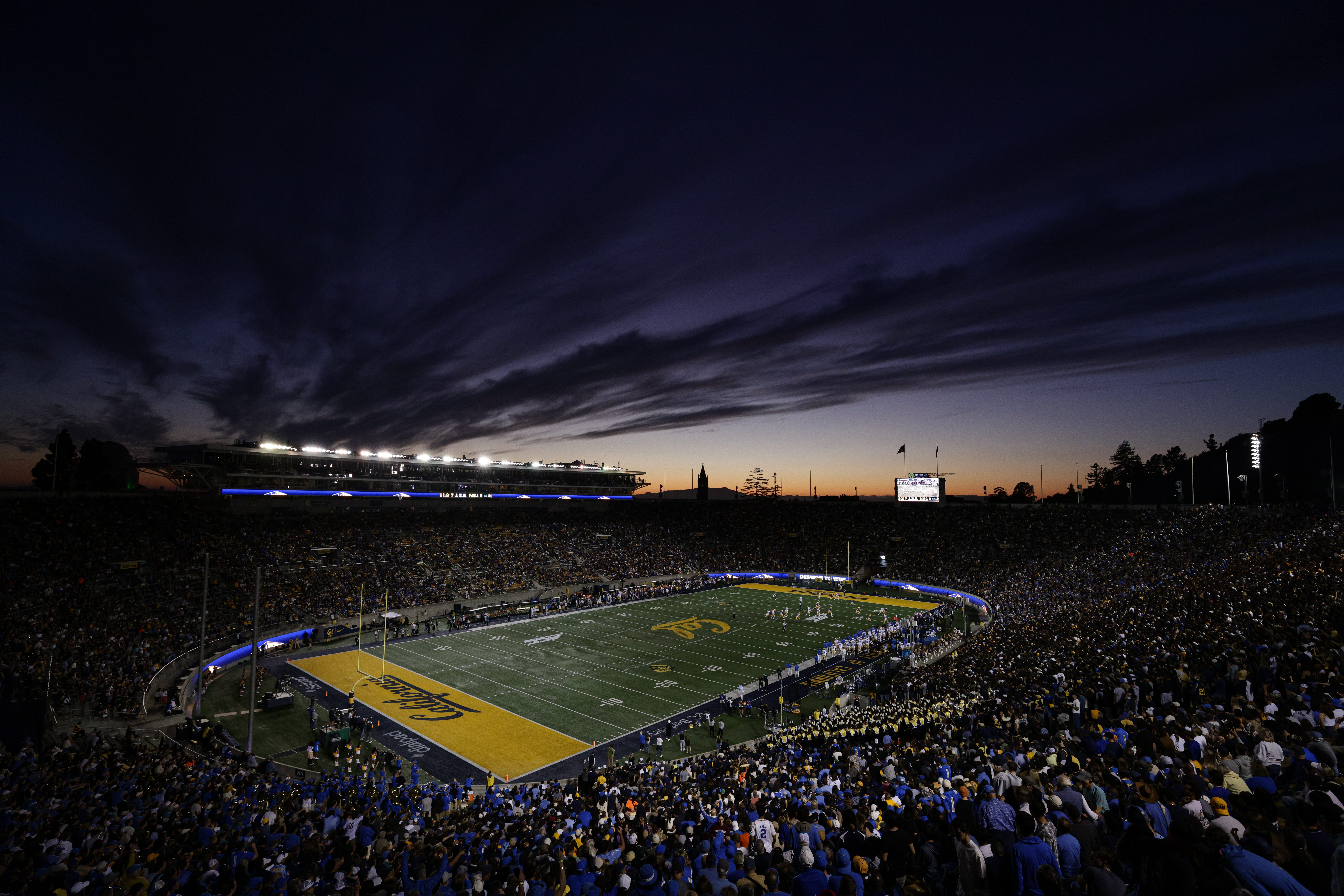
Because I’m a Cal fan with a broken brain, I thought about all of the ways that Saturday night could hurt.
Many of them came true. I thought about the pain of an off-season of anticipation immediately deflated by a rivalry loss. I thought about another chance to build fan momentum pierced by defeat. I thought about what the game would look like if the offensive line was about the same as last year. I thought about what the game would look like if Bob Chesney’s JMU imports looked cohesive while Cal’s remade defense didn’t.
The one thing I didn’t think about was the game swinging on a JKS misread.
I said before the game that I thought Cal would win because JKS would outplay Nico Iamaleava. For 3 quarters, that was dead on. JKS made great throw after great throw, keeping Cal in the game, while Nico threw one bad interception. Then:
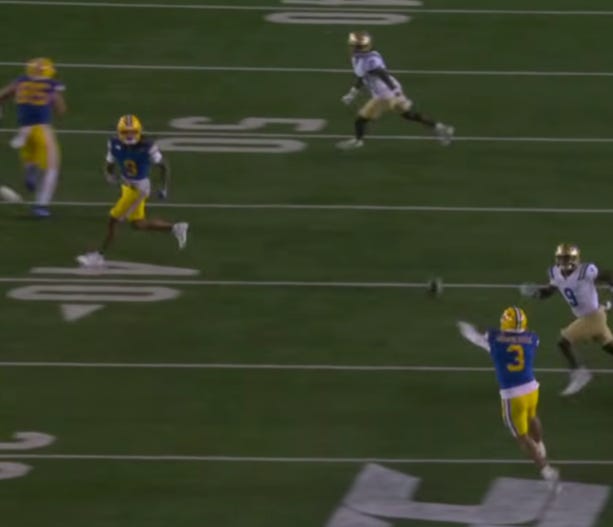
If that throw goes to Ian Strong, it’s probably a first down and at worst 3rd and short. if JKS pumps and holds the ball a second longer and lets Mini’s route develop, he might be able to hit him over the top for a huge gain. Instead JKS floats an aimless ball between them for an easy pick, and the game was all but decided.
This game isn’t entirely, or even mostly, on JKS. As noted above, JKS was the reason this game wasn’t already over.
The problem last year was that Cal needed their superstar quarterback to be nearly perfect to win games. Cal’s off-season roster overhaul was supposed to fix that problem.
Against UCLA, JKS had to be perfect to win, and Cal football is still feeling a lot like 2025.
Offense
Efficiency Report
11 drives: 3 touchdowns, 1 field goal attempt (1-1), 3 punts, 4 turnovers (1 fumble, 2 interceptions, 1 downs), 2.2 points/drive.
Removed: Cal’s kneel down to end the first half, and the final two drives in the end of the game when down by two scores.
This isn’t terrible efficiency against a Big-10 defense, though obviously we’ll need to evaluate that over time to see how much better UCLA’s defense is under Chesney. There were flashes of what Cal could become, and based on the evidence of one game, I’m confident that Cal’s skill position upgrades have in fact raised the floor and the ceiling of the offense. Ian Strong had some nice high point catches, Chase Hendricks was active and reliable. If Cal can get Dorian Thomas back and healthy to add a more viable pass catching threat to their two tight end sets, things could get interesting.
There are, however, some of the same old issues:
Run blocking must improve, or play calling must change
Last year, Cal had one of the least effective rushing attacks in power conference football - 325 handoffs to running backs, for 1182 yards, or 3.6 yards/run.
Against UCLA, Cal handed the ball off 34 times, for 141 yards, good for 4.1 yards/run.
That’s a slight but non-impactful improvement from last year, and still well below the efficiency threshold necessary to be an effective rushing offense. And maybe that shouldn’t be shocking considering that Cal’s line is basically the same line from last year.
What HAS changed from last year is run/pass balance. Last year, Cal quickly realized that their strength was JKS, and ended up calling drop back passes on 63% of their plays. Against UCLA, that fell to 53%.
Put simply: Cal cannot be an effective offense if they run the ball 47% of the time and only gain 4 yards/run, with one run going longer than 11 yards. That particularly won’t work if Cal is going to be very run heavy on early downs, because it puts JKS in a bunch of 3rd-and-long situations that aren’t ideal for any offense, particularly when teams can tee off on passing downs like UCLA did on the 3rd and 8 sack/fumble play that nearly put Cal in an 18 point hole at halftime.
Defense
Efficiency Report
12 drives: 5 touchdowns, 1 field goal attempt (1-1), 5 punts, 1 turnover (interception), 3.2 points/drive.
This was a very boom-or-bust match-up - UCLA either scored a touchdown or punted it away quickly, with four 3-and-outs.
Two of UCLA’s early 3-and-outs were very similar - Cal batted down 2nd down attempts from Nico, then got pressure to force an incompletion on 3rd down. UCLA’s 2nd half drives were stopped to some extent by self-inflicted errors. One ended after an illegal substitution penalty turned 3rd and 1 into 3rd and 6, while another UCLA drive was killed by an unsportsmanlike conduct penalty.
When Cal was actually able to force UCLA into throwing downs and focus on pass rush, the defense was actually OK and is maybe a tiny sliver of optimism. Nico wasn’t able to make easy reads and Cal got solid pressure. It’s just that Cal forced vanishingly few passing downs in the first place - just six 3rd downs of more than 4 yards to go, and one of those six was caused by a penalty.
Cal just couldn’t defend on early downs to force passing downs because . . .
Trucked in the run game
There are a number of ways to contextualize run defense, and all of them look miserable for Cal. Here are a few:
Let’s start simple: 8.7 yards/run obviously looks rough, but sometimes teams can put up big numbers with a couple of explosive runs and UCLA obviously got those, especially in garbage time. Was it really that bad?
Yes, it was that bad, because UCLA ran the ball 27 times and was stopped for no gain or a loss ZERO times.
Of those 27 runs, 21 went for 4+ yards.
The short summary is that Cal consistently lost the battle up front, and as the game went on UCLA’s backs increasingly made Cal miss in space to turn shorter runs into longer runs.
How concerning is this? UCLA clearly has excellent skill position guys, so I’m not shocked that they broke off a few big runs. I’m much more concerned that UCLA’s rebuilt offensive line was so dominant over Cal’s rebuilt defensive line. UCLA also went portal shopping for tackles. They went with Hall Schmidt, who lost his starting job at Boise last year before transferring, and Jordan Davis, who was largely an unremarkable three year player for South Alabama coming off a season ending injury.
Cal’s front was apparently beat up coming into the game, but this was still a distressingly one-sided battle.
Participation report
Here is a list of defensive players who were widely viewed as in competition to make the two deep but didn’t play against UCLA:
Cornerback Marquis Groves-Killebrew
Outside linebacker Justin Beadles
Outside linebacker Joshua Pierce
Cornerback/nickleback Jasiah Wagoner
Those names are notable because by my count 26(!) different players got snaps on defense for Cal. I’m waiting to get that number confirmed by the stat tracking service we subscribe to (some of the participation may have been on special teams only) that hadn’t updated as of deadline for this article. Those four names are noteworthy because a few of them (particularly Beadles and Groves-Killebrew) were expected to compete for a starting slot and in a game where Cal went DEEP into the rotation there’s a decent chance that they were injury scratches.
Special Teams
Low impact day
Both teams averaged 42 yards net punting, both field goal units succeeded without incident . . . probably the only special teams play of note was Cal’s decision to pop up a kick late in the 2nd quarter while also committing a 5 yard offsides penalty, gifting UCLA 12 yards of field position that helped them get into field goal range . . . though admittedly this would have been forgotten if Cal didn’t just completely lose track of Mikey Matthews in an obvious deep passing situation as if the Bears were just expecting UCLA to take a knee or something. Those three points felt consequential at the time, but when you end up losing by 21, oh well.
Don’t return kickoffs
I doubt this had a major impact on the game, but twice Niles Davis elected to return kickoffs from the goal line, and twice was unable to get the ball particularly close to the 25, and I must renew my annual plea: please just signal for a fair catch.
Coaching/Game Theory
Would the play have worked?
The single most important in-game decision made by Tosh Lupoi was to attempt a 4th and 3 conversion when just past midfield, with a bit more than 11 minutes remaining.
It was the 10th play of the game for back-up center Ashton Rivera, who entered the game when starting center Bastian Swinney left with an injury, and the play was dead before it began when Rivera snapped the ball prematurely, while players were still in motion and JKS wasn’t even looking for the ball.
The play wasn’t immediately harmful, as Cal’s defense forced a 3-and-out for UCLA, but the real harm was 1) loss of a scoring opportunity combined with 2) loss of field position, as Cal got the ball back on their own 18.
In the moment, I would have preferred a punt because Cal’s defense had gotten a few stops and I liked their odds to hold if Cal pinned UCLA deep. But in retrospect, knowing how fragile Cal’s defense was, maybe maximizing scoring opportunities was the right call?
It was ultimately a marginal decision, but an early insight into how Tosh wants to call games.
Big Picture
In a few months, we will look back on this game in one of two ways. It will either be a signpost of how much progress Cal has made as a team, or the first warning sign of roster weaknesses that cannot be solved in-season.
First games are often deceptive, because practice can only tell you so much, and games reveal reality.
Did Cal play 26 guys on defense because the roster is lacking in top end talent? Was it really just an extended part of fall camp evaluation? Or a deliberate strategy to try to maintain intensity and build depth?
Cal will have two weeks to prepare for Syracuse, with a tune up game against FCS Wagner (who lost to Robert Morris 28-7 in week zero, then beat DII Southern Connecticut State on Saturday) in between.
Cal has one week to figure out how to get right before a road game against Syracuse, who easily dispatched FCS New Hampshire this week.
A lot of people were ready to start making conclusions about Cal’s players and (very inexperienced) coaches after one game, which is an instinct I fully understand and may have succumbed to over the weekend. We have one data point, and it’s concerning. But we’ll start finding out more over the next few weeks to see if Cal’s coaches can make improvements and get the Bears on a positive trajectory.
It’s hard to avoid (because my UCLA-hating brain is screaming the opposite) but one game evaluations and conclusions are not useful. It’s reasonable to downgrade your expectations after the first piece of 2026 data, but far too early to give up on the season.
Good recap but as much as I hate to say it, UCLA. was better prepared and their offense was much more deceptive with reverses, counters dive fakes and ensuing pitches to streaking RB's and options. We had none of that. We were very generic in our run offense with mainly zone blocking and NO deceptive plays like the aforementioned UCLA run offense.
On defense we played mainly man to man and our corners had trouble covering. Our LB's are mainly inexperienced compared to our bunch last year and that really hurt.
I was a high school head coach for 33 years and a college ILB coach for 2 after I retired from HS. so I critiqued the game like I used to in my coaching days. I went to Cal and will always love Cal, so this game really depressed me.
Great thoughts Nick. Thanks for enduring the painful job of the post game early thoughts and contemplation.
This loss to Bob Chesney and JMU’s talented coaching staff (and many top line JMU transfers) ought not be a surprise. Bruin uniforms on one of last year’s playoff teams did not disguise the energy and talent that came to play in Berkeley.
Two weeks’ time will tell us where we really stand.
Go Bears!