

We landed at Harry Reid International Airport at around 6:00 on Friday night and headed to the taxi stand to get to The Strip.
Our taxi driver was a gregarious fellow, a workaholic immigrant from Vietnam (he made me guess) who peppered us with questions and filled the entire 20 minute ride with friendly chatter. He shared that, when he wasn’t working, he loved nothing more than to sleep, and that he slept so much and so soundly that at times his friends and family worried about him.
Then he said something that rattled around in my brain all weekend long:
Dying is easy!
Living, he explained, was the hard part. Just to survive (let alone be successful) is a never-ending trial of toil and effort. But dying? Our driver cheerfully said it was just as easy as slipping off to sleep, something we all do every day.
Every day since the beginning of the end of the Pac-12 four years ago, Cal has been fighting so hard just to survive. Administrative reform, furious fundraising, new resources, new hires, a coaching regime change, a massive recruiting push, all of it an attempt to create a new era of Cal football.
And then, when that new era of Cal football failed to launch against UCLA and Clemson, Cal’s army of new hires were forced to go back to the drawing board. They seemingly threw out most of the offense that was installed in the pre-season, changing up a ton of personnel and rolling with a five-wide pass-happy new look.
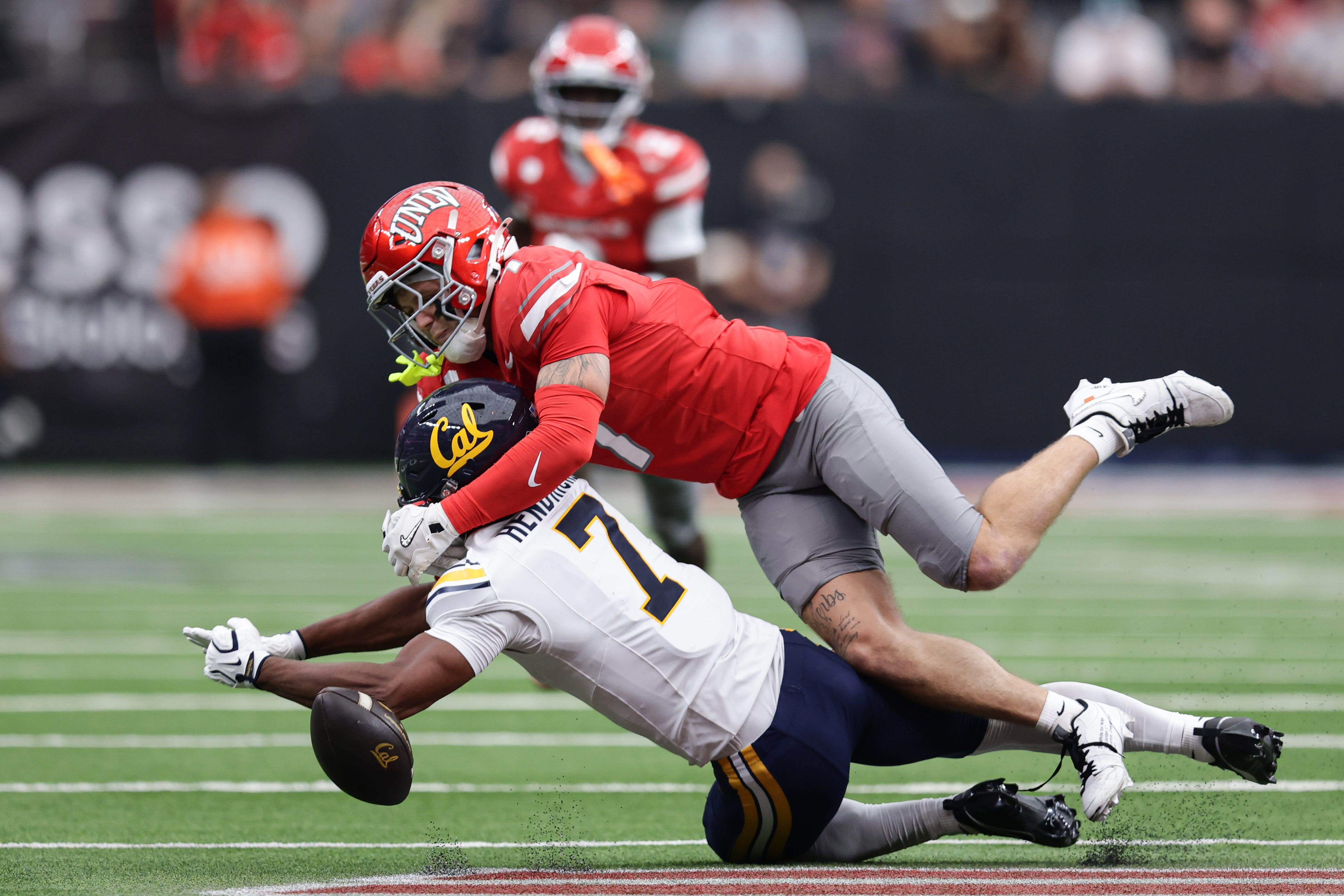
And then Cal lost their best defensive player to injury, and UNLV adapted to Cal’s wild-and-crazy new offense, then their QB threw the worst pass of his career, then two other DBs tossed for targeting, then Cal started leaking big plays, then their QB and best WR went down, but Cal kept trying SO HARD that they just kept committing aggressive penalty after aggressive penalty . . .
And then lost to UNLV anyway.
There is no choice but to get on with the hard work of trying to live, because we all know how easy it is to die.
Offense
Efficiency Report
17 drives: 4 touchdowns, 2 field goal attempts (1-2), 7 punts, 4 turnovers (3 downs, 1 interception), 1.8 points/drive.
Here is why we use points/drive - One could easily look at this game (31 points! A season-high against FBS teams!) and think that this was a major break through.
But because Cal went up-tempo and pass-happy, this game featured twice as many possessions as the Clemson game, and so this game lagged the UCLA game in terms of scoring efficiency. Hell, I was generous and gave Cal credit for that final, meaningless touchdown. If you remove that, we’re down to 1.5 points/possession, about the same as what Cal put up against Syracuse.
Having said that, this WAS an improvement in an absolute sense. Cal managed 5.6 yards/play, a season high against FBS teams and a meaningful improvement.
What was different?
Let’s just get this out of the way: regardless of what we hear in press conferences, I think this game plan had Nick Rolovich’s fingerprints all over it, and I’m just going to assume that he is Cal’s de facto offensive coordinator at this point.
We can split what changed into two categories: personnel, and strategy/play-calling.
On the personnel front, Cal RADICALLY changed their wide receiver usage. In the first three non-Wagner games, Cal basically used just 6 players as targets- Ian Strong, Chase Hendricks, Cooper Perry, Jordan King, Mason Mini, and Taimane Purcell.
But against UNLV, Cal handed a bunch of snaps to basically brand new players 1st year Tyree Sams and 3rd year Carson Perry-Smith, plus a ton of snaps to Quaron Adams, Mark Hamper, and Kyion Grayes. All of them got targets and catches.
But that shift makes sense in light of Cal’s shift to what was basically an air raid offense. Cal dropped back to pass on 66 of 83 offensive snaps, or 79.5%. In many ways, this game plan was even more extreme than many I saw over the years from Mike Leach, who also passed the ball that much or more, but at least maintained the fig leaf of a running threat by using a 4 WR, 1 RB formation most of the time. Cal basically ran their first 3 drives with 5-wide on every play.
I have mixed feelings about this. On one hand, it makes sense. If you were given the following facts . . .
Run game wasn’t very effective to start the season
#1 and #2 running backs hurt and unavailable
Upcoming opponent shredded for 8.6 and 9.0 yards/pass respectively against Memphis and North Texas
Despite what you’ve seen to start the season, you’re still pretty sure you have a generational QB talent.
. . . then you would probably draw up a game plan that featured a ton of passes and a ton of receivers.
On the other hand, going five wide has a few very obvious draw backs:
The defense knows it’s gonna be a pass. UNLV was able to rush the passer with impunity
Cal has already proven that they aren’t good at executing bubble screens against FBS quality competition.
Pretty quickly, UNLV started responding with zero coverage blitzes (keeping five men in man-to-man coverage on Cal’s 5 WRs and blitzing 6), and the only counter to that generally is bubble screens. Which . . .
How exactly is Cal teaching blocking to their receivers?
Bubble screens can be wildly effective against zero coverage. If you can block on the edge, it basically means that your receiver is in space, one-on-one against a DB. If that receiver is at all good in space, that means just one broken tackle means a huge gain, if not a house call.
That “if you can block on the edge” part is pretty important, though. In addition to a number of failed blocks, Cal picked up another three holding calls. Those holding calls killed three different Cal drives (two immediately ended drives leading to a subsequent punt, a third pushed Cal to the edge of field goal range ending in a missed kick).
Fans (somewhat reasonably) tend to hate bubble screens because they are often a very low-reward play, but they are a more or less mandatory constraint play in most modern offenses. It’s a great way to punish a defense for either bringing too many defenders into the box or for playing too many players deep to take away longer throws. I get why Cal tried to incorporate them into the offense.
The problem is teaching and execution, because based on the evidence, Cal’s WRs and TEs are unable to block for these plays without committing penalties, so the majority of Cal’s bubble screens have either been blown up at the line, or even worse resulted in a 10 yard, drive-killing penalty.
Which coaching failure is more galling? Failing to teach WRs how to execute an outside block? Failing to recognize that your players can’t execute the block, and building an offensive system that your players can’t execute?
JKS vs. Jackson Brousseau
There was some rumbling after the game that Cal’s back-up QB out-performed the starter. For what it’s worth:

In a similar number of reps, JKS had a better completion percentage and yards/attempt, and both players took the same number of sacks. If you took out the interception, you’d say that JKS marginally won the battle.
That’s a pretty gigantic thing to ignore, because that interception was the single most damaging mistake Cal made in a game full of them, killing a scoring opportunity and swinging field position in a way that eventually allowed UNLV to cash in. But the idea that Brousseau was obviously better, particularly when 86 of his 200 passing yards came in a borderline garbage-time drive down 14 points, isn’t really backed up on the stat sheet.
I will say this much: Brousseau is an overqualified back-up QB, something that hasn’t really been the case for Cal since . . . well, maybe back to the days when Cal kept switching between Nate Longshore and Kevin Riley?
Defense
Efficiency Report
14 drives: 5 touchdowns, 1 field goal attempt (1-1), 7 punts, 1 turnover (1 interception), 2.8 points/drive.
On a yards/play basis, this was actually UNLV’s 2nd worst offensive performance of the season, but it was their highest scoring game of the year for exactly one reason.
Explosives, explosives, explosives
The good news? UNLV’s success rate was only 31%, which is really bad! 4th percentile, per GameOnPaper.com.
The bad news? When UNLV got a successful play, they made it count - their explosive play rate (12%) was in the 90th percentile, and big plays (including three house calls) won UNLV this game:
70 yard touchdown pass (on 3rd and 8)
55 yard QB run (on 3rd and 3)
36 yard touchdown pass
44 yard QB run (on 3rd and 8) that set up a touchdown
I’ll do a film review later this week, but I strongly suspect that Kingston Lopa’s absence was felt particularly keenly here on some of these plays.
On UNLV’s other 57 offensive snaps, they did very little with the ball, averaging just 2.5 yards/play. But Cal’s defense has already shown themselves to be very vulnerable to the big play, and after 5 games I think it’s something you’re just going to have to bake into your expectations unless or until Cal fixes their busts. That goes double if Lopa is out.
Special Teams
High impact in all directions
Notable special teams plays:
Cal getting caught on another fake punt, which allowed UNLV to continue a drive that ended in a field goal
Cal recovering a fake onside kick to start the 2nd half, which . . . didn’t mean much because a 4th down failure meant UNLV ended up starting their first drive from about the same spot as if Cal had kicked it out of the end zone, but hey it was a free extra scoring chance.
A 51 yard field goal from Towns McGough that was both inaccurate and also probably not long enough
A UNLV fumbled kickoff return when the UNLV dude ran into his own blocker, which ignited Cal’s ultimately futile comeback.
Tyree Sams’ installation as a punt returner, which led to two nice returns, one of which was negated by a hold that costed Cal 19 yards of field position.
5 kickoff return attempts from Cal, including one goofy end around lateral thingy to start the game. The first three all failed to get back to the 25 yard line, which of course led to me cursing in the stands when Niles Davis attempted a 4th return, only to watch him run it back to midfield
Coaching/Game theory
Lots of 4th down decisions
Cal attempted the following 4th down conversions (before the final drive):
4th and 2 from the UNLV 49 on the 1st drive of the game
4th and 2 from the UNLV 23 on the 1st drive of the 2nd half, down 17
4th and 5 at the UNLV 48, 9:20 to play down 7
The latter two are obvious: you’re losing in the 2nd half, you need touchdowns, you’re in plus territory. The first decision is maybe a little marginal considering how your offense has played to date, but it’s still plus territory. My bigger gripe was going 5 wide on both 3rd and 2 and 4th and 2 when the threat of a run really matters in short yardage.
On Penalties
I would roughly put Cal’s 16 penalties into four categories:
Cal is bad at blocking
5 of Cal’s penalties were holds, but none of them were called on offensive linemen. Covered above under Offense. Time to reevaluate how we’re teaching our non-linemen how to block
Cal is overaggressive on defense
5 of Cal’s penalties were basically personal fouls on defense (targeting, roughing, hands to face). Some were maybe a tad unfortunate/random, but this is probably an inherent part of how Cal plays football, expect this to be a cost of doing business. Hopefully over time the defense plays well enough that it’s a cost we’re willing to accept.
Procedural penalties
3 of Cal’s penalties were delays/false starts. Not great, and the delay on the first offensive play of the game doesn’t exactly inspire confidence, but this isn’t crazy in the context of 83 offensive snaps
Other
One intentional grounding, one defensive holding, one defensive PI. The defensive PI was incredibly costly because it turned a likely 3rd and long into a free first down that allowed UNLV to ice the game.
Big Picture
This is almost certainly a lost season.
That sucks to hear after five games. It also feels a little bit reactionary when you’re 1-1 in conference play, but when you combine the eye test with the advanced metrics (Cal is 88th in SP+ and 82nd in FPI) and the potential injury situation it’s really really hard to see how Cal gets to a bowl game, let alone gets anywhere near the 8 wins that much of the fan base set as the pre-season expectation.
It’s so bad, in fact, that there are serious (but troll-adjacent) national commentators saying that Cal will have to consider firing Tosh Lupoi after just one season.
These were in-the-moment reactions to another bad game and the collective body of work after 5/12ths of the season, but it’s silly mostly because I cannot imagine a scenario where Cal eats another huge buy-out to go on top of the 10 million they had to pay Justin Wilcox, only to then go and hire ANOTHER head coach. If Cal had that kind of money available to kick around they would probably be much wiser to spend it on assistant coach and roster improvements anyway.
So all that really matters right now is whether or not everybody involved can identify what has gone wrong and fix it. That can mean tweaks that help Cal get better on-field results (and maybe even some wins) in 2026, but what matters a lot more is what happens in the off-season.
Can Cal retain the players they want to retain? Can Cal retain the coaches they want to retain? Most importantly, can Cal keep major donors onboard to continue financing the effort to save Cal football, and can Cal bring in the right new coaches (like, say, an offensive coordinator?) who can get it right in 2027?
Dying is easy...the bear will not quit, the bear will not die. I personally cannot impact anything that happens on the field. The only thing I have control over is how I chose to support this team. I will be critical, but I will also be unwavering. This shit is hard. Go bears forever.
Thx Nick, with you that 2026 is now fundamentally a lost season. So we are back on the Wilcox yearly OC hamster wheel - unless we keep Rolo and make him the OC for the rest of this year and into 2027. That might be the ONLY way to save JKS for next year. For me, staying alive means checking the box score on Sat night or Sunday AM, as I'm dying watching the Cal football program right now... GO BEARS (sigh).