

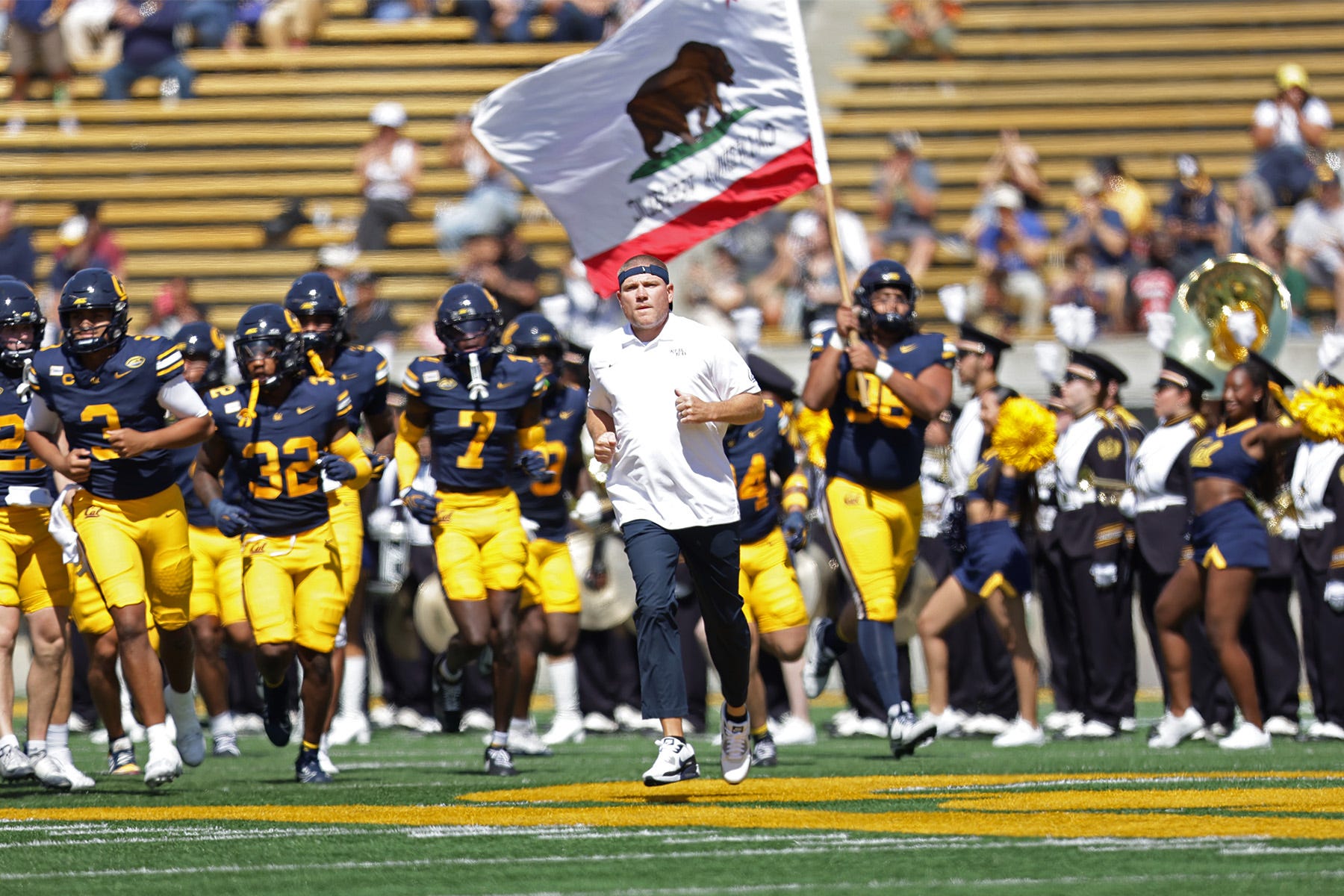
In my decades of watching Cal football, Saturday’s game against Wagner was the least interesting I have ever seen, and by a wide margin.
This is not the fault of anybody in particular, but a reality caused by a few factors.
First: the gap between FBS and FCS has increased over the last few years, so FBS vs. FCS games (particularly power conference teams vs. FCS teams) have less analytical value.
Second: this is Cal’s third game of the year, whereas Cal typically plays their FCS team in their first or second game, when there is more to learn about the roster. What exactly were we going to learn from this game that we didn’t learn against UCLA or Syracuse?
Third: Cal typically plays a Big Sky team (generally the best or 2nd best FCS conference), and often a team from the FCS top 25. Wagner, on the other hand, is notably bad. 338th in Bill Connelly’s all-of-college-football analytical rankings, the 17th worst at the FCS level.
Combine those three factors and you get a game that is nearly as useful as a scrimmage. This wasn’t the Spring Game, but it was closer than we’d all like to admit.
And then Cal spent that scrimmage against Wagner basically throwing a bunch of WR bubble screens and swing passes for easy touchdowns. Which is fun, sure, but those kinds of plays weren’t successful plays against UCLA or Syracuse and probably won’t be particularly successful against the rest of Cal’s schedule. So what did we learn?
Not much. Look, I think Adam Mohammed is a really talanted running back who has upgraded that position for Cal. But when Wagner is turning THIS situation …
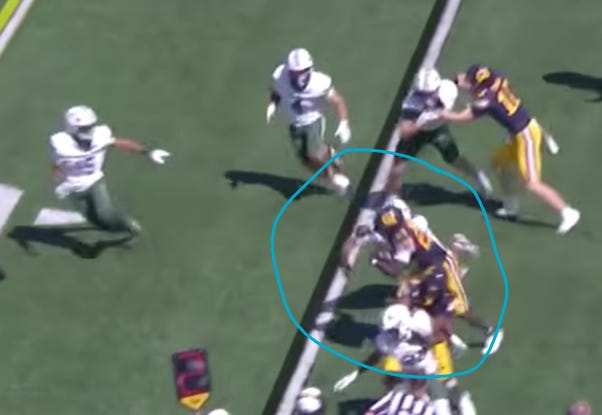
… into a 65 yard touchdown, we’re just not getting useful data.
As a result, I don’t feel like my usual column would be a good use of my time, nor a good use of yours. Toward that end, I’m working on some film breakdown of interesting stuff against UCLA and Syracuse that should be a good use of everybody’s time.
However, in order to have time for a more interesting post later this week we’re going with an abbreviated Monday column:
POTENTIALLY INTERESTING THINGS WE LEARNED AGAINST WAGNER
Dorian Thomas is healthy enough to play
Thomas, arguably Cal’s best portal pick up, suffered some kind of injury in fall camp and didn’t play vs. UCLA before getting two snaps against Syracuse.
In his absence, Cal gave 58 snaps to true freshman Taimane Purcell, which resulted in five targets and two catches for 14 total yards. That’s not nothing - any production from a first year player is noteworthy - but on a team that’s still lacking in pass catching depth, they need Thomas back and looking like he did last year for New Mexico.
Is that close to happening? Thomas caught all of one pass in his time on the field against Wagner, so maybe he needs more time to recover and/or shake off the rust. But I’d like to see what he can do with JKS and the rest of the first string offense, and Cal needs more play makers on the field.
Michael Klisiewicz won the starting right tackle position over Jimothy Lewis
When Cal replaced Lewis with Klisiewicz roughly halfway through the Syracuse game, I assumed that Lewis had suffered an injury. For that same reason, I wasn’t surprised when Klisiewicz got the start against Wagner - why would you risk a guy dealing with an injury against an overmatched FCS team? But then Lewis came onto the field with the rest of the 2nd unit and played out the rest of the game, meaning that Klisiewicz just went out and won the job.
Klisiewicz is in his 2nd year at Cal and was an under the radar Bay Area recruit - the 100th best tackle in the 247 composite who only received three other FBS offers, none at the power conference level. How he’ll adapt to ACC play remains to be seen (I’m hoping to look closer at his film in the 2nd half against Syracuse) but it would be massive for Cal if they could find a playable tackle through their own internal development.
Cal has serious special teams issues
Cal is currently 119th in the country in yards allowed per kickoff return, and of the 12 teams below them on the list, 6 have allowed a kickoff return for a touchdown. Relatedly, Cal is 124th in the country in touchback percentage.
Cal is currently 109th in the country in field goal accuracy.
Cal is currently 128th in the country in punt return average. That’s four total returns, for 7 total yards. Two of those seven yards came from a muff fumbled forwards two yards. I’m guessing that Cal wanted to give Quaron Adams a chance to try his hand at punt returning to see if he could give them a spark. He attempted two returns and fumbled both catch attempts.
So far this season, Angus Davies has been an excellent punter and has saved Cal’s bacon with some Aussie-rules-tackle-avoidance skills. Otherwise, special teams has been rough. Maybe all of this is all small sample size gremlins, and Cal will start making plays in this phase of the game . . . or at least just not actively hurt their chances. But until we see it . . .
Big Picture
This game was something of a Rorschach test. Optimists saw Cal’s starting offense score on every drive except for one, which ended on a fumble from the back-up running back. Pessimists saw special teams errors and a deeply boring set of play calls.
Me? I honestly kinda checked out when Kyion Grayes turned a WR screen into an 80 yard touchdown with one cut.
If you left this game angrier about Cal football, may I suggest that you might need to dial down the passion for your own self-preservation. If you left this game more optimistic, may I suggest that we didn’t really learn anything at all.
If you left this game going ‘‘oooo whiz bang long touchdowns hooray boom goes the cannon! Train concert? Sure, why not? What a lovely day in the warm late summer Bay Area sun!” then may I suggest that you brought the right attitude.
See you all on Friday, when real football starts back up.
So Nick's thoughts made me look at https://fbschedules.com/ncaa/california/ to remind me what Cal's out of conference schedule at this point looks like. And for me this raised a lot of questions. We already have lots of travel across a broad range of the U.S. in any year from Syracuse to Miami. And those East Coast ACC teams have an array of matchups with Big10 and SEC and Big12 teams in the Central and Eastern time zones and then we play those ACC teams. So I'm a bit puzzled by the strategy in our scheduling.
I would think our out of conference games would be completely dominated by these teams: UCLA, SDST, UNLV, ASU, Colorado, UW, Utah, and Ore St. Maybe Hawaii. They are all easy to reach for Cal Fans and the team, maintain a recruiting presence in a region where family would have opportunity to then watch play, and these teams then have comparative play against other worthy teams.
I guess I can see playing SacSt and SJ St for occasional local Cal Fan interest and low cost travel and also recruiting presence as semi-home games. But at Wyoming, at Minnesota, and at Wisconsin? And in 2027 we host both SacSt and Old Dominion? To what purpose? Maybe Minnesota and Wisconsin have a pool of potential players who would be interested in getting a Cal degree? But in a world of constant player shuffling, does that carry as much weight at such distance?
When we were in Pac-12, it certainly made sense playing distant Big10 teams and there also was the old Rose Bowl connection between conferences. But given fragmentation of the Pac-12 we actually have a diversity of teams in the West across different conferences that provide great comparative stats for rankings, etc from Colorado to Hawaii, provide more interest for Cal fans, and reduced travel time and costs. I just don't see a strategy.
There was no need to tip their hand too much and show anything deep in the playbook.