


The Write for California staff has many writers who are interested in statistics and data visualization. We each take different approaches to our analysis, and this variety lends comprehensive insight into the team. Or, it would if there were any depth or nuance to be understood about the data about this Cal offense. It’s bad. It can’t move the ball, it can’t score, and it turns the ball over too much. There are only so many charts and tables we can use to convey what is abundantly clear to everyone with eyes (and even people without). Anyway, with that glowing recommendation for statistical analysis of Cal offense out of the way (hey, the defense and special teams are still interesting!), let’s dive into some ratings from Cal’s performance against Clemson.
BCF Ratings
Our friends at BCF Toys used FEI data to evaluate possession-level measures capturing team performance. These largely capture performance based on how well Cal moved the ball and how well they turned possessions into points, with the reverse capturing how well the defense performed. They even evaluate the impact of special teams on scoring, an impact that was painfully felt on Friday.
Offensive Ratings
We illustrate the ratings with boxplots, which capture the spread of the data. The box represents data between the 25th and 75th percentiles, and the horizonal line represents the median, or midpoint of the data. I have written some variant of those two previous sentence so many times over the years that I would not be surprised if some hooligan inscribes them on my headstone.
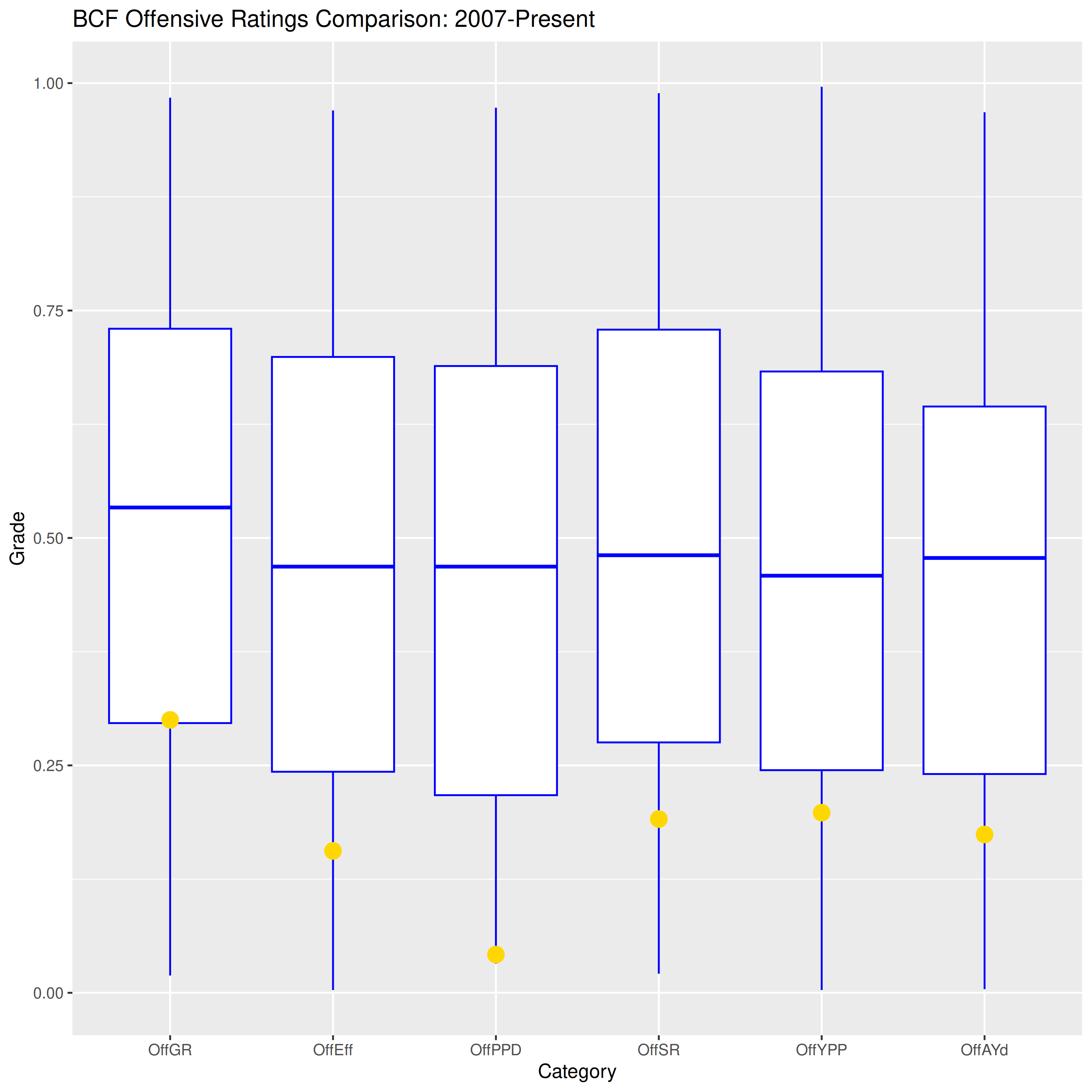
The ratings are bad across the board. The Game Rating and Efficiency rating show that the offense generated very little scoring value with each possession. The Points per Drive rating was the second-lowest we have seen over the past 20 years—only the 2019 shutout loss at Utah was worse. The Scoring Rate is slightly more charitable because it rewards the offense for getting into field goal range (even if the field goal is missed), and Cal twice found their way into field goal range. Overall, those ratings indicate that Cal was utterly unable to turn possessions into points. And the Yards per Play and Available Yards measures indicate that Cal was also woefully inefficient and unproductive at moving the ball. In sum, Cal could not move the ball far or with any degree of consistency and they could not generate points—not ideal.
Defensive Ratings
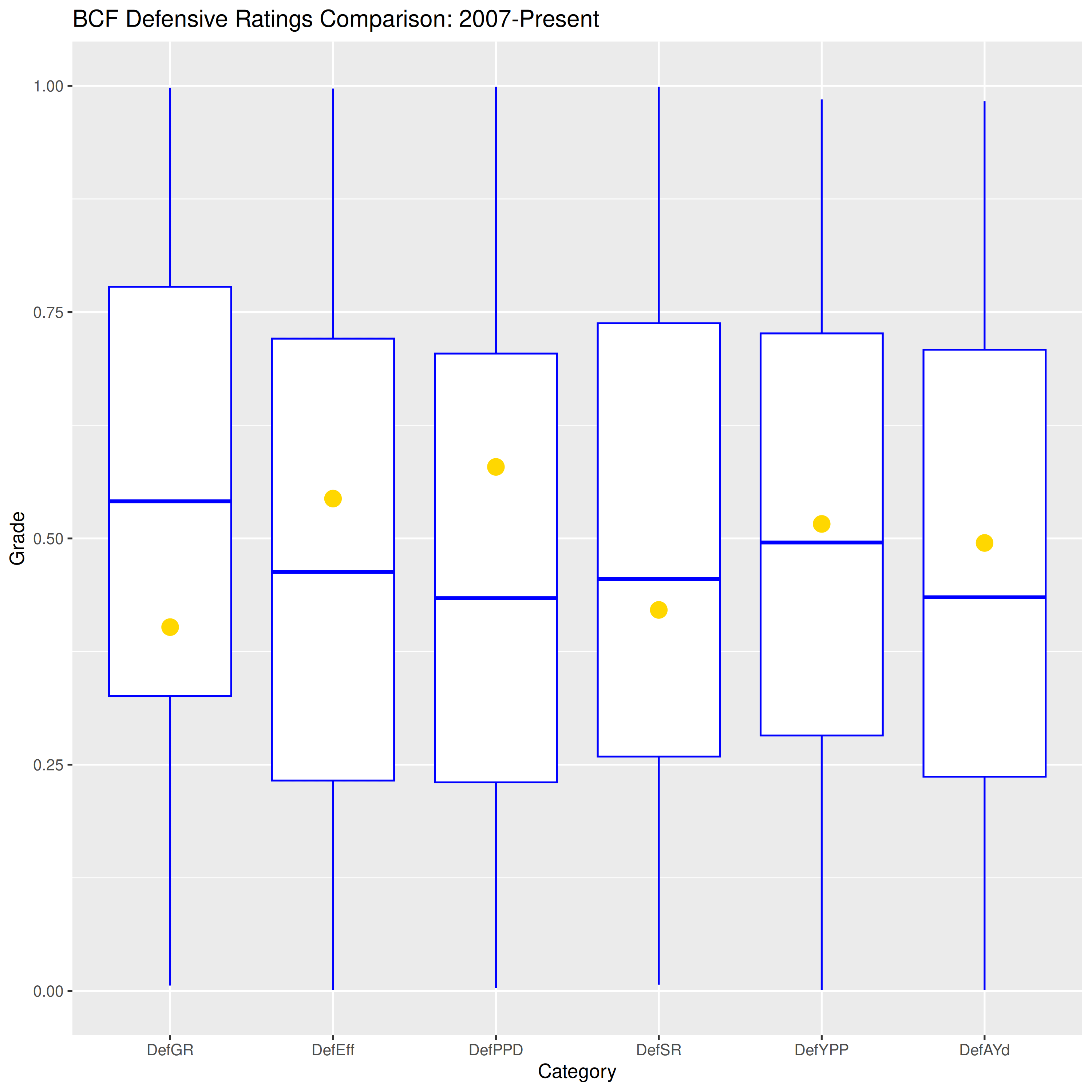
This is the typical profile of a moderately successful bend-but-don’t-break defense. Efficiency and Points per Drive were decent, suggesting that Cal was successfully limiting Clemson’s ability to score (although that lower Game Rating grades Efficiency on a curve and tells us that Clemson’s offense is bad, somehow with a lower rating than Cal’s offense according to FEI). The Scoring Rate also took a step back compared to Efficiency and PPD, because Cal consistently let Clemson get in scoring range, but the Tigers struggled to turn those yards into touchdowns. Yards per Play and Available Yards were mediocre, suggesting that Cal was letting Clemson move the ball moderately well. Put all those ratings together and you get a classic bend-but-don’t-break: the opponent has opportunities to move the ball but struggles to turn that yardage into points.
Special Teams
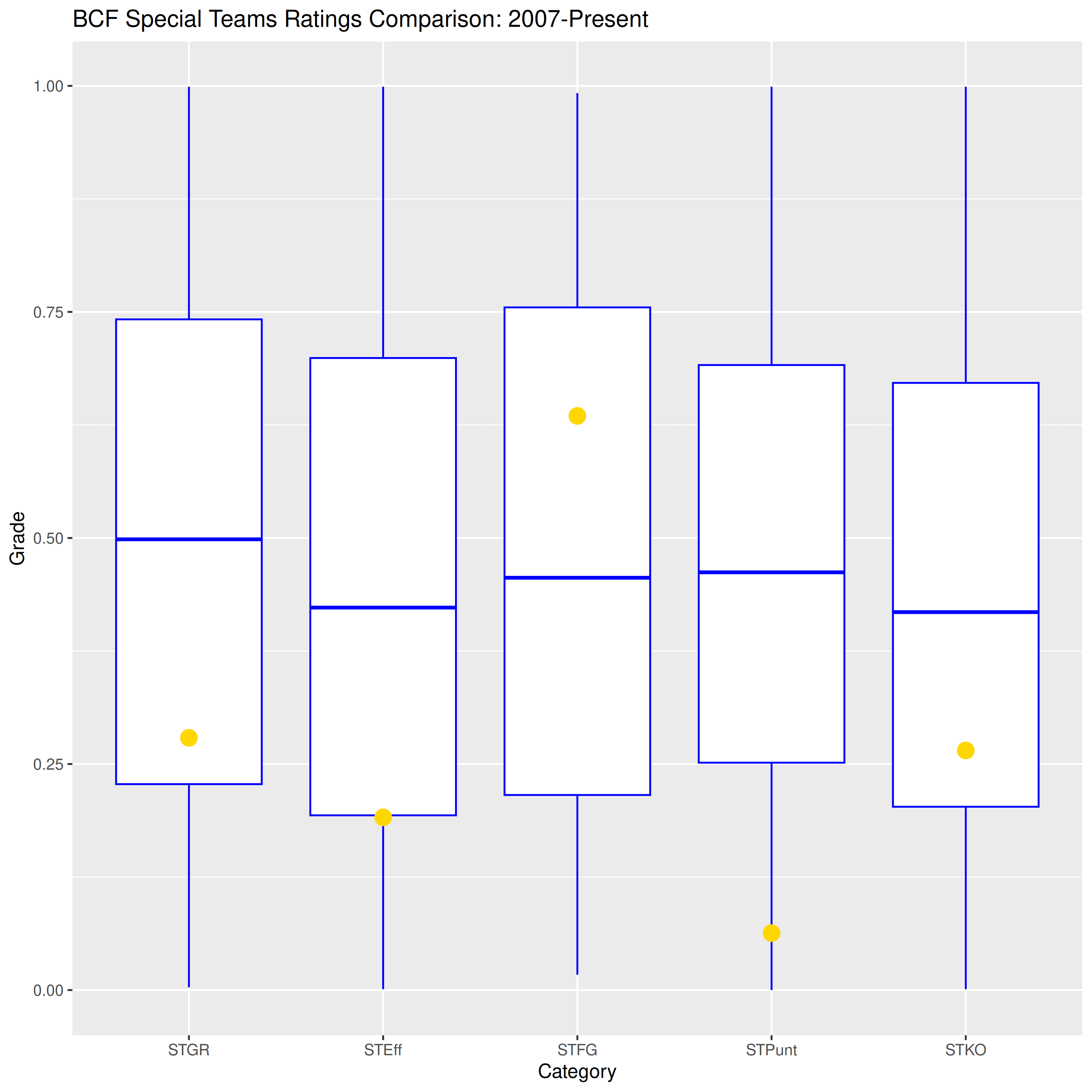
Special teams were bad across the board, with exception to Field Goals. Efficiency (and its related, opponent-adjusted Game Rating) were awful, indicating that special teams was a net negative for Cal (the offside giving Clemson a first down that continued a TD drive and the punt return for a TD stand out). Thanks to the punt return for a TD, Punting earned a terrible rating. Meanwhile kickoffs earned another bad rating because Cal consistently allowed decent returns while failing to generate anything positive on our own kick returns.
BCF Clusters
With an abundance of bad ratings, this one seems destined for our ignominious cluster…
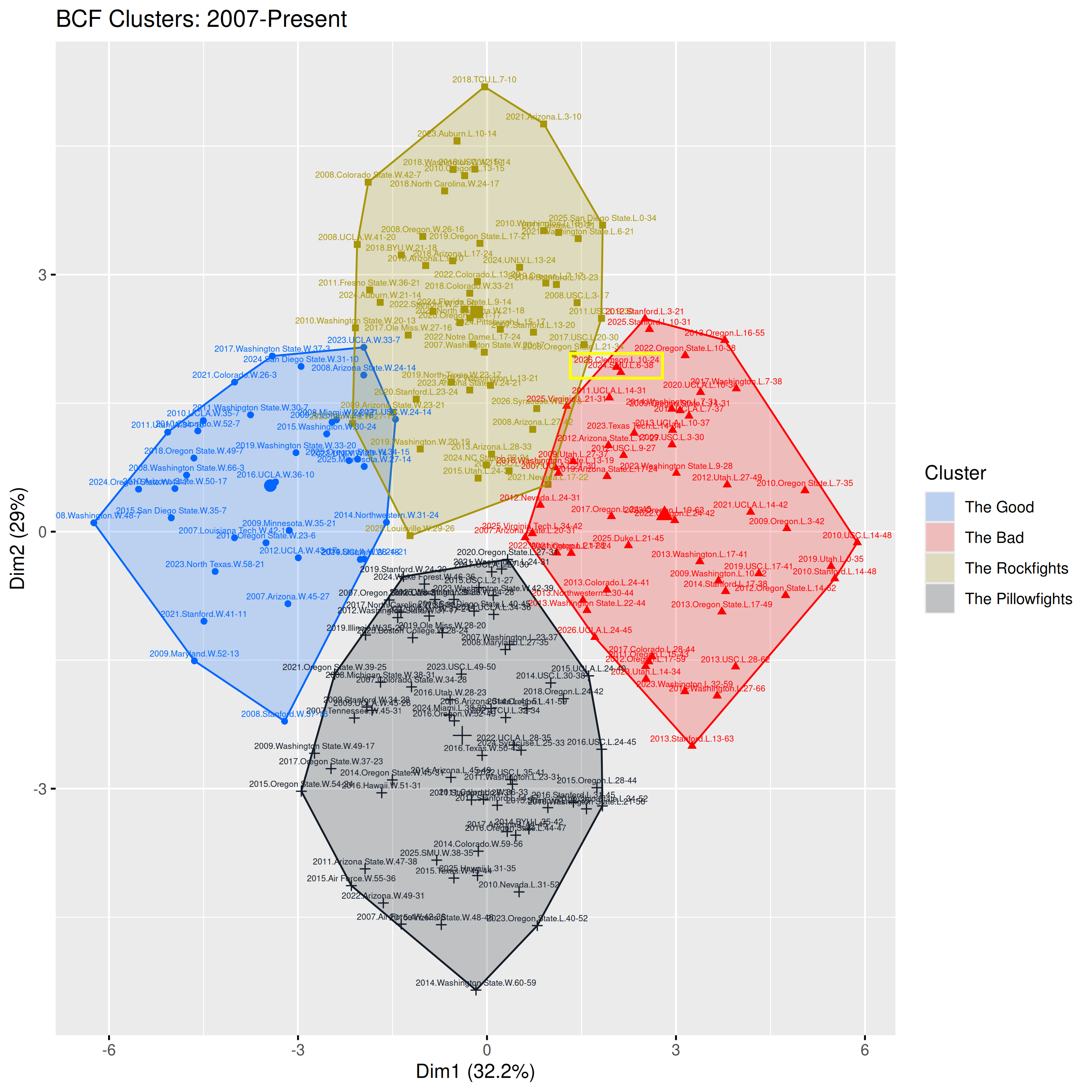
Indeed, this one fell into The Bad. Relatedly, last week’s extremely unusual win in The Bad has since migrated to the Rockfights; the boundaries of these categories remain ever-changing. This game was far from the worst of The Bad (losses on the lower and right sides are particularly painful), and instead sits near the Rockfights. This one certainly had the feel of a Rockfight and may have stayed a Rockfight if not for Clemson’s game-sealing 75-yard TD in the waning minutes. Alas, another Bad. That’s 2 Bads and 1 Bad-turned-Rockfight in Lupoi’s first three FBS games. Not a great start to a new era of Cal football.
Deja Vu
I compared the ratings from this disaster to all previous BCF ratings to determine which game was most similar and the winner is…2008 Oregon State (Cal lost 21-34). Although Cal surrendered 34 points, the defense was only responsible for one TD drive thanks to a kickoff returned for a TD, a punt returned to the Cal 2-yard-line, and a pick six. And like this past game, Cal struggled to find the end zone and relied on a double-pass play (shout out WR Jeremy Ross!) for one of its rare TDs (the other two were courtesy of a 65-yard Jahvid Best run and a 51-yard kick return by Best to set up a short field). Like Friday night’s game, this one featured some awful quarterbacking (neither QB completed more than 50%) and many unsuccessful drives (14 punts, and nearly as many combined punting yards as total yards). What a fun throwback.
Somehow we've got to come up with five more wins to get to 7-5 and a bowl game. Taking on this Herculean Task requires that we start by beating UNLV. Wiser minds than mine can palaver about the games following the UNLV win. I propose we focus on winning one game at a time. For my credentials enabling me to to opine such a strategy I present my Cal degree which validates the last 56 years of declaring GoBears! at every available opportunity. And yes: Go Bears!
To quote Urban Meyer...the contribution of assistant coaches is often overlooked and underrated (or something like that). You need more than having a talented roster, you need good assistants, and so far, all of the newness is showing. Doesn't mean they won't improve, but it may take a season or two, however...the receivers aren't blocking well, or cathcing everything, and that's really coaching thing. The talent on the O-line wasn't all that heralded, either, except one guy from MSU, and he's now 2nd string. Gonna be a lot of lessons learned the hard way this year, and JKS will likely be gone after this season, and that new legislation won't be around in time to prevent that. There's obviously a host of new system issues that are plaguing this team right now.