


While we’re all hoping for better wins, we’d be hard-pressed to get a weirder one.
Syracuse outgained the Bears 437-249, ran 27 more plays than Cal, produced close to double the number of first downs, and possessed the ball for longer. Cal averaged 4 years per play and trailed by 4 with less than 5 minutes remaining.
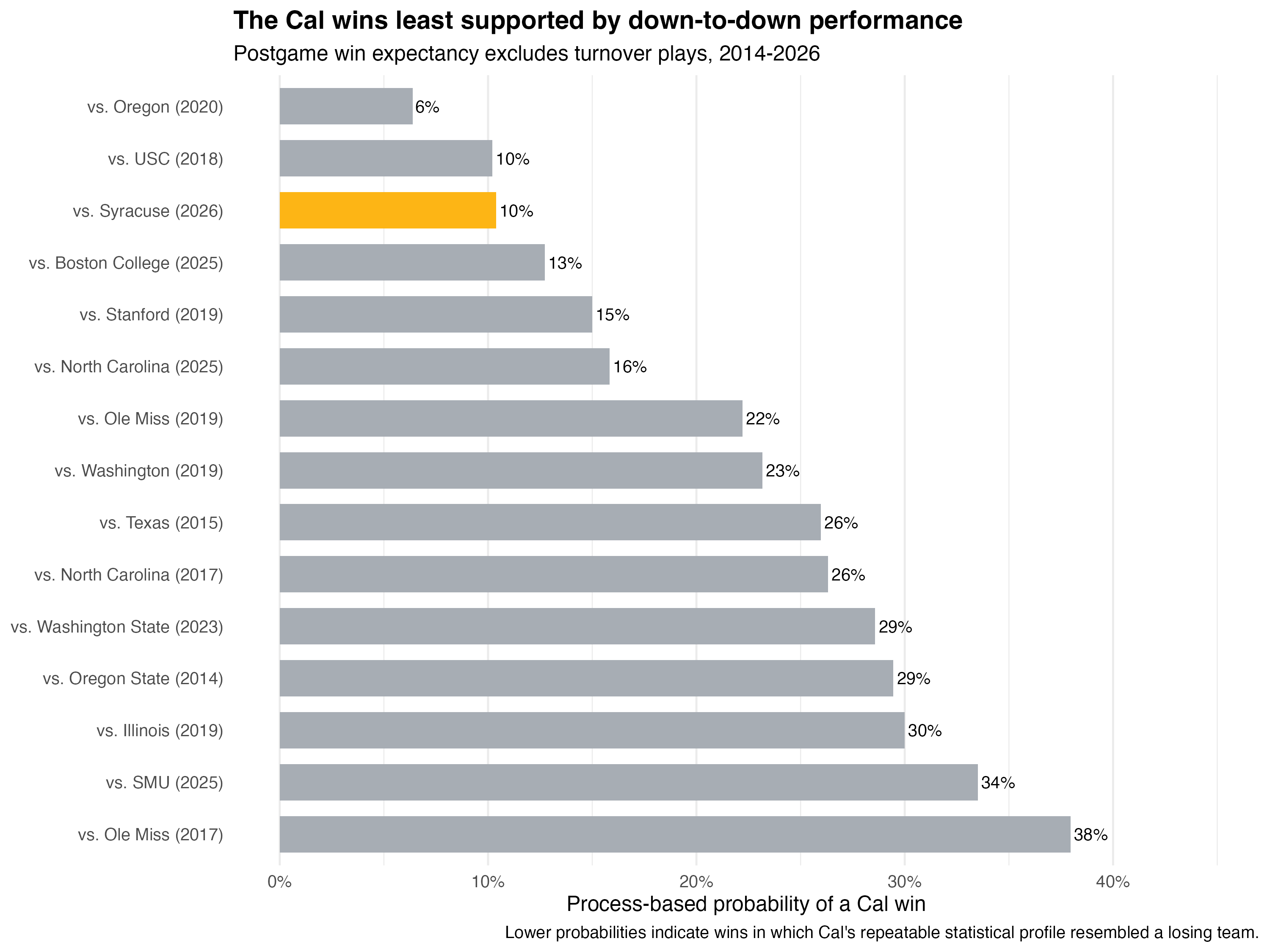
Based on Cal’s down-to-down performance (excluding turnovers), a team with those statistics would be expected to win only ~10% of the time.
A Historically Unlikely Win
To get a sense of just how unlikely the Cal win was, we estimate a logistic regression trained on >12,000 FBS games between 2014 and 2025. The outcome is whether the home team won, and the independent variables compare home and away teams across five dimensions of play: expected points added per non-turnover play, success rate, explosive-play rate, yards per play, and average starting field position.
Game-level statistics from the Cal-Syracuse game were then entered into the model after estimation to get a postgame win probability. A historical comparison makes just how weird this win was even clearer.
Looking at 65 Cal victories since 2014, the Syracuse game ranks third-lowest in “process”-based postgame win probability. Only Cal’s 2020 win over Oregon (6%) and 2018 win over USC (~10%) had statistical profiles less consistent with a win under the main model.
This is not a ranking of Cal’s biggest pregame upsets. It doesn’t use the betting line or preseason expectations to calibrate likelihood of victory. An underdog can have a dominant statistical performance and a favored team can win despite being outplayed. The model instead asks: conditional on how teams actually performed, which Cal victories look least like victories?
Saturday’s game is near the top because the Bears did not win by dominating snap-to-snap. They won, in large part, due to key defensive plays by Kingston Lopa: Cal’s estimated win probability rises to 54.7 (!) once turnover margin is included.
A Historically Pivotal Performance
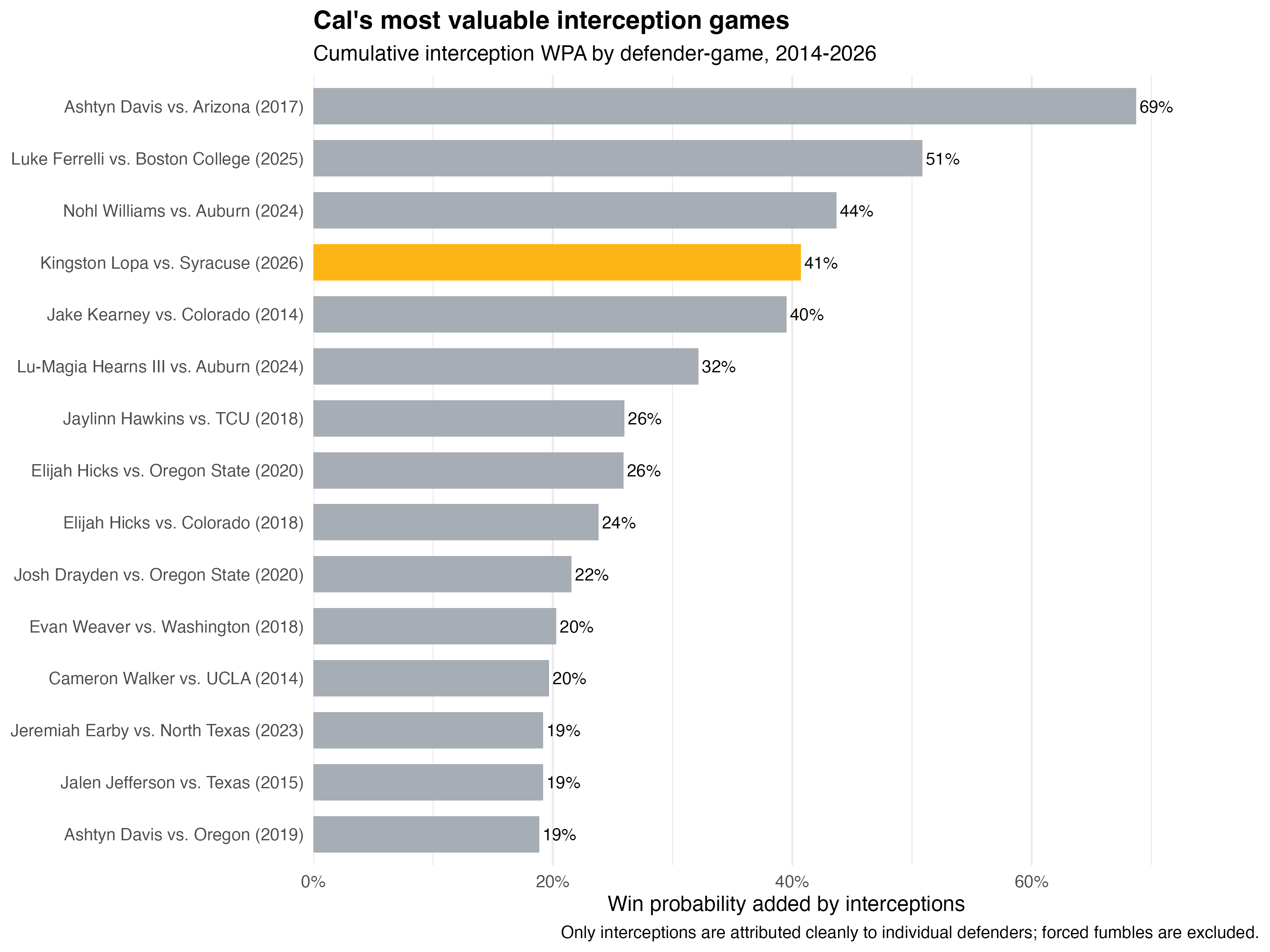
So how valuable was Lopa’s performance, historically speaking? The cbfastR play-level win probability model assigns Lopa’s three interceptions a cumulative 40.7 percentage points of win probability added. That would rank 4th among Cal games since 2014: behind Ashtyn Davis against Arizona in 2017, Luke Ferrelli against Boston College in 2025, and Nohl Williams against Auburn in 2024. All very notable performances in their own right!
Numbers aside, Lopa’s performance was the clear difference—and obvious to anyone watching on Saturday. Lopa was the first Cal player with three interceptions in a single game since Jaylinn Hawkins in the 2018 Cheez-It Bowl. He had a 53-yard return, a go-ahead defensive touchdown, and, to top it off, the game-sealing pick.
What Comes Next?
Of course, Cal fans hoping for more wins likely also hope for those wins to not earn an “improbable” designation. Personally, I’ll take the luck. But it’s better to be both lucky and good.
Encouraging, though, is that Cal improved on dimensions that needed improvement coming out of the UCLA game. The Bears did not turn the ball over after giving up three to UCLA. And they held Syracuse to fewer rushing yards. Even if there is more work to do, these are important improvements!
A Note on the Methods
The analysis uses cfbfastR FBS play-by-play data from 2014 onward. For process-based measures, nullified plays and official turnover plays are removed. For each game, we calculate home vs. away margin in non-turnover EPA per play, success rate, explosive-play rate, yards per play, and average drive-start field position.
The main logistic regression is estimated on national FBS games from 2014-2025, using home team victory as the dependent variable. The fitted model is then applied to the Cal-Syracuse statistical profile. A second logistic regression includes the same variables, adding turnover margin. The outputs are postgame probabilities.
While I enjoy the nerdy analysis, my take was that Syracuse "pulled a Cal" reversing the script and imploding, as we typically do at the end of a game. I'll take the win, however improbably, b/c that's what being a long-time Bear fan is all about. Unfortunately.
I dont know the stats on the game but the 2016 Dykes home win against a then ranked Utah team by turning away six plays inside the ten yard line… was incredibly unlikely. https://www.espn.com/espn/wire?section=ncf&id=17688787