


Saturday was a very good day for the Bears, as they won their marquee non-conference game on a national stage (although most of the country was asleep by the time the game ended). But we’re not here to evaluate the game with vibes. We’re here to evaluate the game with PFF’s statistics.
PFF Grades Comparison
Armed with one thousand eyeballs at one thousand typewriters, PFF graded every player on every snap of the game. Those grades were distilled into a dozen team-level stats reported below.
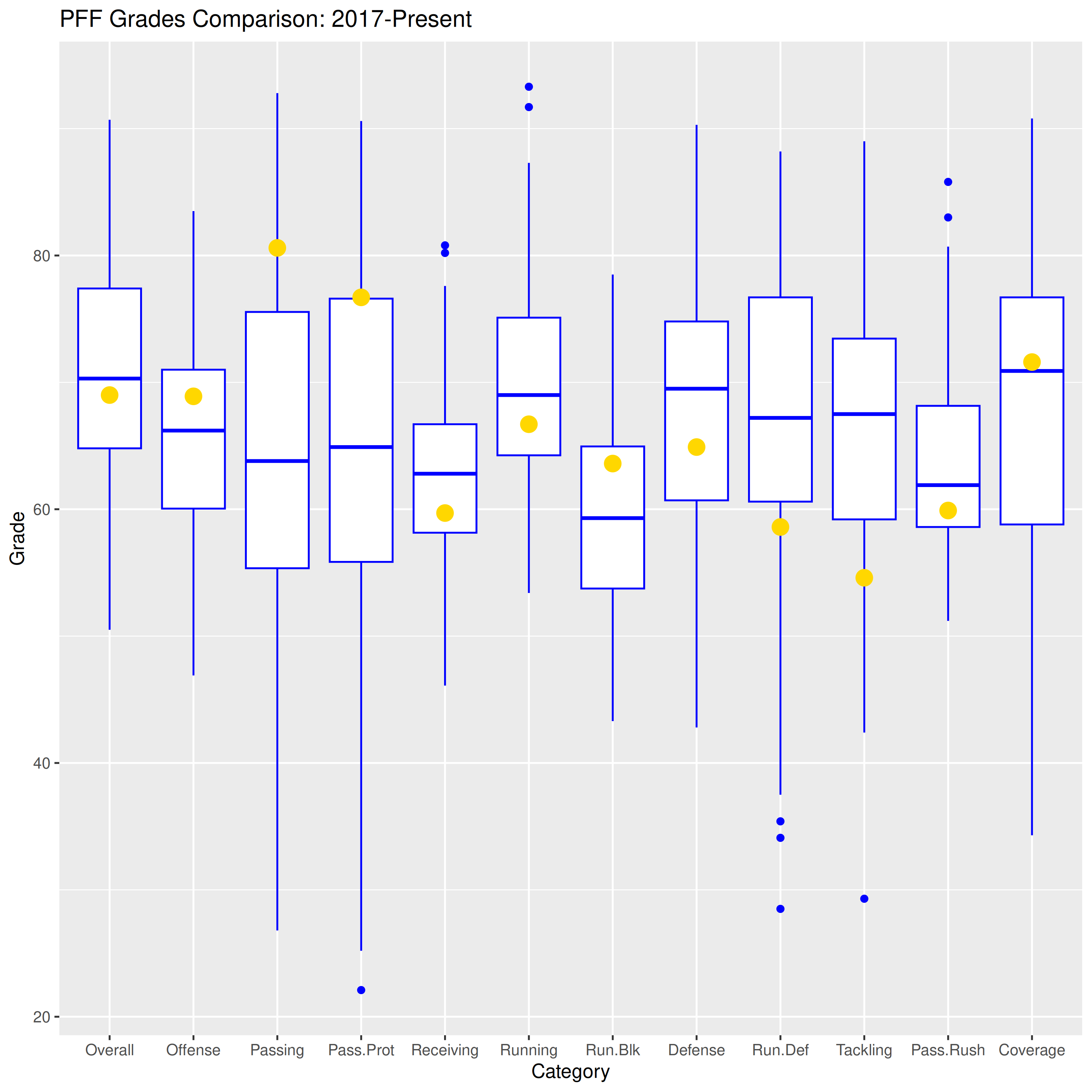
Again, the vibes were great on Saturday. But the grades? Much more of a mixed story. The offense was anchored by another stellar day from JKS, whose O-line did some solid blocking in pass protection and run blocking. Despite the strong play from their supporting cast, the RBs and WRs did not grade so well.
Compared to typical Wilcox teams, the defense earned sub-par grades. Coverage was merely middling (admittedly, it’s held to a very high standard under Wilcox) while run defense and tackling were much worse than usual. That run defense grade is a bit puzzling, as Cal had a solid run stop rate (63%, as we’ll talk about a bit more below). Ijeboi broke off a few decent runs, although they were not exceptionally long. Perhaps the run defense grade is influenced by some of the tackling struggles.
PFF Clusters
Going into a matchup of top-25 defenses squaring off against true freshman quarterbacks, many of us expected this one to be a Rockfight. And it certainly started off that way, but this is an odd mix of grades. They’re not good enough for The Good and it certainly wasn’t Bad or a Pillowfight. The middling defensive grades should keep it out of The Rockfights…so all we’re left with is the hodgepodge collection of Bizarro Games. Does our classifier agree?
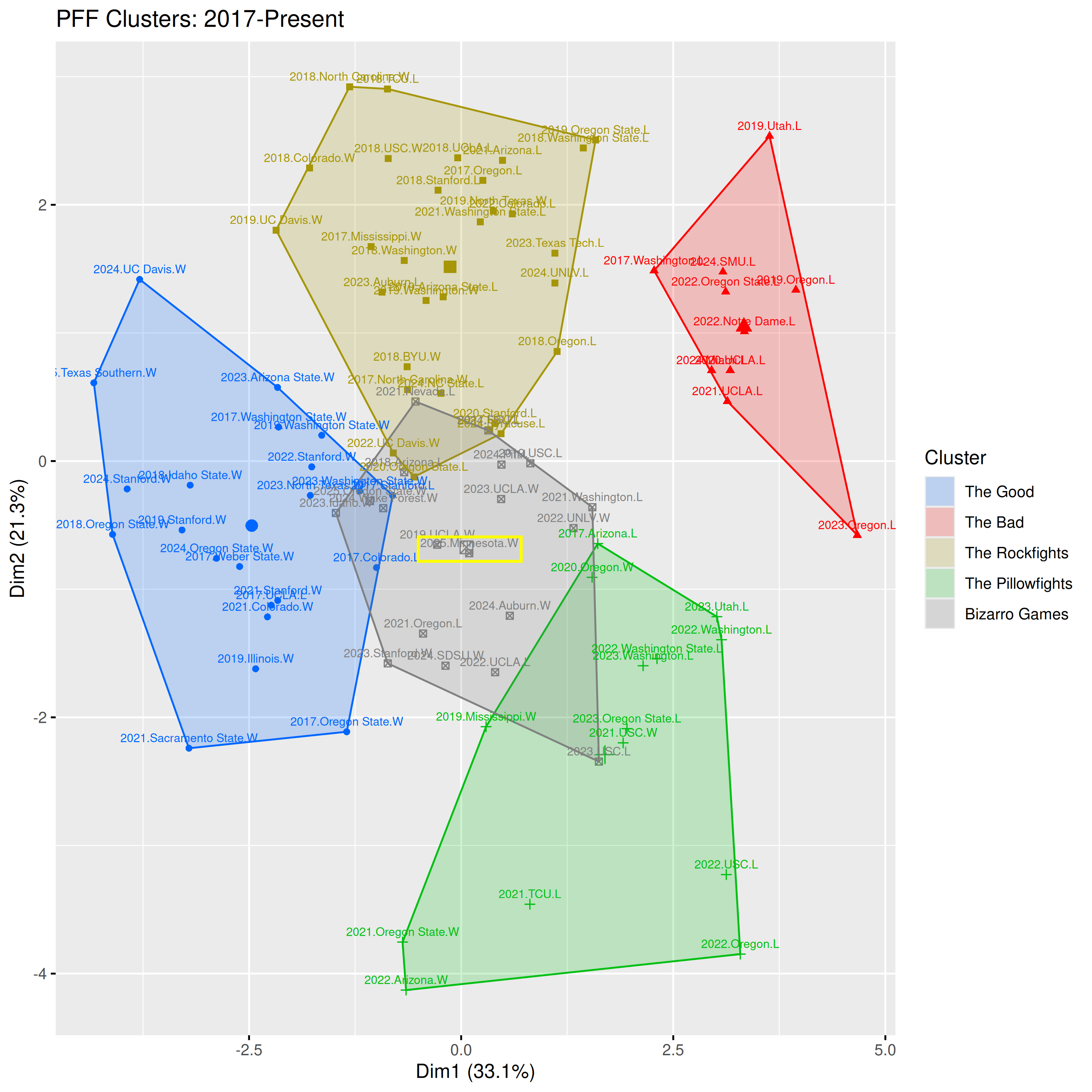
Indeed it does, as this one fell into Bizarro Games. Interestingly, this one sits directly in the middle of Bizarro Games, suggesting that this was the most typical Bizarro Game so far. We added this fifth category last season to make sense of some head-scratching performances. Usually these games are reasonably successful performances hamstrung by a few fatal flaws (usually blocking and/or tackling). Looking over this week’s grades, that same pattern seems to hold here.
Odds and Ends
Here is the usual assortment of other interesting stats from the game.
Offensive Player of the Game: WR QuaRon Adams, 83.3. Adams played one snap and hauled in a 20-yard pass. Runner up is LT Frederick Williams III (81.2), another solid entry for the O-line! In fact, 3 of the top 5 highest graded players were from the O-line (shout out to Leon Bell and Tyson Ruffins).
Defensive Player of the Game: LB Harrison Taggart, 76.1. Taggart did a fantastic job filling the void left by Uluave’s absence in the first half.
Iron men [played every snap]: LT Frederick Williams III, QB Jaron-Keawe Sagapolutele, RT Leon Bell, C Tyson Ruffins, RG Sioape Vatikani, LB Luke Ferrelli
Pass protection: Cal allowed 9 pressures on 46 pass plays, for good rate of 19.6%
Pass rush: Cal forced 10 pressures on 38 pass plays, for a below average rate of 26.3%
Tackling: Cal missed 14 tackles on 73 plays, for a disappointing rate of 19.2%
Shake and bake: Cal evaded 13 tackles on 67 plays for a better-than-usual rate of 19.4%. This was a rare game where Cal evaded tackles at a higher rate than they missed tackles.
Run stops: Cal stopped 22 of Minnesota’s 35 runs, for a strong rate of 62.9%
But wait, there’s more! I finished pulling the pass protection, tackling, and run stop data for all games from the Wilcox Era. Now we can compare each week’s stats to all previous games. The plot below shows boxplots for each of those stats, along with each season’s average superimposed over the boxplots.
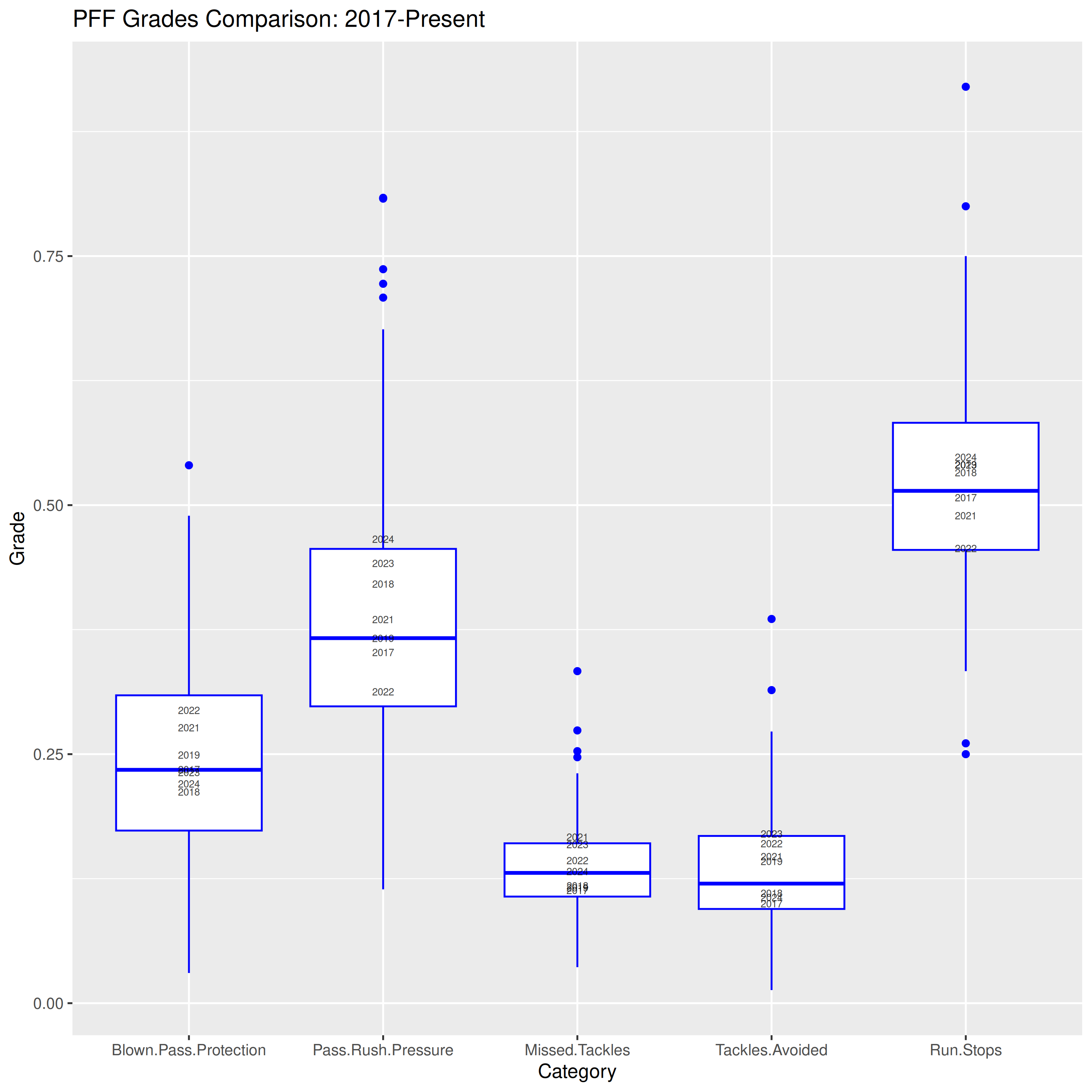
Despite the struggles of the O-line over the last several seasons, it speaks to the tenacity of the Wilcox defenses that Cal consistently generates pressure more often than the opponent. In a typical game Cal forces pressure on about 36% of pass plays, but they only concede pressure on about 23%.
The missed tackling stats are the opposite: Cal consistently misses more tackles than the opponent. The 2017-19 teams were better with their tackling, but this discrepancy also arises because the offense has consistently been lacking in slippery, elusive players (with exception to the 2023 season, anchored by a healthy Ott’s ability to embarass defenders).
Finally, Cal consistently forces stops on over half of the opponent’s run attempts, and this stat has been getting better in recent years. (PFF defines a “stop” as follows: 1st down) opponent gets less than 40% of the yardage needed for a first down; 2nd down) opponent gets less than 50% of the yardage needed for a first down; 3rd/4th down) the opponent fails to convert the down)
Here is how those stats look from Saturday’s game.
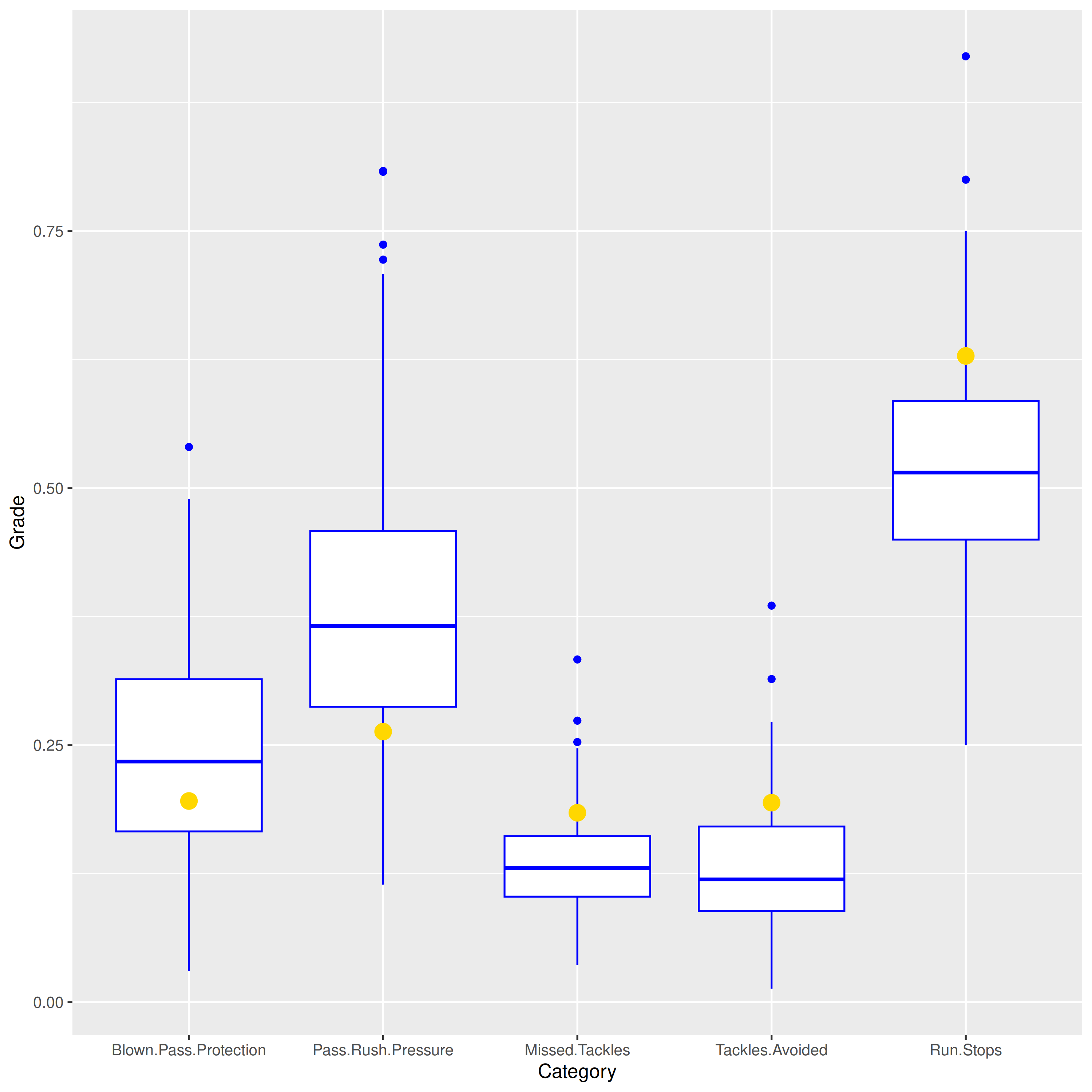
Pass protection held up well, although the team struggled to generate much pass rush. Tackling struggled, although Minnesota also struggled to tackled the Bears at a near equal rate. And the run stop rate was quite high, a crucial success in forcing Minnesota to rely more on their true freshman QB.
That’s all for this week. We’ll keep visualizing the Odds and Ends stats each week from here onwards.
There is something new happening that is probably not a statistical thing, but feels very real nonetheless. Starting with the first quarter of the Oregon State game and becoming stronger with each game, it is a feeling of confidence that this team, led by this quarterback, will find a way to win.
Good pass protection by both teams is something I observed as well. Cal's OL is definitely improved from the last several years; the personnel and coaching changes from the offseason appear to have made a difference.
IMO the biggest reason Cal struggled to stop 3rd-and-long plays from Minnesota was because we couldn't get pressure on the QB. He was able to survey the field and find his man.