


Welcome back to The Good, The Bad, and The Rockfights [TBD], our weekly attempt to make sense of what we saw on the field the previous weekend. Last week brought an end to the Wilcox Era and an end to our traditional approach of clustering games into Good, Bad, Rockfights, Pillowfights, and Bizarro Games. We are now in a post-Wilcox Era, and the team’s performance profile may start to branch out beyond the types of teams we saw under Wilcox; this will especially apply in 2026 under an entirely new coaching staff. Today we will take a preliminary look at what kinds of Cal football teams we have seen historically (from 2014 onward, which is as far back as PFF’s advanced grades go), and identify some new categories to describe those teams. And in Part 2 of this piece (later this week), we will look at how the SMU game fits into our new categories.
New Team, New Data
To capture more types of Cal football performances, I pulled all PFF data that exists for Cal, starting in 2014. We will use PFF’s same set of team-level grading categories—Overall, Offense, Passing, Pass Protection, Receiving, Running, Run Blocking, Defense, Run Defense, Tackling, Pass Rush, and Coverage—to characterize Cal’s performance. And we will use the same k-means clustering algorithm to sort the data into clusters of similar games (for many more details on the algorithm, including a helpful animation of how the clusters are created and refined, check out this Wikipedia page). At its most basic level, the algorithm sorts the games into clusters, where games within a cluster are more similar to each other than they are to games in other clusters. One of the challenges of k-means clustering, however, is determining how many clusters to create (or choosing the k in k-means). Solving this problem directly addresses our question of how many types of Cal football games exist.
How Many Types of Cal Football Teams Should We Recognize?
The optimal number of clusters can be determined quantitatively (mathematically) and/or qualitatively (eyeballing the data, trusting your gut, vibes, etc.). Using a quantitative approach, I found support for breaking down the data into 2, 3, 6, and 11 clusters of games. Let’s examine each breakdown:
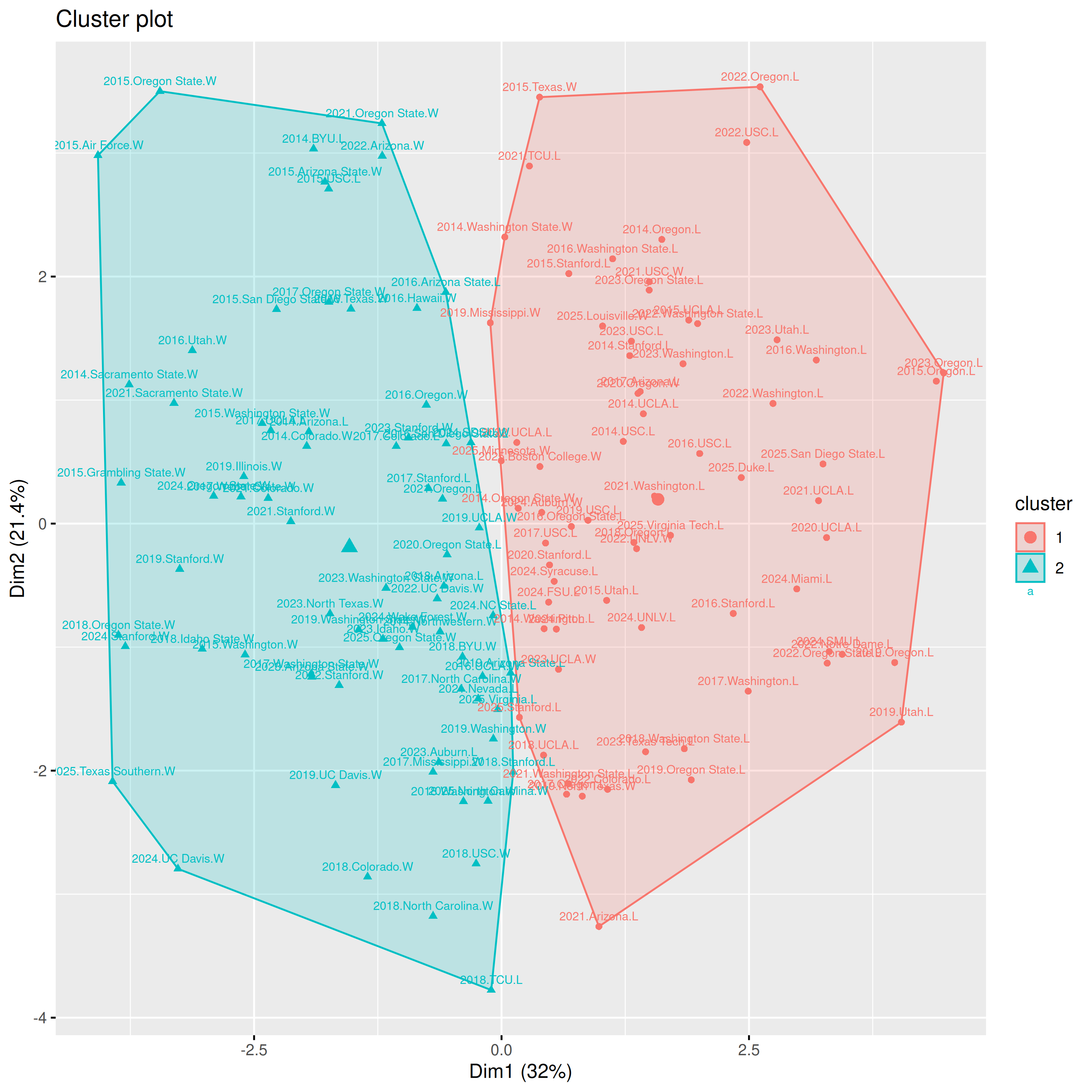
[Reminder: in these plots each data point represents a game and all the grades that performance earned, and more similarly graded games are closer together while games with very different grades are farther apart. For example, the Cheez It Bowl (bottom middle) is on the opposite side of the plot from the 45-44 win over Texas in 2015: one was an all-defense, no-offense rockfight while the other was a scoreboard-breaking shootout.]
Breaking the data down into two clusters gives us a cluster of better games and a cluster of worse games. This is not a very helpful way of understanding Cal football games, particularly because this categorization largely aligns with wins and losses. We need further insight through additional categories. How about three?
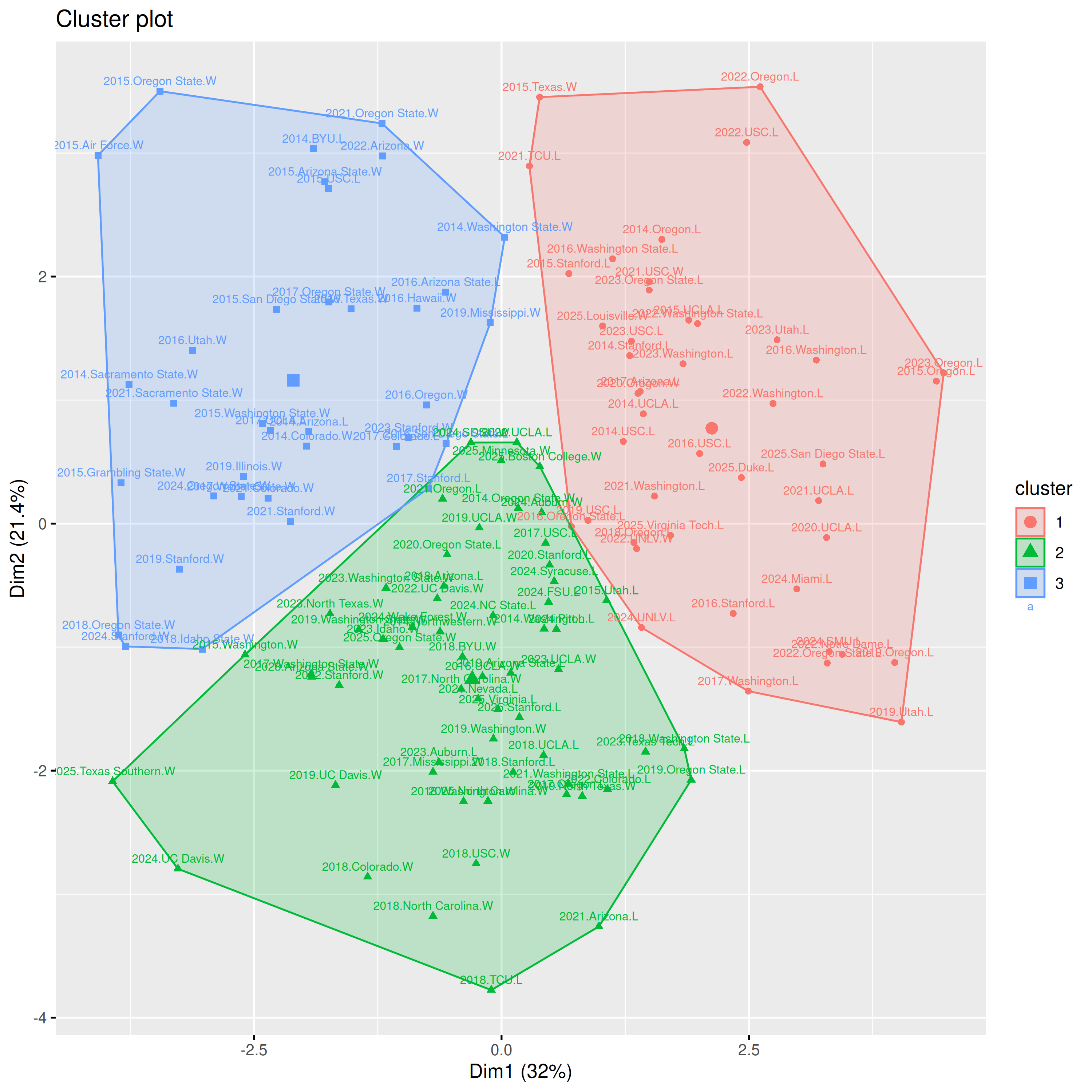
This is definitely more informative. We have better games on the left, worse games on the right, and in-between games in the green cluster. A three-cluster categorization can be useful (it was quite useful in our original Good, Bad, Rockfights categorization back when Wilcox’s teams primarily played three types of games), but with twelve seasons and around one hundred fifty games of data, we need more differentiation. The green cluster, in particular, has an unusual combination of games: should the 35-3 win over Texas Southern this season be in the same cluster as the Cheez It Bowl loss and the 45-31 win over Oregon State in 2014? The Texas Southern game was a dominant win, the Cheez It Bowl was the ultimate Rockfight, and the Oregon State game was a typical Sonny Dykes shootout. Meanwhile the red cluster is mostly losses, but it has everything from eye-bleachingly bad losses (2019 Utah, 2017 UW, 2024 SMU) to shootout losses (2022 USC, 2021 TCU), and even some wins (2015 Texas, 2020 Oregon, 2021 USC, 2022 UNLV, 2025 Louisville). These categories need to be broken down further. How about 6?
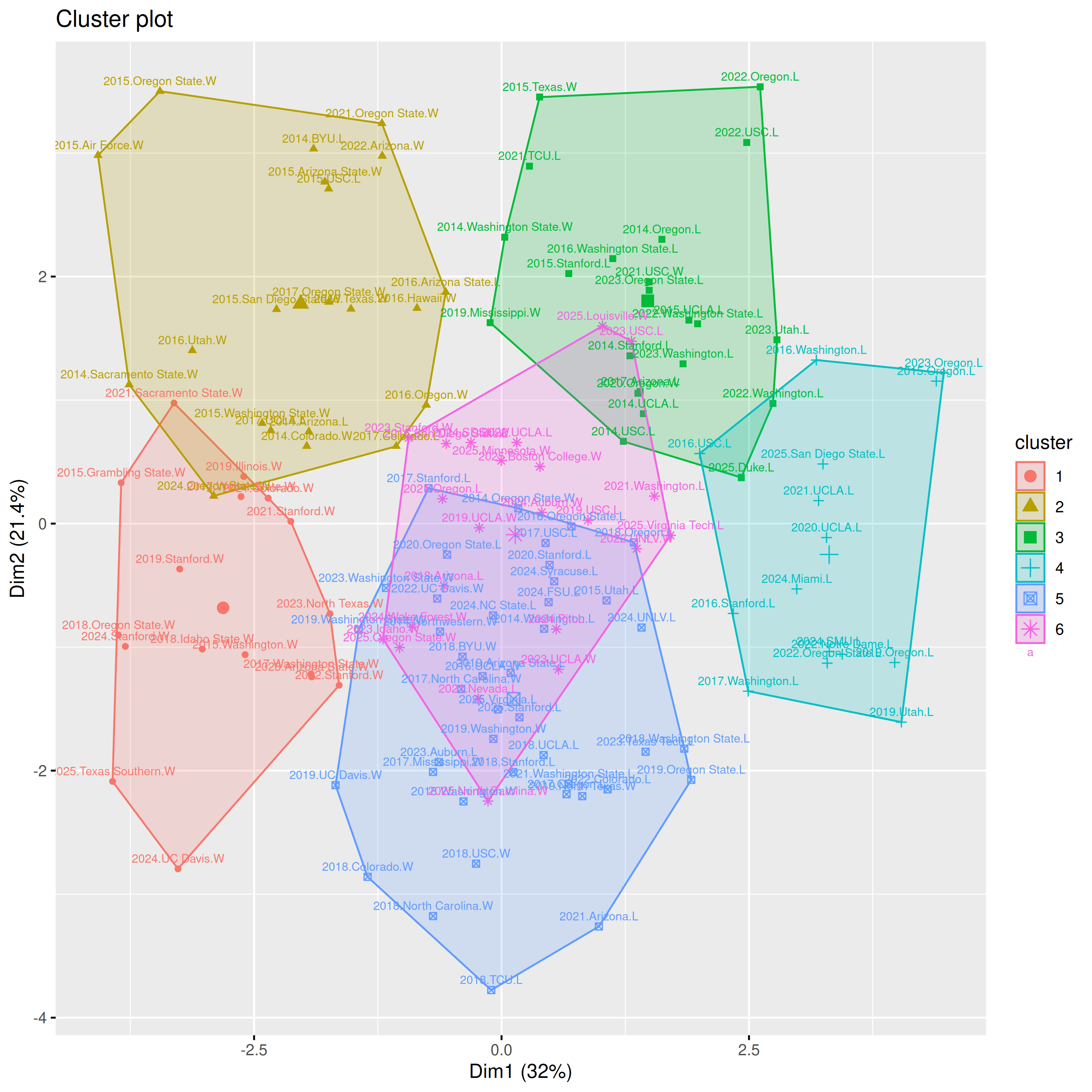
Even better! The red and yellow clusters capture two different types of wins, the green and teal categories capture two types of losses, and the pink and blue categories capture two distinct types of in-between games. I will not yet go into too much detail about what each of these categories represents (we’ll cover that later, because this is the clustering solution we ultimately choose). But what if we want even further differentiation? What about 11 types of games?
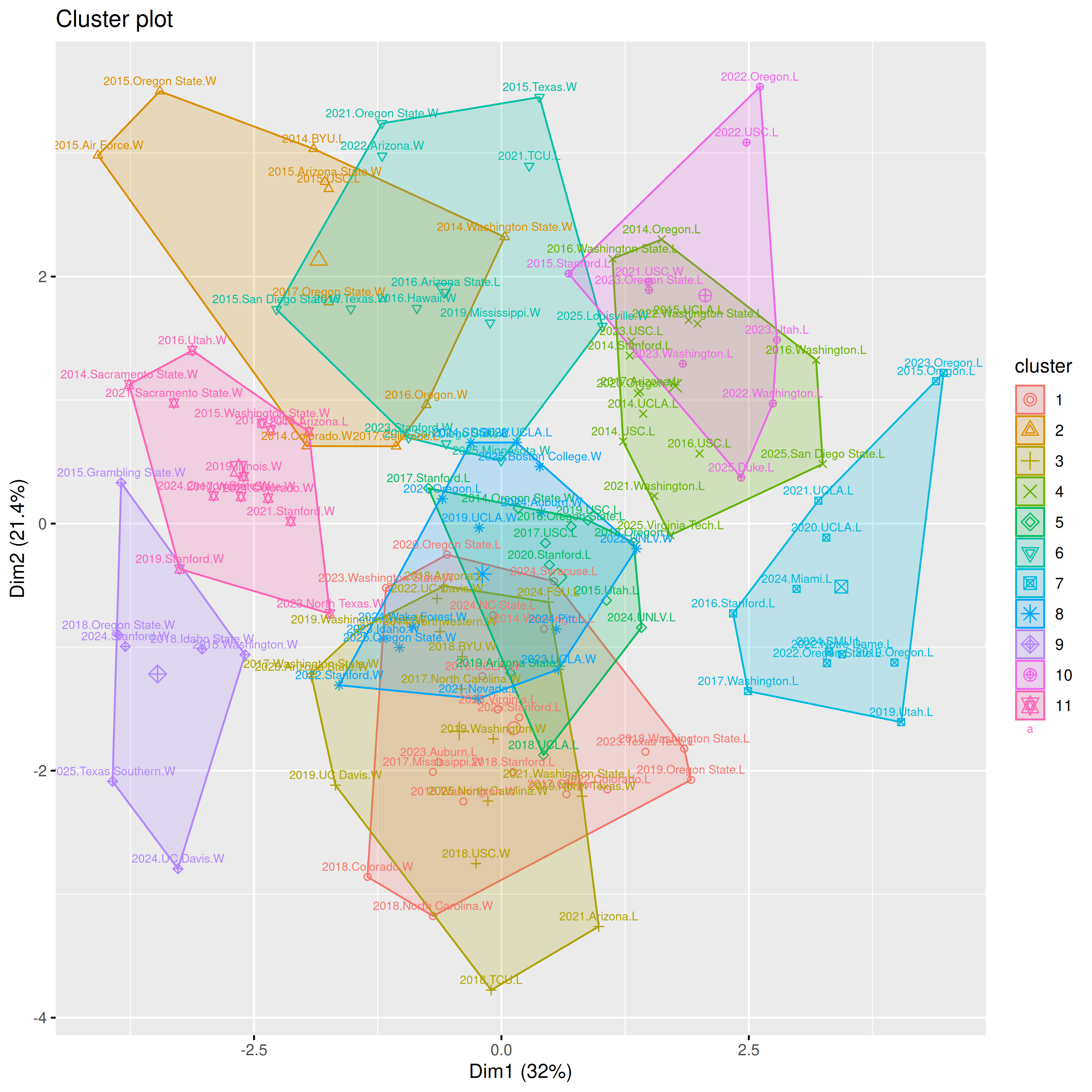
This is…a lot. The left side of the plot captures three types of wins, the right side captures three types of losses, and the lower middle captures four-types of in-between games. While this does indeed differentiate the games, there’s a bit too much differentiation here (and quite a bit of overlap among some of the categories). It’s differentiated to the point of being overwhelming. So let’s go back to six categories of games.
The Six Types of Cal Football Games
After looking over the data in each cluster and what kinds of grades they receive from PFF, I’ve created the following names for our clusters. Each name captures a bit about what types of games belong to the cluster.
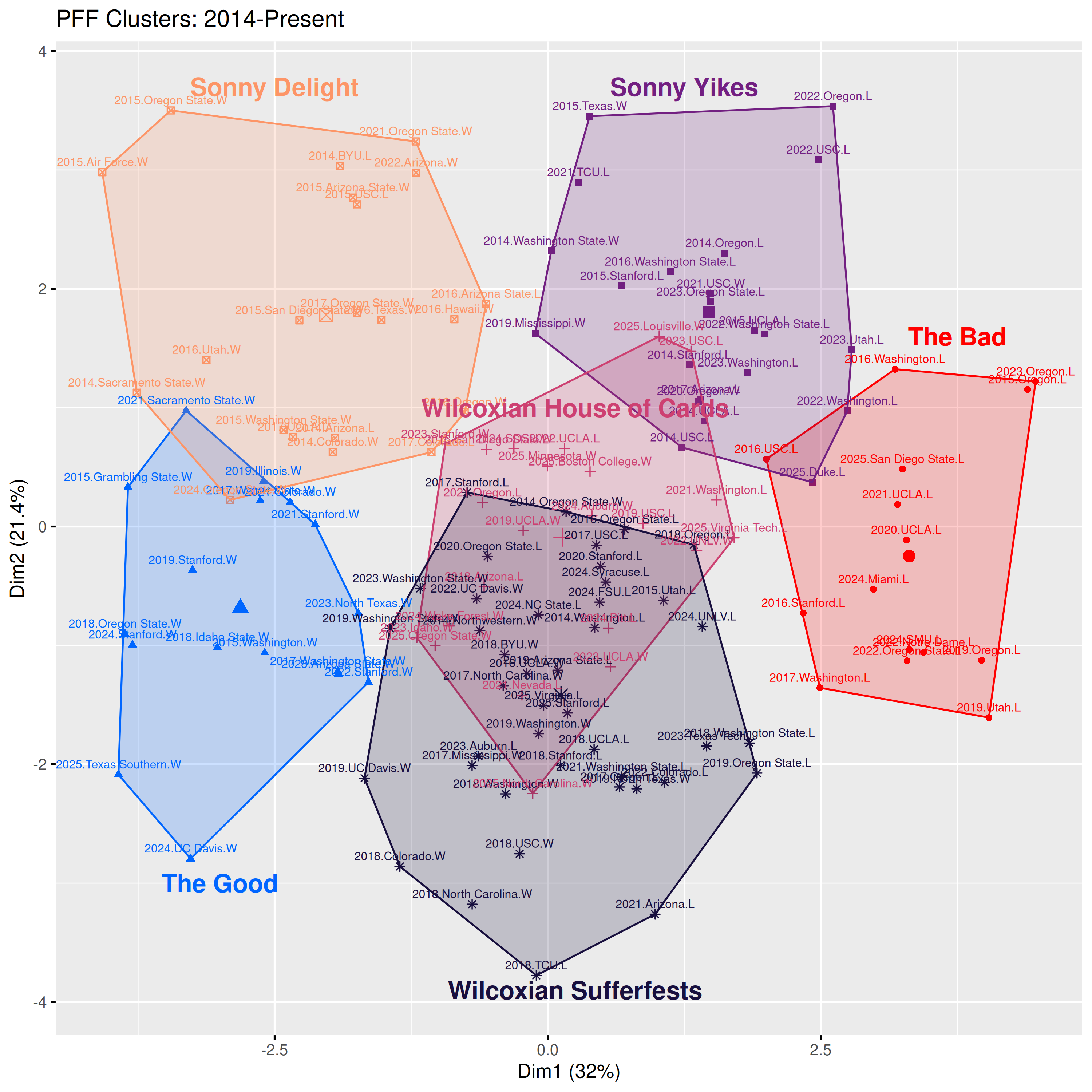
We’ll go through each of these clusters one-by-one to define the cluster and identify its most typical game (which is the game closest to the center of the cluster).
The Good: as the name suggests, the Bears earn solid grades in all defensive and offensive categories. The 2018 win over Idaho State exemplified a solid performance on both sides of the ball as Cal cruised to a 45-9 lead before surrendering a couple garbage time touchdowns.
Most typical game: 2018, Cal 45, Idaho State 23 (PFF grades: Overall: 87.8, Offense: 73.5, Passing: 83.9, Pass Blocking: 76.5, Receiving: 57.6, Running 76.7, Run Blocking 67.5, Defense: 78.9, Run Defense: 78.2, Tackling: 70.5, Pass Rush: 76.1, Coverage: 74.1)
The Bad: another obvious one—Cal struggles on both offense and defense in The Bad. If you have not repressed the memory, you may recall Cal’s season opener at UCLA in 2020 (at 9am on a Sunday, just to make things extra weird). Cal turned in one of the worst offensive performances of the Wilcox Era, with an excruciating average of 2.4 yards per play. Meanwhile the defense was steamrolled by the UCLA running game, which tallied 244 yards. Nothing about this game was pleasant.
Most typical game: 2020, Cal 10, UCLA 34 (PFF grades: Overall: 54.4, Offense: 55.6, Passing: 52.2, Pass Blocking: 60.0, Receiving: 49.6, Running: 68.8, Run Blocking: 64.4, Defense: 55.3, Run Defense: 56.0, Tackling: 51.3, Pass Rush: 61.2, Coverage: 52.3)
Sonny Delight: our first new category in the post-Wilcox Era. This was a typical strong performance in the Sonny Dykes era: spectacular offense and just enough defense to seal the victory. The typical example, the 2016 Cal-Texas game, saw Texas take multiple leads, including multiple double-digit leads, before the Bears sealed the victory behind a flurry of touchdowns in the final sixteen minutes (including one would-be touchdown that would have pushed the score to 57-43).
Most typical game: 2016, Cal 50, Texas 43 (PFF grades: Overall: 79.6, Offense: 78.9, Passing: 81.6, Pass Blocking: 76.3, Receiving: 78.8, Running: 62.1, Run Blocking: 64.6, Defense: 65.2, Run Defense: 54.3, Tackling: 49.7, Pass Rush: 59.4, Coverage: 79.5)
Sonny Yikes: our next new category, this is a typical high-scoring loss we would often see under Sonny Dykes. The main difference between Sonny Delight and Sonny Yikes is that the latter has slightly worse defense and a more inconsistent offense, often one that goes through a scoring drought at some point during the game (which usually allows the opponent to build an insurmountable lead). Although the example below is from the Wilcox Era, it followed a common script for these types of games: Cal and OSU spent much of the game trading touchdowns until a fifteen minute scoring drought by Cal allowed the OSU offense to score 17 unanswered points, ballooning a 3-point lead to a 20-point lead.
Most typical game: 2023, Cal 40, Oregon State 52 (PFF grades: Overall: 64.1, Offense: 74.0, Passing: 70.0, Pass Blocking: 42.9, Receiving: 66.2, Running: 82.6, Run Blocking: 65.4, Defense: 47.9, Run Defense: 54.1, Tackling: 63.2, Pass Rush: 59.8, Coverage: 34.5)
Wilcoxian Sufferfests: These rockfight-flavored games are dominated by strong defenses and lifeless offenses. Often the Rule of 21 applies here, where the first team to hit 21 points usually wins. The example below comes from this year’s Virginia game, where some early and late scoring by both teams was sandwiched around 8 consecutive scoreless drives by both teams. These games are often decided by a critical turnover or two, such as the game-sealing pick six that ended Cal’s potential game-winning drive.
Most typical game: 2025, Cal 21, Virginia 31 (PFF grades: Overall: 73.8, Offense: 62.9, Passing: 67.5, Pass Blocking: 51.7, Receiving: 64.3, Running: 65.7, Run Blocking: 50.5, Defense: 72.4, Run Defense: 78.7, Tackling: 74.8, Pass Rush: 65.2, Coverage: 64.7)
Wilcoxian House of Cards: This is a newer class of game that emerged later in the Wilcox Era. This category captures many in the Bizarro Games category that emerged last season. These are games where skill players on offense turn in strong performances, but the offense is hamstrung by awful line play. Similarly, the defense is generally strong in every facet except tackling. Overall, these are good performances held back by a frustrating lack of execution in the fundamentals. The example below, the 2024 win over Auburn, had mostly strong grades except for a poor tackling grade and a spectacularly bad pair of grades for the O-line. Self-inflicted wounds are critical in these games: Cal had 11 penalties and allowed 8 tackles for loss, consistently setting the offense back (which is part of the reason Cal punted on 5 consecutive possessions). The defense struggled tackling, with 11 missed tackles on 62 plays. Fortunately Auburn was eager to give the ball away, as they had a whopping 5 turnovers.
Most typical game: 2024, Cal 21, Auburn 14 (PFF grades: Overall: 67.9, Offense: 65.7, Passing: 82.1, Pass Blocking: 25.1, Receiving: 70.1, Running: 70.6, Run Blocking: 47.5, Defense: 66.9, Run Defense: 66.9, Tackling: 61.5, Pass Rush: 65.0, Coverage: 66.7)
Cluster Grades
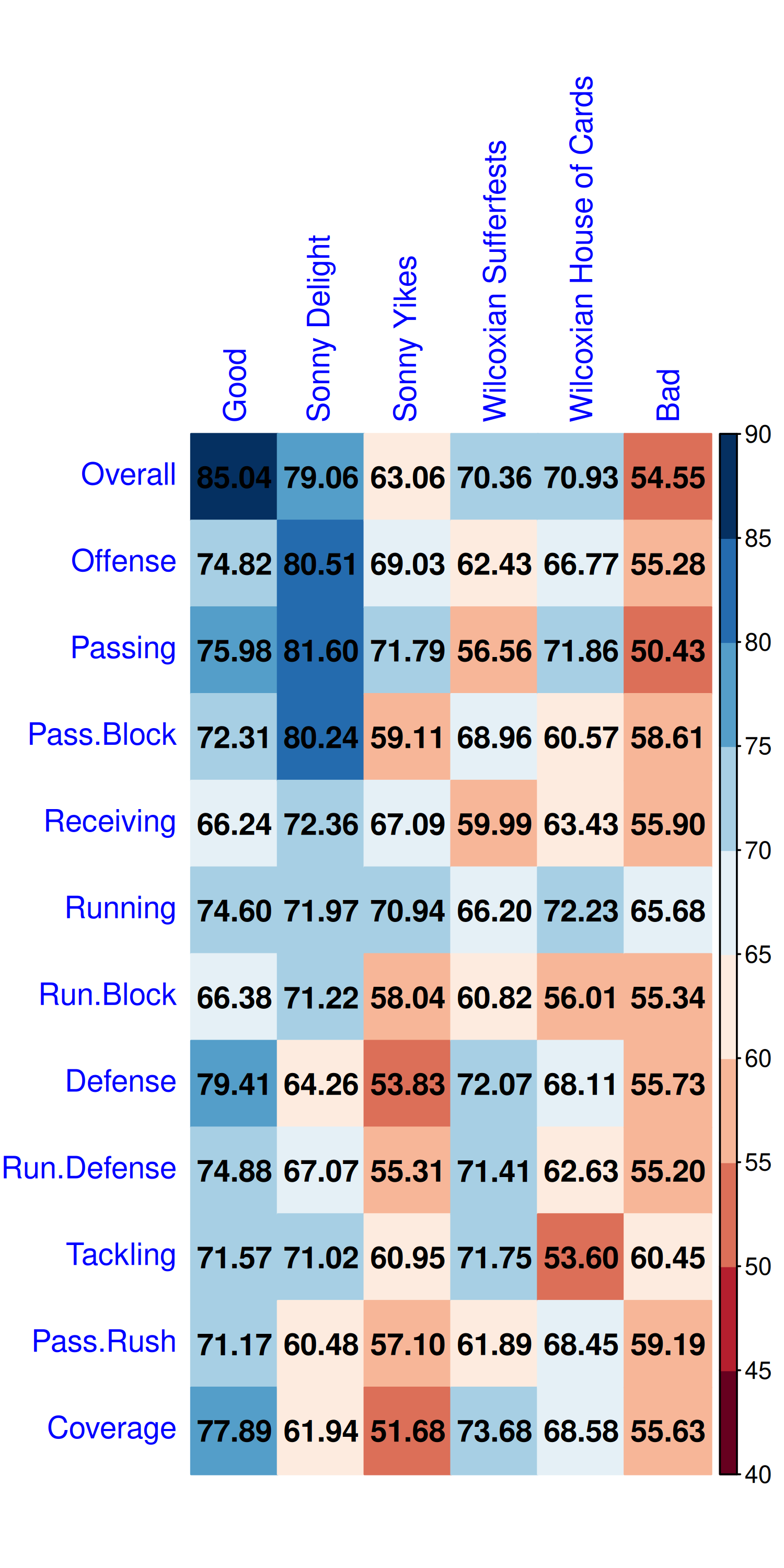
The following chart shows the average PFF grades in each cluster. Grades are color-coded with better grades filled with a darker blue while worse grades have a darker red. Some clear distinctions are visible between the clusters.
A few interesting notes from the clusters’ grades:
The Sonny Delight offense is even better than the offense in The Good. When that offense was rolling, it was unstoppable.
On the other hand, the Sonny Yikes defense was even worse than the defense in The Bad. When that defense had a bad day, it had a very bad day.
Despite all the struggles by the offensive line under Wilcox, they tended to have decent days during his Sufferfest games. Unfortunately, the passing game was unable to lend any assistance to the reasonably successful ground game.
Sonny Yikes teams resemble Wilcox’s House of Cards teams but with much, much worse defense.
While the Sonny Dykes and Justin Wilcox teams felt very different, it is remarkable to see how the 2014-16 and 2017+ teams tend to occupy different places in the plot. These clearly were very different teams.
Cluster Trends
The Cal football team has evolved considerably over the last twelve seasons, and the most common clusters each year show this trend. The table below shows each type of team and how often they showed up each season.
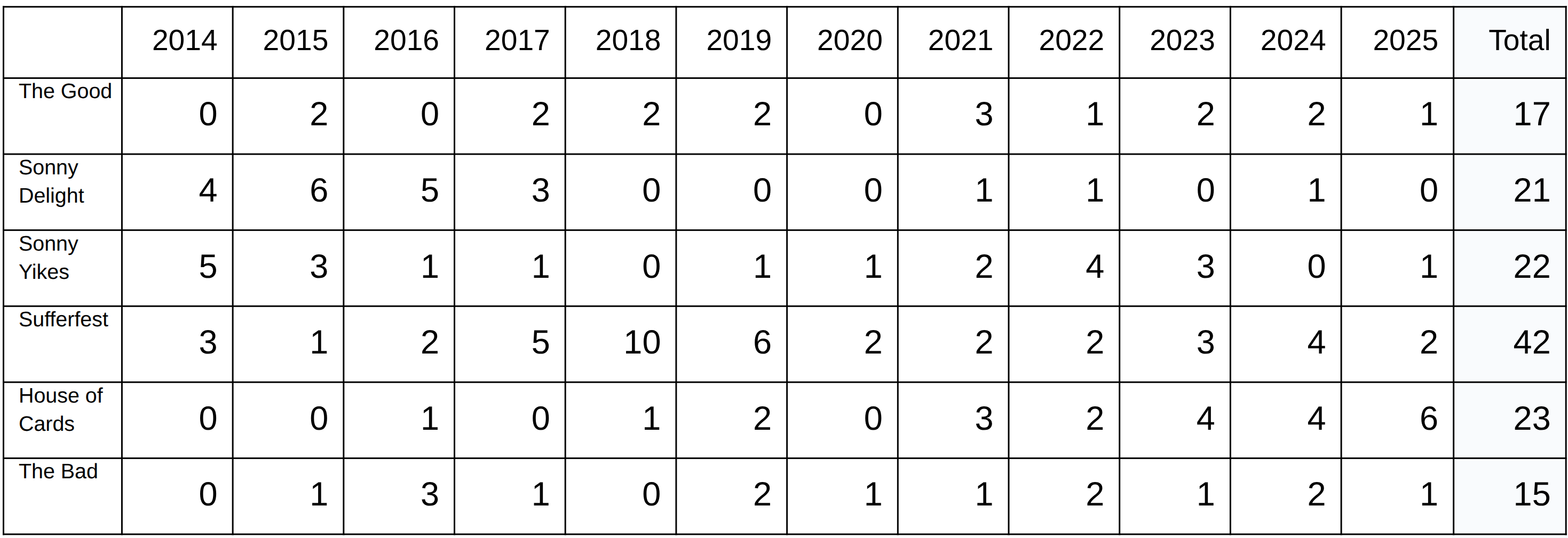
Sonny Yikes was the most common type of game in 2014, as the team was still recovering from the horrors of the Andy Buh defense. Sonny Delight was most common in 2015 and 2016, before a strong pivot to Wilcox’s Sufferfests from 2017-2020 (including TEN in 2018). The team’s identity changed distinctly after new offensive and defensive coordinators took over in 2021, with a surprising number of Sonny Yikes games. Declining performance on the offensive line and with tackling led the 2023-25 teams to be most often characterized by House of Cards.
Now that we have evaluated the last twelve seasons of Cal football, what kind of team did we see on the field against SMU? Tune in next time to find out.
Well done! Dim 1 / 2 are composite attribute loadings on principal axes, but I wonder if you can intuit a primary attribute they tend to reflect.
Very interesting retrospective. Really captures that early Wilcox enthusiasm and subsequent letdown. Felt like we might combine the styles and win but ended up just substituting one Achilles' Heel for another.