

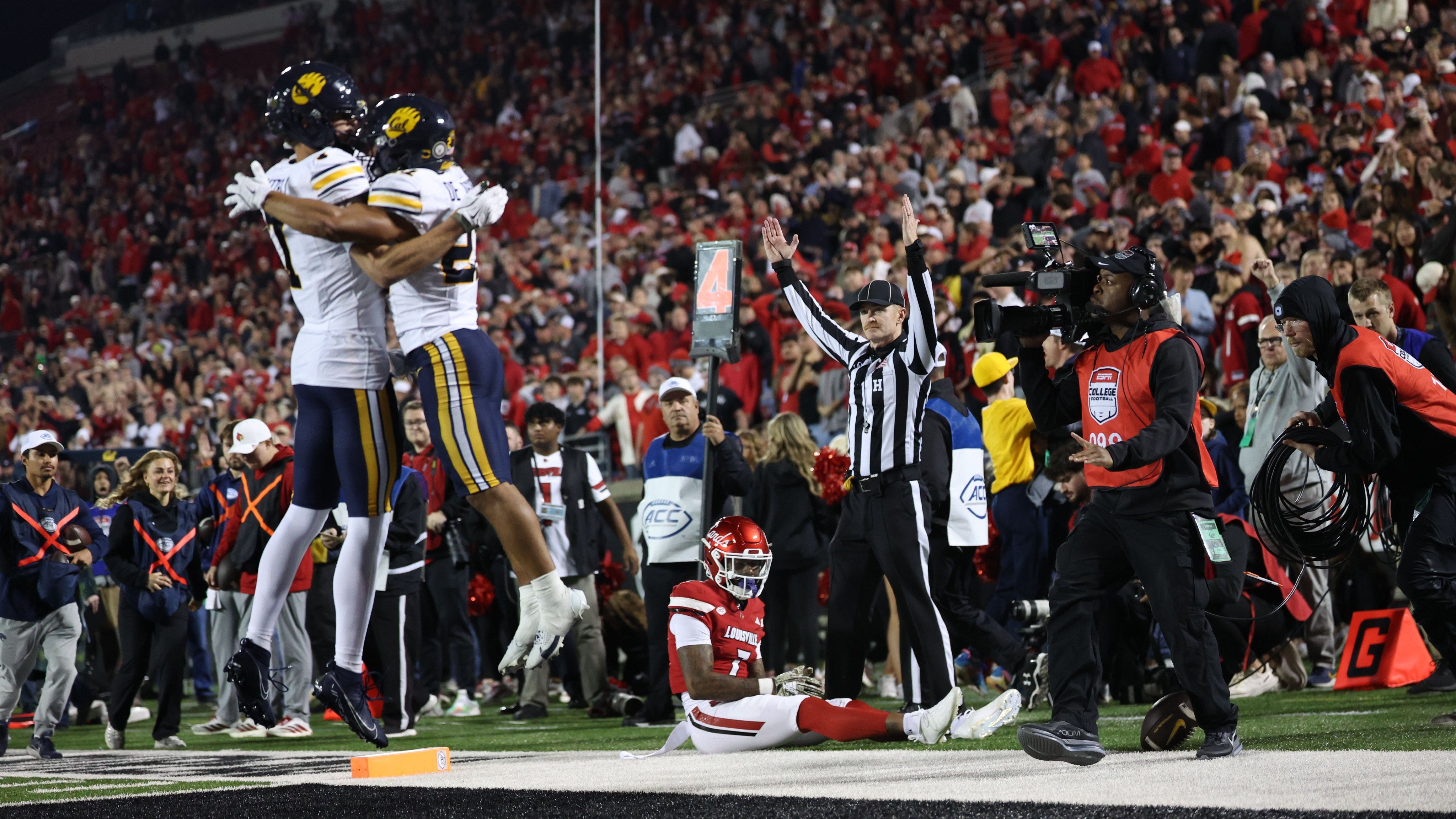
Thank you (De) Jesus - via @calfootball twitter
Here is where I must eat the tastiest of humble pie. I said the following before the game, while predicting a blowout loss:
I think Louisville is also a particularly bad matchup for Cal. The Cardinal have probably the best pass rush Cal will face all season, and a generally excellent passing defense. They are perfectly set up to take away Cal’s only strengths on offense.
Cal went out and had the best game any team has thus far put on the Louisville defense. The Bears scored more offensive points than any prior opponent (Virginia required a defensive score to get to 30), had the best success rate (50%) that Louisville has allowed by a wide margin. The Bears out produced Miami, Virginia, Pitt . . . all teams with excellent offenses, all teams who are ahead of Cal in the ACC standings.
In short, this offensive performance came out of nowhere. How’d the Bears do it?!
I know it’s hard, he’s only 5’7’’, but locate #21 pre-snap on every play shown in this video (which is sadly not comprehensive), and enjoy perhaps the greatest single game performance by a receiver in Cal history:
Offense
Efficiency Report
12 possessions - 3 touchdowns, 4 field goal attempts (3-4), 5 punts, 2.4 points/drive. Cal offensive points/drive entering the game: 2.0. Louisville defense points/drive allowed entering the game: 1.3.
For roughly three quarters the Cal offense was incredibly efficient. Six of seven drives ended in Louisville territory, five of seven drives went for at least 50 yards, and Louisville had no answer for JKS. In the 4th quarter Louisville was able to ramp their pressure up and force some incompletions, but it was still a wildly impressive offensive showing.
Can you make an entire offense out of plays to one dude?
I’m being a little hyperbolic . . . but only a little.
Cal ran 74 offensive plays. 24 of those plays featured Jacob De Jesus in some fashion. Roughly 1/3rd of Cal’s offense was centered around a 5’7’’ wide receiver.
And it . . . worked? On the 24 plays in which De Jesus was either the receiver, rusher, or passer, Cal gained 186 yards, for 7.75 yards a play. On the 50 plays that did NOT feature De Jesus, Cal gained 241 yards, for 4.8 yards/play. For those curious, if Cal averaged 7.75 yards/play as a team, they would lead the nation in that stat. If Cal averaged 4.8 yards/play as a team, they’d be tied with Army for 124th in the nation.
As noted by the Cal radio broadcast, De Jesus broke the Cal record for catches in a game with 16. He was targeted 22 times, which for all I know might be a record too, though reliable target data doesn’t really exist. It’s a credit to Cal’s coaching staff for recognizing the strength of the offense and building a game plan that maximized that strength . . . though I wouldn’t blame any Louisville fans gnashing their teeth in frustration that their defense was unable to adapt to Cal spamming passes to one dude.
A remade offensive line comes through
Cal started a new look offensive line. Here’s the new starting lineup:
LT Nick Morrow, LG Jordan Spasojevic-Moko, C Bastian Swinney, RG Tyson Ruffins, RT Braden Miller
For those trying to keep track, that’s three new starters (Morrow, Swinney, Miller) and a position shift for Ruffins from center to RG. And it worked! Cal came in with a pass heavy game plan, running 52 pass plays in total, and only took three sacks.
I’m of two minds about all this. On one hand, kudos to the coaching staff for recognizing that changes needed to be made, and kudos to the five guys along the line who held up much better against Louisville’s very good pass rush than anybody would have reasonably anticipated.
On the other hand, it is certainly frustrating that Cal’s coaches were unable to (apparently) identify the best offensive line grouping until the tenth game of the season. Would improved offensive line play have made the difference between victory and defeat against Virginia Tech or Virginia? It’s a question with no clear answer.
JKS is the truth
Look, I don’t even want to narrow this down to one throw, because for nearly the entire game JKS was as good as anybody could expect a true freshman to possibly be, even without considering the circumstances of the season. Of his 17 incompletions, two were batted down and another six were contested catch opportunities that weren’t made. On the road, facing a ferocious pass rush, JKS gave his receivers chances to make a play on almost every drop back. He’s a special, special player.
Defense
Efficiency Report
12 possessions - 2 touchdowns, 4 field goal attempts (4-4), 4 punts, 2 turnovers (1 interception, 1 downs), 2.2 points/drive. Louisville offensive points/drive entering the game: 2.3. Cal defense points/drive allowed entering the game: 2.0.
Louisville was moving the ball pretty effectively for the first three quarters of the game - 23 points in 7 drives is a cool 3.3 points/drive! Then they hit a brick wall - their final five drives totaled 20 plays for 12 yards.
What changed? Well, more on that below.
A great coverage game
Louisville wasn’t very effective passing the ball for most of the game, and got worse as the game went along. To some extent that’s a credit to Cal’s pass rush, who bothered Miller Moss a bit more than I expected. Still, Cal only pressured Moss on 29% of his dropbacks.
No, this was a game won by coverage. Moss dropped back to pass 42 times, and he completed passes to a Louisville receiver other than himself just 18 times. That’s TERRIBLE. Early on in the game Louisville was able to exchange some of that inefficiency for explosiveness, but that died off in the 2nd half and all that was left was incompletion after incompletion. Cal’s secondary, particularly Paco Austin, won them this game.
Questionable Louisville game management
Look, I get that being a football coach is a hard thing. Can you successfully run a play if your opponent expects it?
A clever man wouldn’t call his best play, because he would know that only a great fool wouldn’t prepare to stop his opponent’s best play. I’m not a great fool, so I can clearly not call my best play. But you must have known I was not a great fool; you would have counted on it, so I can clearly not call my best play!
I kid. Smart teams know to keep running the same basic ideas until the other team stops you. If the other team can’t stop the zone read keeper, then you tell Kyron Drones to keep the damn ball. If the other team can’t stop Jacob De Jesus, then you spam passes to Jacob De Jesus.
Louisville didn’t learn this basic lesson of football playcalling, because their running game was dominant, PARTICULARLY when they handed the ball to Keyjuan Brown, who gained 136 yards on 14 carries for nearly 10 yards/rush:

Even worse, when they DIDN’T hand the ball off, their offense was quite bad. And yet, in their final six drives of the game covering the 4th quarter and overtime, Louisville handed the ball off to Brown on just 5 of their 30 plays.
Those five plays were great! Two of them were back-to-back 6 yard runs for a first down. Two of them were back-to-back runs of 9 and 2 yards for a first down to start overtime (to be fair, that 2nd play was nullified by a killer illegal block). The clock did not prevent Louisville from giving the ball to Brown, because Louisville had timeouts to burn on every single drive.
Cal put the ball in the hands of their best players and they won the game. Louisville decidedly DIDN’T do the same thing. Is it Miller Moss’s fault for having a bad game, or is it Jeff Brohm’s fault for not recognizing what was - and what wasn’t - working for his team?
Special Teams
Louisville was great, and it was almost the difference
Cal was much better at moving the ball down the field than Louisville, but thanks to iffy drive finishing, this game was nearly decided by field goal kicking. Louisville’s Cooper Ranvier went 4-4 including three long kicks, while Cal’s Chase Meyer missed a 40 yarder to go only 3-4, and that was almost the difference.
Punting was functionally equal until Brook Honore shanked his last punt for 18 yards in what looked like an ill-advised attempt to kick out of bounds to prevent a late punt return. That maybe should have been the difference in the game, because Louisville only needed to drive for maybe 10-15 yards to get in range for the ultra reliable Ranvier. Thankfully Brohm called for a pass play and Miller took a sack, and that basically ended any chance for Louisville to avoid overtime.
Coaching
Justin Wilcox, the man
In the immediate aftermath of Cal’s game winning play, the ESPN2 broadcast captured Justin Wilcox running out onto the field with an expression of joy I’m not used to seeing on the face of a man I mostly associate admirably with stoicism.
My reaction to seeing Wilcox’s pure joy was the following:
I posted that BEFORE I saw this video taken from the Cal locker room, an apparently spontaneous show of support for the theoretically embattled head coach.
I admire many things about Justin Wilcox. In nine years in Berkeley, he’s been given many opportunities to complain about many different things, but has been steadfast in his refusal to make excuses. He’s adapted to the player empowerment era without throwing the kinds of tantrums that have been common across the coaching industry. He’s tried to adapt and change to increase Cal’s odds of success. He supports his players in a way that has engendered admiration and loyalty. There has been barely even the whiff of scandal from anybody associated with his program for nine years in an era when most programs seemingly have a handful of people arrested every other year.
If football coaching were a normal job that isn’t zero sum, he’d be allowed to stay for as long as he wanted. It’s unfortunate that being a good dude and fostering good vibes isn’t how success is defined in college football.
What it does mean is that Justin Wilcox never loses his locker room. His teams never quit, and it means that his teams are often well positioned to win late season games in surprising ways when other teams might check out.
As Wilcox is fond of pointing out after losses, effort is not enough to win games. Cal needed a radically altered game plan, a reshuffled offensive line, good fortune, and clutch plays to win this game. But none of that would have been possible without a baseline level of effort that not every team manages after back-to-back losses that kill off loftier goals that might have been set prior to the season.
There’s a reason that I ran around yelling incoherently around my living room when De Jesus scored to end the game that went beyond just generally being a Cal fan. I like Justin Wilcox, I want him to succeed, and his success brings me happiness.
Big Picture
Having said all of that . . .
Bad reasons to decide to retain or fire a coach:
Whether or not the refs call targeting on Miami in the final minutes.
Whether or not a Boston College receiver holds on to a tough catch at the goal line in the final minute . . . and whether or not BC’s quarterback identifies Luke Ferrelli in shallow zone coverage on the next play.
Whether or not UNC’s wide receiver can hold onto the ball as Paco Austin tries for the punch out.
Whether or not Chase Meyer makes a long field goal at the end of regulation against Virginia Tech.
Whether or not Cal converts a 4th and goal do-or-die OT play against Louisville
You get the idea, right? Every single year, games are decided by single plays. There are many more single plays that lead down the path that allows that final single play to swing a game one way or the other. None of these singular plays, by themselves, are useful evaluation tools.
Frankly, I also don’t think it’s a particularly good idea to make the decision based off context-free single season record. Cal is currently 6-4, meaning that the Bears could finish anywhere between 9-4 and 6-7. I think it’s bad analysis if you said that a 9-4 record means that Justin Wilcox automatically deserves more time or an extension. I think it’s equally bad analysis if you said that 6-7 means that he automatically deserves to be fired.
And if Cal’s decision makers allow Cal’s performance in the next three games swing the decision one way or the other between retaining or firing Justin Wilcox, that would be deeply concerning to me.
Because the decision should be made based off the entire record, within context of what Cal could/should achieve based on the resources available. Justin Wilcox has coached 102 games at Cal. He should be evaluated based on the collective interpretation of those 102 games and everything that goes into determining the results of those 102 games.
That is a decision for Ron Rivera, and a decision to worry about a few weeks from now.
Right now, the focus is on ensuring that a sad-sack Stanford is plunged further into the depths of despair. Beat Stanford. Keep The Axe. Go Bears.
The UofL fan behind me hates Moss. And the drunk lady near us said we should take him back to CA with us, to which my son said nope, you can keep him. I kept telling the guy behind us that we are not good against the run. Brian Brohm needs to keep running the ball. Guess Brohm doesn't listen to me.
Also not sure why they didn't blitz in OT. We don't seem to have a good plan against he blitz.
OCs Brian Brohm and Bryan Harsin both had the chance to play "run the same play until proven they can stop us". Harsin won.