

College football is a near impossible game to predict.
Sure, plenty of what Cal did right on Saturday was the residue of design. Jericho Johnson, Solomon Williams, and AJ Tuitele popping on the defensive front was supposed to happen. Ian Strong and Chase Hendricks delivering on their transfer portal bona fides was something we were counting on. Daniel Harris and Isaiah Crosby holding down Tech’s passing game and making tackles in the run game isn’t a surprise.
But when you have a huge roster and guys inevitably get hurt, surprises are inevitable.
Consider Jackson Brousseau, who previously had played in 14 games, only one of which was a win over an FBS team?
Consider Jordan King, a former walk-on who keeps getting recruited over and keeps earning his way onto the field.
Consider Carson Perry-Smith, another walk-on generously listed at 5’11’’, who needed every inch of his frame to bring down a looping, terrifying touchdown pass to give Cal the lead.
Consider Tyree Sams, JD McKinley, and Taimane Purcell, all 1st year players, all but Purcell relatively unheralded recruits, all not expected to see significant action behind more established veterans, but producing in unexpected roles.
Solid football teams are built on contributions from the guys you expect, and contributions from the guys you didn’t necessarily expect. Cal got exactly that against Virginia Tech. Not coincidentally, for the first time this year, Cal looked like they just might be a solid football team.
Offense
Efficiency Report
11 drives: 3 touchdowns, 2 field goal attempts (2-2), 6 punts, 2.3 points/drive.
First four Cal drives: 16 plays, 40 yards, two first downs, zero points
Final seven Cal drives: 53 plays, 363 yards, 22 first downs, 25 points
What changed? Two things, ultimately:
Cal backed off from running the ball as frequently.
As noted in pretty much every game column this year, Cal cannot effectively run the ball with any consistency, and the run needs to exist solely as an infrequent counter to keep defenses honest. In Cal’s first four drives, they had a 7-9 run-to-pass ratio, and it was helping to bog down their drives.
Jackson Brousseau got comfortable.
In Cal’s first four drives, not a single pass went further than about 5 yards past the line of scrimmage. Meanwhile, Brousseau turned a pretty decent pocket into the only sack of the game, missed an open Ian Strong in favor of a throwaway on a weird little roll out pop pass option, and probably missed a few other downfield options in favor of shorter throws.
Your new QB starter needing some time to get comfortable and establish himself isn’t exactly a huge shock, but the simple reality is that Cal’s offense cannot function without the threat of a downfield passing game. On Cal’s 5th drive, they established that threat, and the Cal offense rolled to 6.8 yards/play, 3.6 points/drive the rest of the way.
4 receivers, 1 RB, pass heavy: college offense as God intended
Cal threw the ball 62% of the time, and most of the time in a 4 WR, 1 RB set. To be fair, Cal did have tight end on the field most of the time, but that tight end often lined up in the slot running a route just like any other wide receiver.
In other words, it looked like a standard spread college football offense. It also worked like one too. It gave Brousseau well-spaced passing options all over the field, and Cal’s offense attacked the intermediate middle of the field from sideline to sideline. And having a running back on the field meant that the RB could either assist in pass protection or be available as an outlet, something that Ashten Emory did capably.
Did Cal’s offensive line (which ‘allowed’ one sack that wasn’t the fault of the line anyway) look better in pass protection because they played better, or because the new look offense got the ball out faster and asked less of the line? This is probably a both-things-are-true situation.
Sure, there were still wrinkles that were hit and miss. The option worked once as a change of pace and flamed out on a second usage. The direct snap stuff to Emory was about as successful as the rest of Cal’s running game.
But mostly it was a pretty standard modern college offense, and that’s fine by me.
Jackson Brousseau evaluation
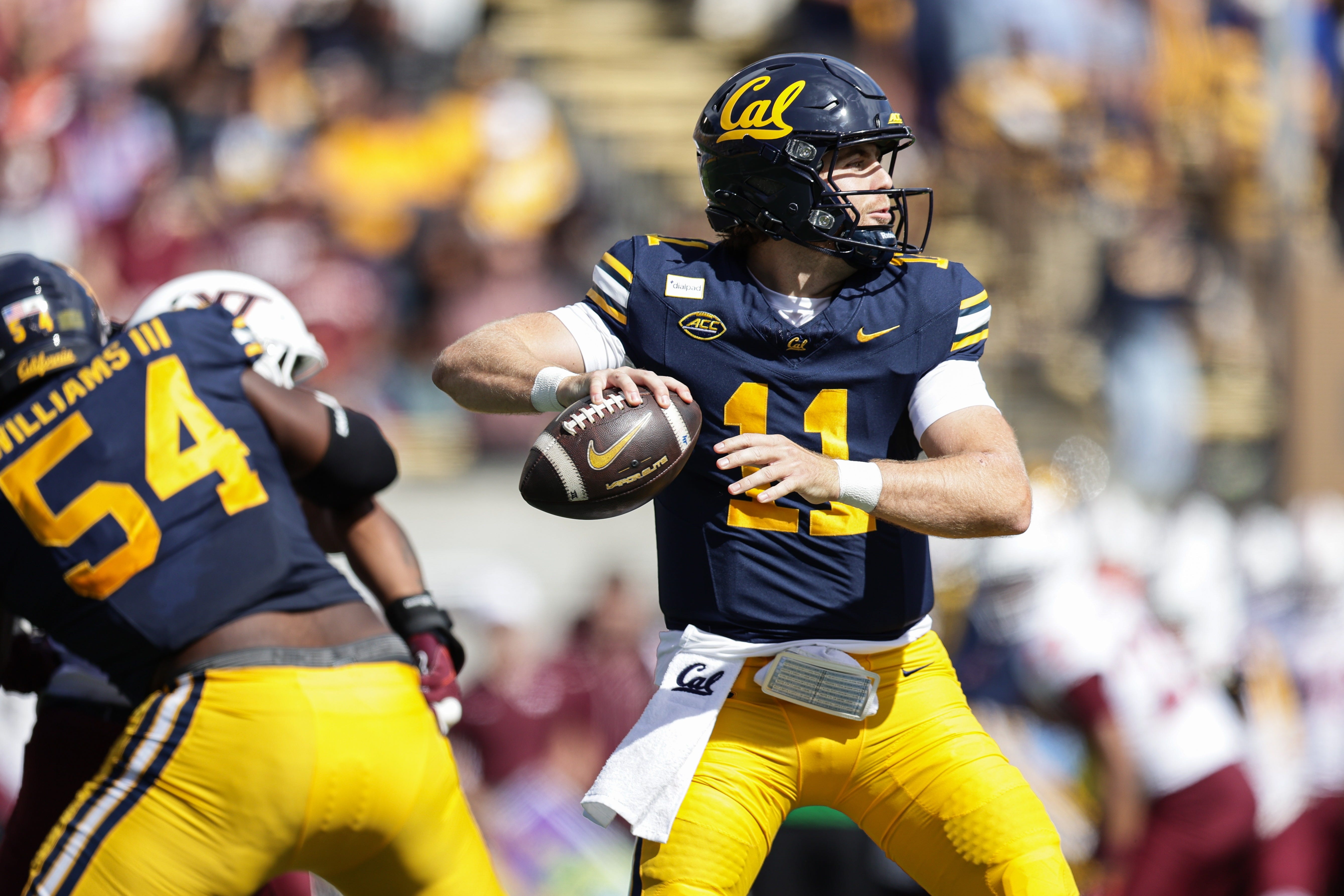
A guy who can capably make most any throw within 20 yards and generally makes the right decision is a valuable college football quarterback, and that’s exactly what Cal got with Jackson Brousseau.
I say 20 yards for a specific reason: Brousseau basically never went deeper than 20 yards, which was how deep he went on sideline fades to Strong (particularly when he got a free play from Tech offsides) and a sideline out to Jordan King.
But that’s not a critique either. Virginia Tech, like most college football defenses, played two deep safeties. Cal doesn’t really have a speedy deep threat WR that can reliably take the top off of a defense. Targeting throws 5-20 yards downfield is where this offense can reliably make things happen.
JKS is a guy who has that deep throw ability in his arm, but unfortunately that’s not as valuable a skill when your WRs aren’t great deep threat options and the line can’t reliably block long enough for deeper options. But JKS is also a guy who can make all of the underneath throws too, and I would like to see him operate in Cal’s new-look offense under new play caller Pat McCann first before making any kind of conclusions that we’re seeing the most unexpected Wally-Pipp-ing in Cal football history.
Defense
Efficiency Report
10 drives: 3 touchdowns, 2 field goal attempts (0-2), 5 punts, 2 points/drive.
One difference between this game and prior games? Cal twice forced Tech to settle for longer field goals, and thus gave the opponent the chance to make a mistake. If all of Tech’s drives that got past the Cal 40 were touchdowns as happened against UNLV, this game wouldn’t have been competitive. But because Virginia Tech was mostly forced to dink and dunk and couldn’t get their run game going, Cal had multiple opportunities to end drives.
Explosiveness problems, fixed for now
All season, and particularly last week, we’ve talked about how the Cal defense has been really good except for a penchant to allow explosive plays, particularly in the run game. Here is a list of explosive plays allowed to Virginia Tech, as defined by Games On Paper:
13:19 remaining 2nd quarter, 3 and 16, V. Tech passes for 32 yards
12:41 remaining 2nd quarter, 1st and 10, V. Tech passes for 30 yard touchdown
0:06 remaining 4th quarter, 1st and 10, V. Tech passes for 20 yards
More on that final play below, because for my money that is exactly two explosive plays. One was a scramble drill pass from Grunkemeyer (possibly with the help of a hold on Solomon Williams where the secondary had to play coverage for a long time, and the other was a nice route and throw where Shemwell got beaten in solo coverage.
If Cal can simultaneously maintain their current level of aggressiveness, limit big plays like they did against Tech, and also cut out some of the personal fouls and PIs (6 in total, for 84 yards) they would be one of the top defenses in the ACC. I think you probably need to bake some number of penalties and big plays allowed in at this point, but Virginia Tech was a great data point for the explosives.
Depth!
Cal was without Kingston Lopa and Nate Burrell for the entire game, and lost AJ Tuitele to targeting. Despite that, the defense held strong and got solid contributions from some unexpected spots. Aiden Manutai and Cam Sidney (PI controversy aside) got playing time in place of Lopa and was solid. Cal got unexpected contributions along the defensive front, with tackles for loss from Odera Okaka and Legend Journey (in his first action of the year). Jericho Johnson had his best game era with five tackles and two TFLs.
The defense played more or less the entire two deep, and unlike the UCLA game, you didn’t notice the drop off from starters to bench guys. With lots of younger players contributing, to my eyes this is a unit that is growing and progressing each week, even if the growing pains are frustrating at times.
Special Teams
One big play, and not screwing up
Cal’s well-timed and perfectly executed fake punt was a huge play that eventually led to a Cal field goal that was disappointing at the time but was pretty important later when Virginia Tech had to try for a touchdown on the final play rather than kicking a field goal to tie or win.
Meanwhile, Cal hit their field goals, (narrowly) won the net punting battle, didn’t allow a kickoff return of note until the end of the game (on that more below) and watched as Virginia Tech gave up a ton of game equity by missing two kicks of their own. In a phase of the game often defined by mistakes, Cal didn’t make any, and that was enough to swing the game.
Coaching/Game Theory/Miscellaneous
Everything that happened in the final 0.20 seconds: YIKES
It is tremendously hard to lose a game when you hold possession inside the 5 yard line trailing by 1 point with 20 seconds remaining, and even harder when you are leading by 5 and kicking off with 18 seconds left. And yet Cal almost pulled the feat off. Here are game management things that were terrible strategic decisions that almost led to the worst snatching-defeat-from-the-jaws-of-victory since the Hill Mary:
Scoring on 1st and goal: This is ultimately my smallest quibble, PARTICULARLY with Cal’s iffy field goal kicking unit, but still: just kneel 3 times, running ~3-4 seconds off for each kneeldown, burn all of Tech’s time outs, then kick the game winning PAT and give VT maybe 5 seconds left from the kickoff? By the way, I’m not completely sure, but it’s worth watching the replay of Cal’s game winning touchdown to decide for yourself: I think James Franklin let Cal score. Leaving 20 seconds left on the clock wouldn’t have mattered if Cal hadn’t:
Squibbing the kickoff: So far this season in FBS games, opponents have returned 15 kickoffs for a touchdown . . . against 4,406 kickoffs. Meaning that Tech had a roughly .34% chance of the game winning kick return. Maybe don’t just cede 15 free yards of field position? And anyway, kicking it out of bounds and letting Tech start from the 35 would have been better!!!
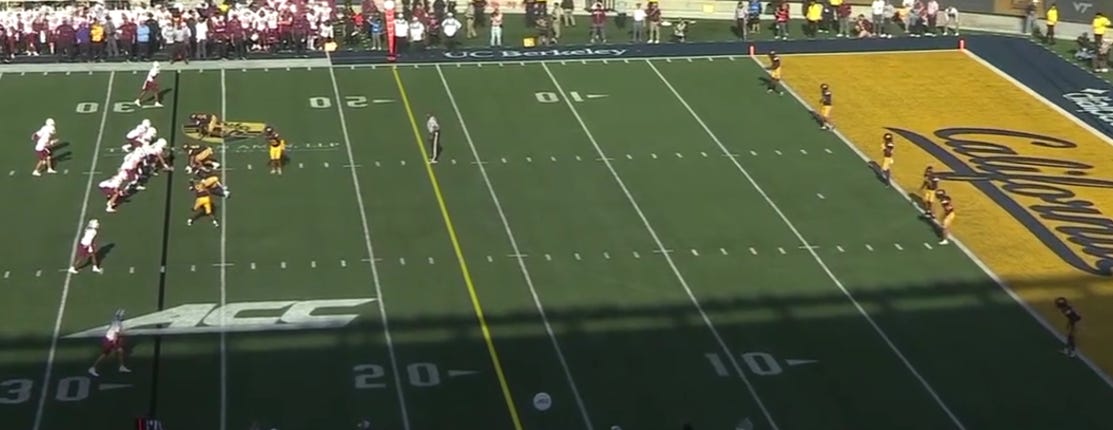
Sitting your entire secondary at the goal line on 1st and 10 from the Cal 27 with 6 seconds left. Look I’m not asking you to play press coverage or anything. Just sit 10 yards deep and be prepared to either contest them on a shorter throw if they’re trying to run two plays, and back pedal if they decide to make that play their final hail mary. That’s exactly what you did on every other play in the drive, and Tech had no choice but to throw it up to somebody to try to make a contested catch.
I mean come on, this is basically saying to Tech “hey you can have a free 20 yards if you want it!” and Franklin said sure:
The Refs
There were a ton of calls/no-calls in this game, many of them extremely impactful. Penalties that eliminated interceptions, granted 10 first downs, and played huge roles in late scoring drives.
I rewatched all of the accepted, called penalties in this game and came to a surprising conclusion: I agreed with all of them. I didn’t LIKE two of them: the targeting from AJ Tuitele was really kind of unfortunate timing/circumstance, and the roughing-the-passer that was a huge help in Cal’s final drive was much the same thing. But by the rule book both were correct calls.
Which then brings you to the major call that wasn’t made: pass interference on Cam Sidney. After watching the replay multiple times, I think Cam Sidney arrived early and certainly never got his head around to the ball, and it’s the kind of call I’d expect refs to make . . . maybe 75% of the time? But they are less likely to make that call on the literal final play of the game, and Sidney was lucky that the ball hit him, perhaps making it appear to the back judge that Sidney had made a play on the ball.
Cal got lucky. I have exactly zero qualms embracing and celebrating that.
Big Picture
This was a massively important win for two reasons:
Various worst-case scenarios are off the table
Based on the evidence of Cal’s first five games, without improvement Cal could have easily slid into a tailspin that ended with something like a 3-9 or 4-8 record. Winning this game, looking like Cal did, means that those kinds of ugly scenarios are very unlikely. If Cal plays the rest of the way like they did against Virginia Tech, then this is probably a bowl team.
It was a demonstration that this staff can fix things and coach competent football
Ideally Cal would have installed a functional offense in the off-season. But that failure has allowed Tosh Lupoi and his staff to display a different skill: the willingness to acknowledge failure and make changes that result in improvement.
How many times have you watched coaches stick to the same plan, promising that players will execute better next week after more practice? How many times have you seen coaches try to make mid-season changes on the fly only to fail in new and different ways?
Watching Cal’s offense to start the season gave Cal fans immediate reason to doubt in Tosh Lupoi’s ability to make hires and guide his staff to on-field success. Watching Cal play solid, reasonable football in a win over Virginia Tech gave Cal fans (and recruits) reason to believe in Tosh Lupoi’s ability to be a successful coach.
This datapoint won’t mean much if it’s just a one-off blip, a random good game through some combination of advantageous match-ups and good fortune. But if Cal plays like they did against Virginia Tech the rest of the way, there will be something in Berkeley that can be built upon.