

I was naively excited for this game.
Not, like, hey-I-think-Cal’s-likely-to-pull-another-upset excited. I predicted Cal to lose, after all.
You see, there was a sneaky-good-on-paper matchup for Cal/Wake Forest. Believe it or not, but Cal came into the game in the national top 10 in defensive Expected Points Added against the pass. Meanwhile, Wake Forest had nationally excellent passing efficiency.
But neither team had been fully tested. Wake Forest hadn’t faced a team with a nationally above-average EPA/dropback (yes, even Miami), and Cal had faced a bunch of pretty iffy passing offenses. But Virginia Tech was at least an above average passing team that seemed to lend credence to the idea that Cal’s pass rush and secondary were at least solidly above average, and maybe even nationally excellent.
Then the game started:
WF pass for 15 yards
WF pass for 14 yards
Incompletion
WF pass for 31 yards
WF pass for 39 yards, touchdown
WF pass for 29 yards, touchdown
Six offensive snaps, all drop backs, none of which got significant pressure, many of which had blown coverages of varying degrees of severity. A 14-0 lead with 51 minutes of football left shouldn’t be Game Over. But at the time, Wake Forest’s dominance was so comprehensive that it felt over, and that feeling turned out to be 100% correct.
In six plays, Wake Forest had demolished the one strength Cal seemed to possess as a team, and the rout was on.
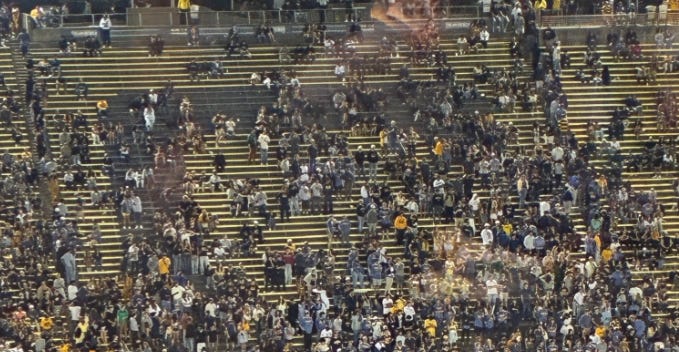
When Wake Forest scored their 4th touchdown of the game midway through the 2nd quarter on their 4th drive, I watched from a high point on the west side of the stadium as students streamed out of the stadium. The high point of excitement was when Wake Forest committed three penalties on one play (which allowed the mic men to once again remind us all that You Can’t Do That. I keep forgetting!).
The rest of the game was an exercise in the camaraderie of gallows humor for those broken enough to stay until the end.
A warning: I’m going light on ‘analysis’ this week and focusing more on big picture stuff, because you don’t need me to play captain obvious and tell you that Saturday night was one of the greatest no-show performances in the history of Cal football.
Offense
Efficiency Report
7 drives: , 5 punts, 2 turnovers (2 downs), 0 points/drive.
Hey, at least the math gets easy when you put up a goose egg.
Based on the eye test, Cal had exactly one thing going for them offensively against Wake Forest: getting them to jump off sides so that they could throw up a contested pass downfield. It’s not the best source of sustained offense, but it did happen three times!
The quarterback controversy we created for ourselves
On Saturday before the game, all kinds of wild rumors were swirling across social media about Cal’s quarterback situation. I would have preferred not to be exposed to any of them, because they’re all unverifiable, not useful for analysis of the team, and they give a certain segment of the Cal fan base brain poisoning.
Here is what I know:
Tosh Lupoi and his coaching staff decided that Jackson Brousseau was the best quarterback available.
This decision was made despite the fact that JKS was healthy and available to play, which was confirmed when, you know, JKS came in to play.
The opinion that Jackson Brousseau was the best quarterback available evidently persisted throughout the entire non-garbage-time segment of the game. Playing JKS for the final 18 minutes of the game against Wake’s back-ups is not useful data.
I find this . . . utterly baffling. I’d kinda get it if they thought that JKS was too hurt to be effective, but if that’s the case, playing him at all would be insane.
Look - Jackson Brousseau is a really excellent back-up QB for a team like Cal, and I’d bet that plenty of other mid-level ACC teams wish they had a guy like him. But he’s also a 4th year QB who couldn’t break into regular action at Colorado State until year 3. There is ample evidence that he’s just not as talented a quarterback as JKS. Electing to play Brousseau over JKS when both are available is malpractice of the highest order.
The offense is probably too depleted to have sustained success, regardless of the QB
Cal lost their starting center on their 2nd series, was (for unclear reasons) without Ian Strong (amongst other WR injuries), and has basically one healthy running back.
I’ve seen worse injury situations, and I’ve also seen other teams manage worse injury situations and remain productive. But this is already a team running a cobbled together late install offense in the context of their injury issues, so I’m acting on the assumption that Cal will have long periods of offensive doldrums against competent defenses.
Defense
Efficiency Report
8 drives: 6 touchdowns, 2 punts, 5.1 points/drive.
I am defining garbage time in alignment with Jake Dickert, who pulled Gio Lopez and his starters when Wake Forest went up 41-0 midway through the 3rd quarter.
But I do think it’s worth just focusing on the first four Wake Forest drives, when the game was put to bed with alarming speed. The raw, ugly numbers from those first 4 drives:
32 plays for 286 yards
8.9 yards/play
84% WF success rate
Zero havoc plays
Six plays of 29+ yards allowed
At this point, Wake backed off a bit on offense and ran the ball more, then backed off even more when they pulled their starters. It did feel a bit like Wake could nearly name the score based on how immediately dominant they were to start the game.
I cannot even begin to speculate why the apparent strength of this team turned into the team’s biggest weakness . . . unless Wake Forest is truly the #1 passing offense in the country.
Stayed tuned for more next week when we play . . . oh god . . . SMU and Kevin Jennings.
Special Teams
It is a coaching failure that Cal players are allowed to return kickoffs
I want Cal’s kick returners to have all the confidence in the world in themselves and their teammates blocking for them. I want them eager to return every kick.
And I want Cal’s coaches to recognize the fact that 90% of the time a Cal kick returner elects to return a kick, the result is Cal starting a drive from the ~13 yard line. Cal’s coaches should have issued a blanket order to fair catch every kickoff they catch inside, say, the 8 yard line. Failed returns happened THREE more times against Wake Forest, and it’s just another sign of a coaching staff that doesn’t seem to have any particular idea of what their team can and cannot do successfully.
Big Picture
We now have seven games of evidence from the Tosh Lupoi era. In the interest of trying to be both fair and comprehensive, here is a list of positive indicators and negative indicators of future success. Let’s start with the positive:
Positive Indicators
Flashes of production and growth from younger defensive portal recruits, like Kingston Lopa, Jericho Johnson, Solomon Williams, and AJ Tuitele.
A pass rush/secondary combo that seemed legitimately good until Saturday night.
A willingness to re-think Cal’s offensive approach after initial system failure, leading to an unexpected upset win over Virginia Tech.
Special teams trick plays that have been both successful and well timed to help compete in close games.
Willingness and ability to get positive contributions out of newer and/or unheralded players like Tyree Sams and Carson Perry-Smith
Negative Indicators
The installation of, in retrospect, an utterly unqualified offensive coordinator, forcing Cal to scrap and replace his installed offense after five games.
Losing to UNLV, a team with a significantly less expensive roster.
The baffling decision to start Jackson Brousseau (2.8 yards/attempt vs. Wake) when JKS was healthy.
A host of key offensive portal additions who have either barely played (Jimothy Lewis, Dorian Thomas) or have underperformed (Ian Strong, Cooper Perry).
A defense that has given away much of their positive production by bleeding big plays: 19 plays of 30+ yards (132nd in the nation).
A team that is currently 131st in penalties/game and 132nd in penalty yards/game.
Special teams play that has generally had a net negative impact on Cal’s chances of winning games.
Having the team woefully unprepared for Wake Forest, to the point where in the stands I was openly wondering if the team had quit.
Since I started writing for this website, I have attempted to closely analyze and write about the following coaches from the moment they were hired at Cal, in chronological order:
Sonny Dykes, Lindsay Gottlieb, Justin Wilcox, Wyking Jones, Charmin Smith, Mark Fox, and Mark Madsen.
I’ve tried to consider the context of their hire, the situations they were handed, the resources the university provided, and the skills they brought into the role. In that capacity, I’ve seen good hires and bad hires. I’ve been too optimistic and too pessimistic.
Right now, based on the evidence to date, I think Tosh Lupoi has more in common with Wyking Jones and Mark Fox than he does the rest of the list.
That isn’t any kind of final verdict. The whiplash we’ve all experienced together going from the UNLV game to the Virginia Tech game to the Wake Forest game means that you already know that just about anything could happen next Saturday.
But if the seven games of on-field evidence is representative of what Tosh Lupoi will produce across the length of his tenure . . . well, there are going to be some painful conversations about time, money, sunk costs, and the long term future of Cal football and Cal athletics.
Excellent piece. I am actually an unrealistic optimist but this team reminds me so much of Tedford that I flash back to being 18 and having bad whiskey from a flask while we were losing by 4 touchdowns.
Thanks Nick!
Read this piece in a small town in Southern Italy….a time for thoughtful reflection on all things Cal football.