

For eight seasons, October has been Cal’s most unpredictable—and in many ways most punishing—month under Justin Wilcox. Since Wilcox took over as head coach in 2017, Cal has been competitive in most other stretches of its schedule, yet momentum seems to wane each October.

A look at the numbers shows where that midseason drop-off has occurred in seasons past. But if Cal can capitalize in coin-flip games, there’s reason to believe this season could be different.
The October Problem
During Wilcox’s tenure, Cal’s October win percentage has consistently dipped. The decline isn’t all bad luck—it’s partly structural. Looking at Cal’s scoring margins week by week across all seasons, the pattern is clear: early-season momentum, a midseason dip, followed by a late-season rebound.
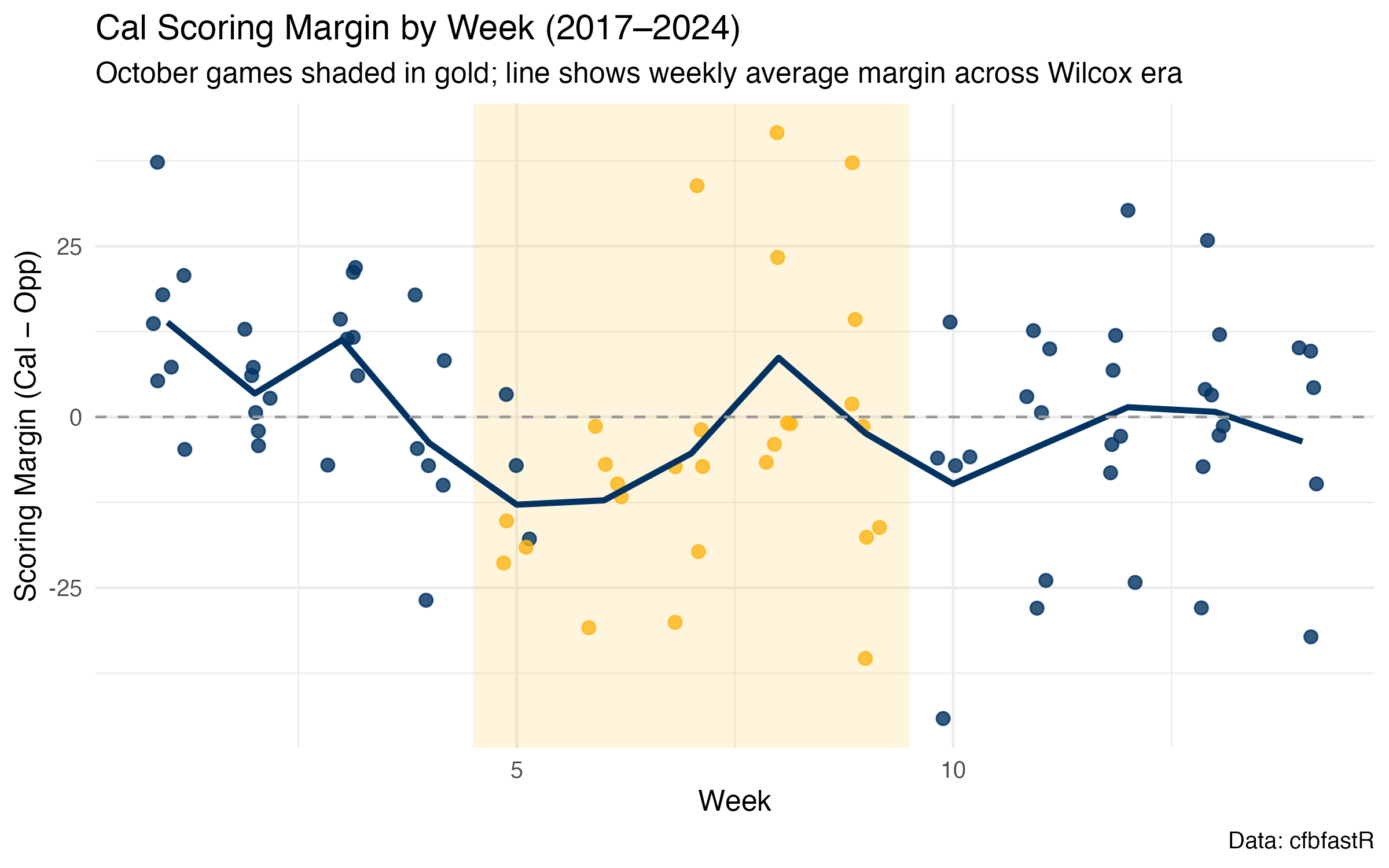
Cal’s scoring margins in early October sink below zero, meaning the Bears, on average, are being outscored by their opponents. It’s a trend that spans different offenses, coordinators, and roster cycles.
Schedule Strength Creates a Headwind
One reasonable theory is that Cal simply faces tougher opposition in October. The data does support this—up to a point.
Roughly 40% of Cal’s October games under Wilcox have come against opponents with average winning margins of +7 points per game or better—“strong” teams. By comparison, in other months, around one-third of Cal’s games have been against “strong” teams, and a larger share have been against “weak” teams with average margins of -7 points per game or worse.
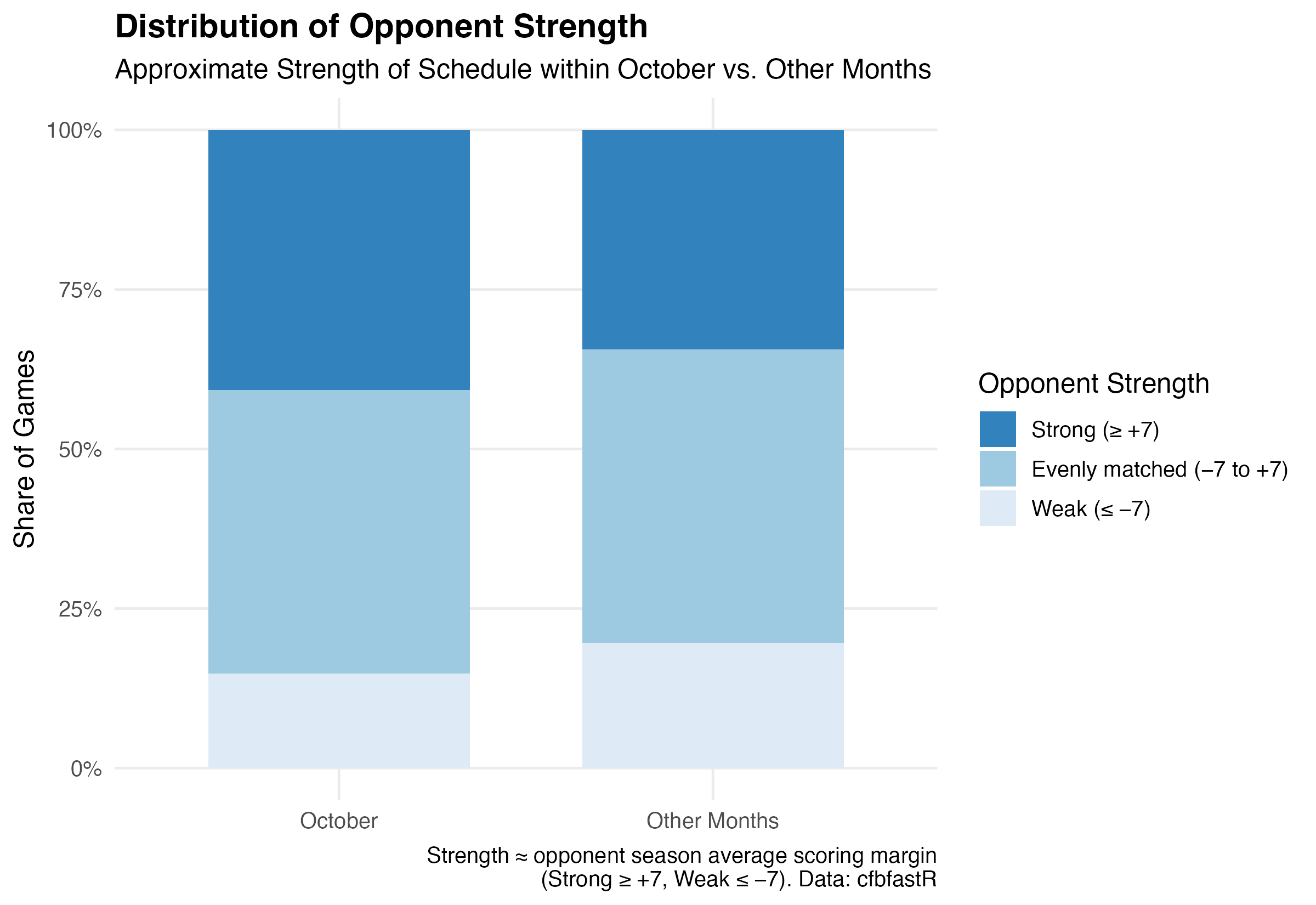
That means that October is where the midseason grind and strength-of-schedule collide. Still, the distributions are not dramatically different—and Cal hasn’t just lost more often in October, it’s also been outscored by a wider margin.
Performance by Opponent Strength
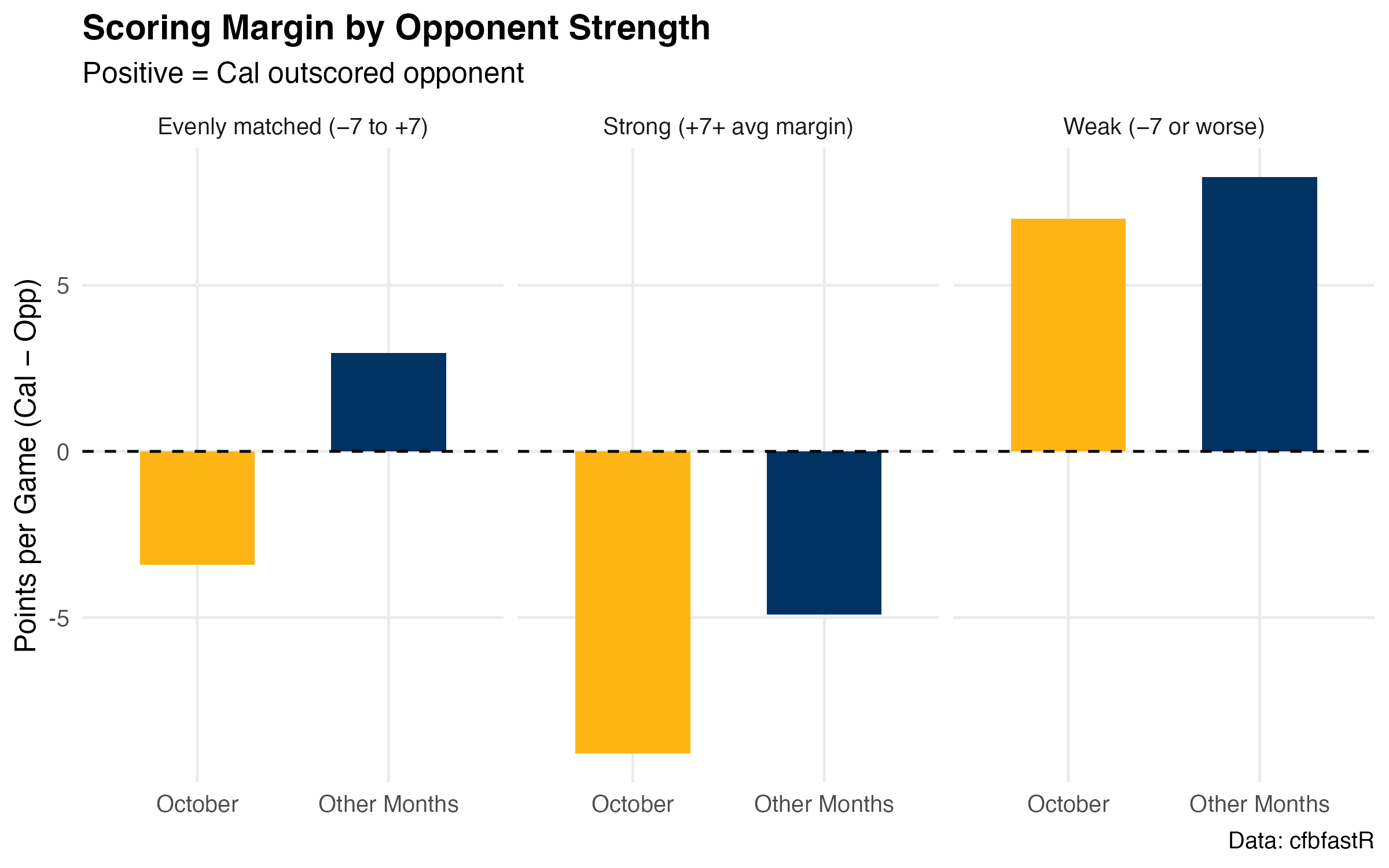
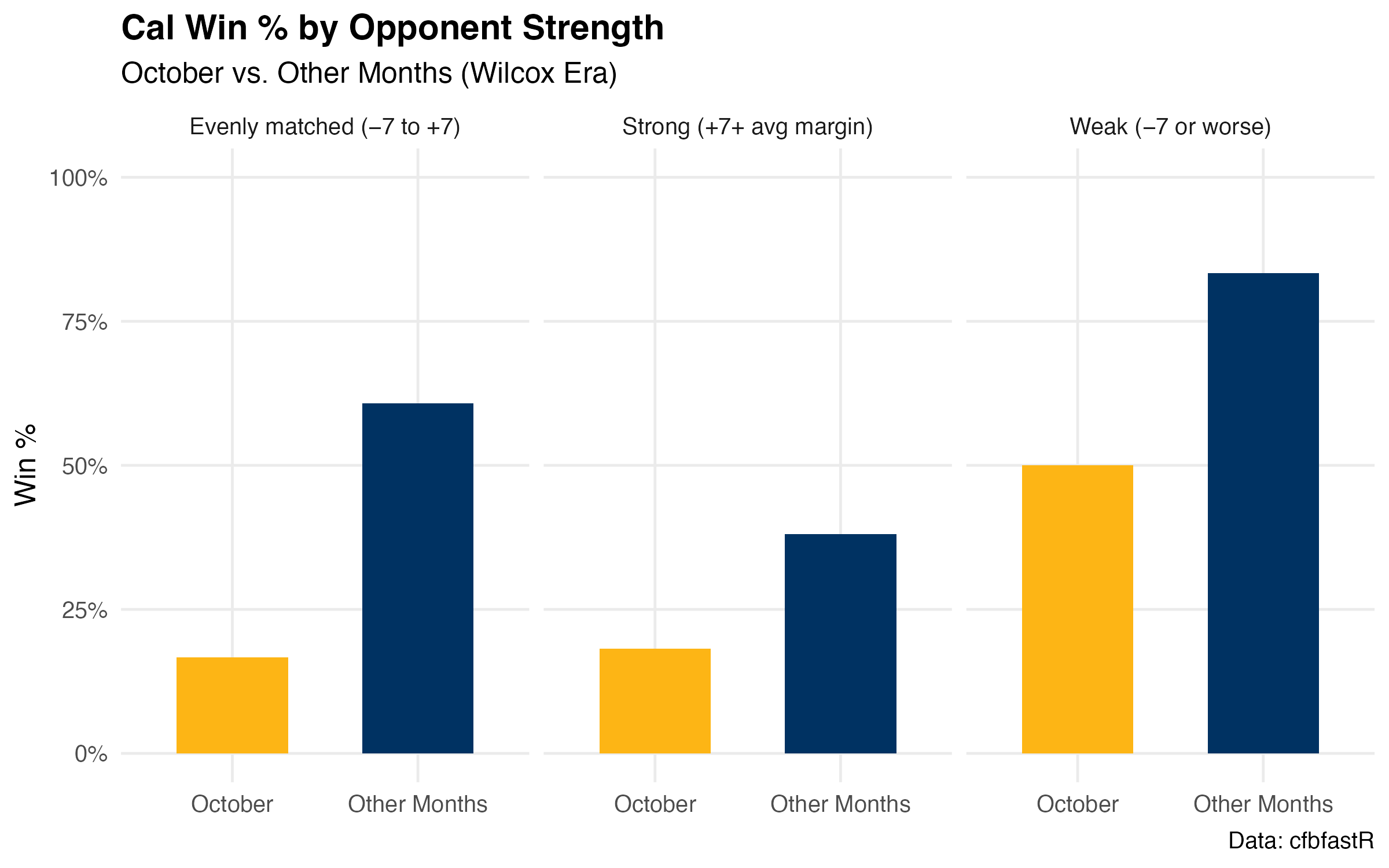
Breaking down Cal’s performance by opponent strength, Cal’s October slump is even clearer. Against strong teams, the Bears have averaged a nearly-double-digit deficit. Even against evenly matched teams—where victories are closer to a coin-flip—Cal has averaged -3 points per game.
Outside October, however, Cal tends to beat evenly matched teams and handle weaker ones more decisively. In short, the Bears’ October struggles aren’t just due to playing tougher teams: Cal has performed worse relative to expectation conditional on opponent strength.
What Makes 2025 Different?
Why might 2025 be different? For one, the schedule is more favorable. Cal’s October schedule this year features UNC (2-3) and Virginia Tech (2-5) and 3 solid weeks without travel.
If Wilcox’s October troubles have been driven by tough matchups, travel demands, and failing to capitalize against weaker opponents, these next two games offer a real chance to break that pattern and flip the script.
Past struggles aren’t destiny. And if the past eight seasons have been a long lesson in managing October letdowns, this one might provide a reason to look forward to October matchups.
As always, Go Bears!
A big part of this is roster depth. October is where starters get dinged up and newer players have to step up. Top teams (which Cal tends to play in October as well like SC and Oregon in Pac 12 days) get 4-5 star depth replacements and Cal doesn't have that luxury.
We're gonna lose to UNC Bill aren't we.....