


Welcome back to The Good, the Bad, and the Rockfights, our weekly exercise in which we characterize the previous game across a wide variety of performance outcomes. While we ordinarily classify the team across a wide range of potential categories, this year we seem to be stuck analyzing the myriad ways Cal’s performance ends up being classified in The Bad. What kind of Bad was it this week? Read on to find out.
Glossary
Want to know what kinds of Cal football games we’re currently identifying, what BCF Toys’ drive ratings measure, or how to read the Good-Bad-Rockfight-Pillowfight chart? This section should answer any questions you have about the plots and analysis. Otherwise, skip ahead to the plots.
Types of Cal football games
Good: Cal moves the ball productively and efficiently, and turns possessions into points. Meanwhile the defense stops the opponent’s drives early and prevents scoring opportunities.
Bad: The opposite of The Good: Cal can’t move the ball well or efficiently and cannot turn possessions into points. Meanwhile the defense surrenders many yards, long plays, and points.
Rockfight: These are led by strong defensive performances where the defense forces the opponent to grind out inefficient drives that usually end in a punt or turnover. Meanwhile, the offense replicates that struggle. These games are usually dictated by the rule of 21: first team to score 21 wins.
Pillowfight: both offenses can do whatever they want while the defenses are powerless to stop them. These are high-scoring shootouts that are usually decided in the waning minutes of the 4th quarter.
Plots
Boxplots: a boxplot illustrates the spread of data points. The plots used in this series highlight the most recent game’s rating in gold while the remainder of the data points are represented in the boxplot. The box captures data between the 25th and 75th percentiles while the horizontal line represents the median, or midpoint of the data. tl;dr: above the box = great, above the line = good, below the line = bad, below the box = turrible.
Cluster diagram: this illustrates our Good, Bad, Rockfights, and Pillowfights clusters. Each data point represents a game, and points closer together received more similar ratings while points farther apart received more dissimilar ratings. We use a k-means clustering algorithm to organize the games into four distinct clusters, which are color-coded in the plot.
BCF Toys Ratings
(the same ratings are used for offense and defense, so I will only define them once)
Game Rating (GR): opponent-adjusted FEI offense rating, capturing the expected scoring advantage the offense had against the opposing defense (and vice versa, for the defensive rating)
Efficiency (Eff): same as Game Rating, but the scoring advantage against an average defense
Points per Drive (PPD): points per drive during regulation, non-garbage time possessions (or opponent’s PPD, for the defensive rating)
Success Rate (SR): percentage of non-garbage time drives ending in a TD or FG attempt
Yards per Play (YPP): yards per play on non-garbage time possessions
Available Yards (AYd): the distance covered on a drive divided by the distance to the end zone when the drive began for non-garbage time possessions (basically, the proportion of the field covered during a possession)
Offense
It would be fascinating to compare the drive data from the first half and the second half, because it was a tale of two completely different Cal teams. It’s feasible to split out the data and re-run all of BCF Toys’ measures from each half separately, and then compare where each half fell. But I can’t be bothered to put that much time into analyzing a 39-point loss.
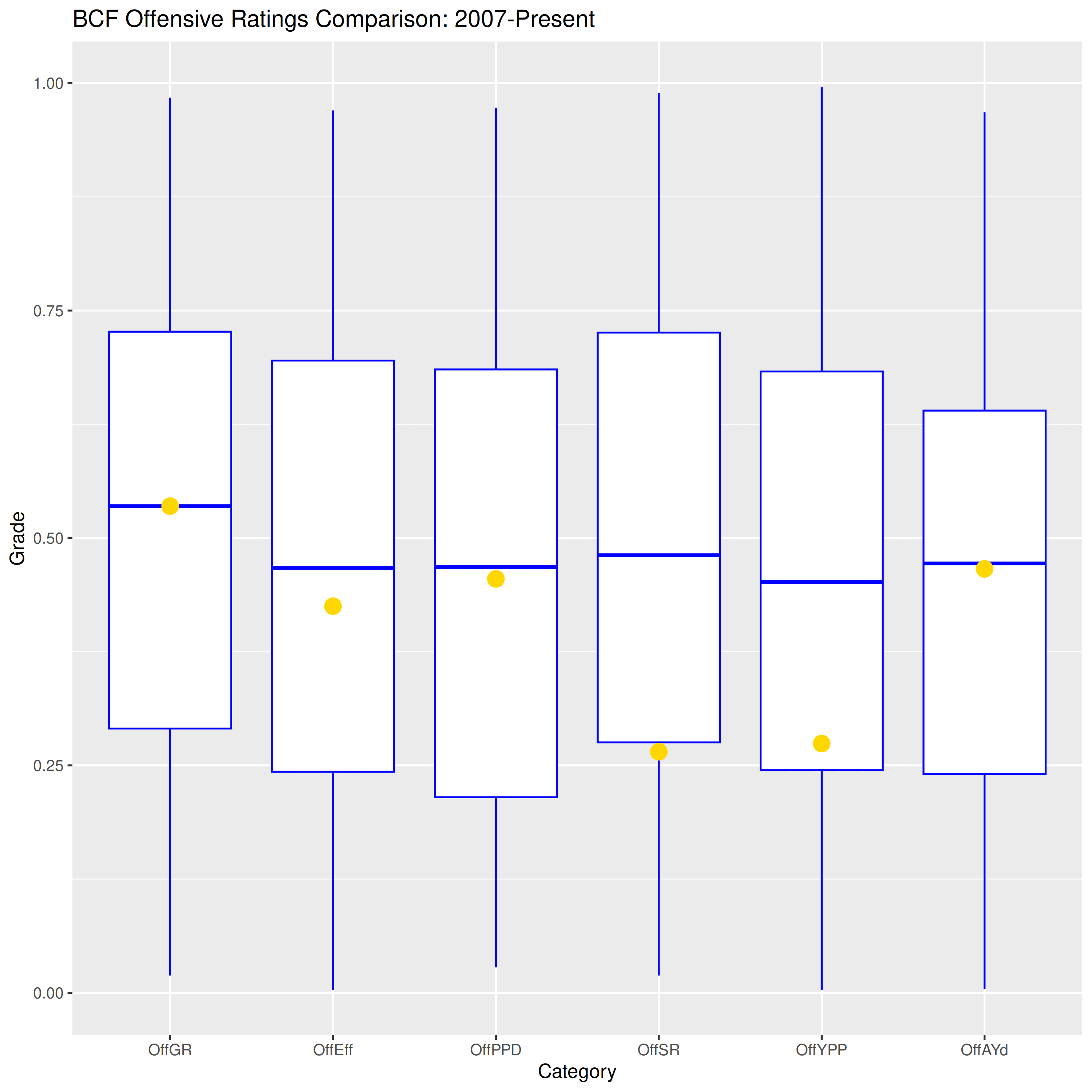
As expected, both halves average out to mediocrity. Cal’s overall offensive performance (Game Rating and Efficiency), Points per Drive, and ability to cover the field (Available Yards) were middling. But the Yards per Play and Success Rate were only around the 25th percentile. This tells us that Cal was actually decent at scoring points on longer drives, but they struggled to create those scoring opportunities due to inefficiency.
Defense
Defensively, things we less nuanced.
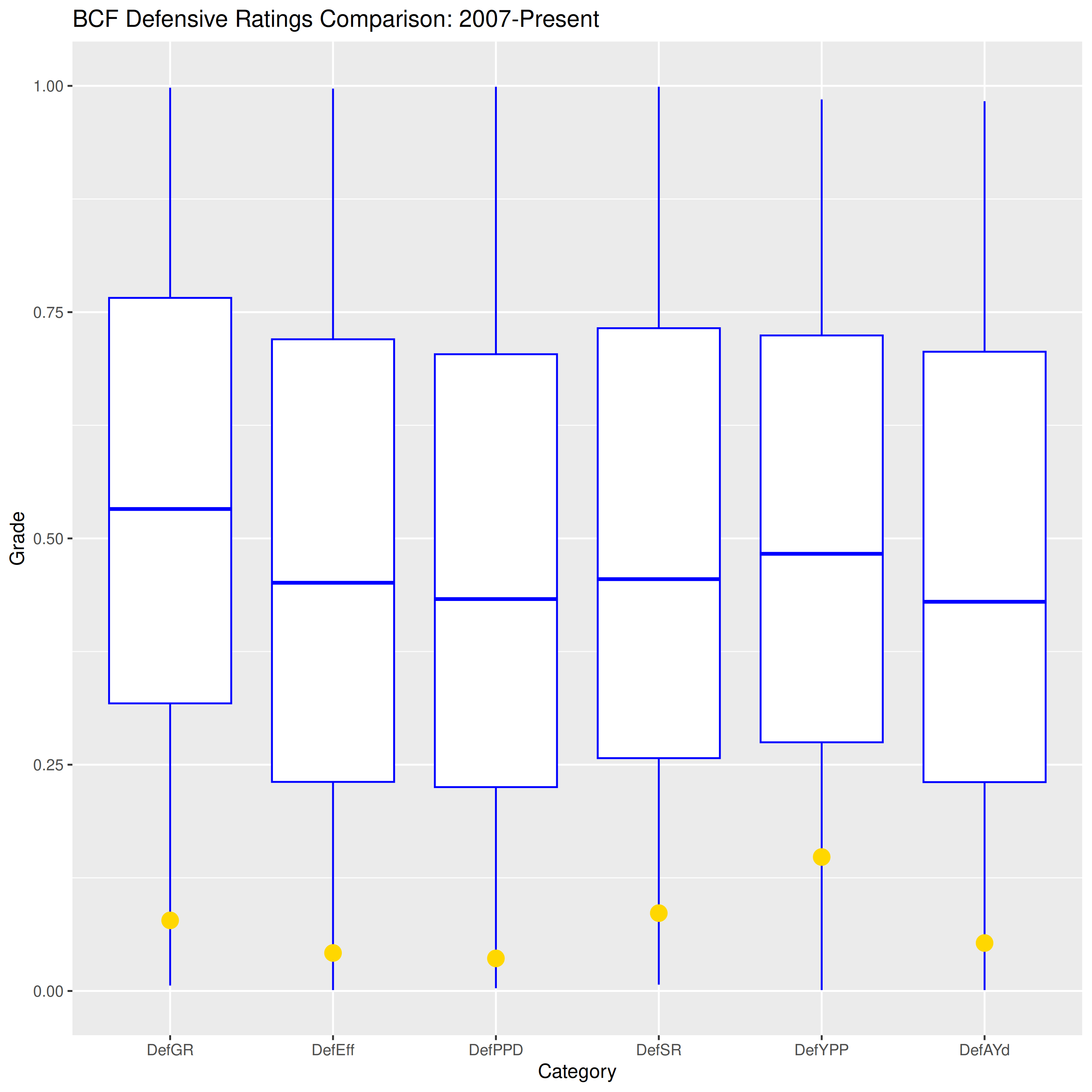
This was terrible across the board. SMU moved the ball far, efficiently, and into the end zone. Nothing pleasant can be found in these defensive stats.
Special Teams
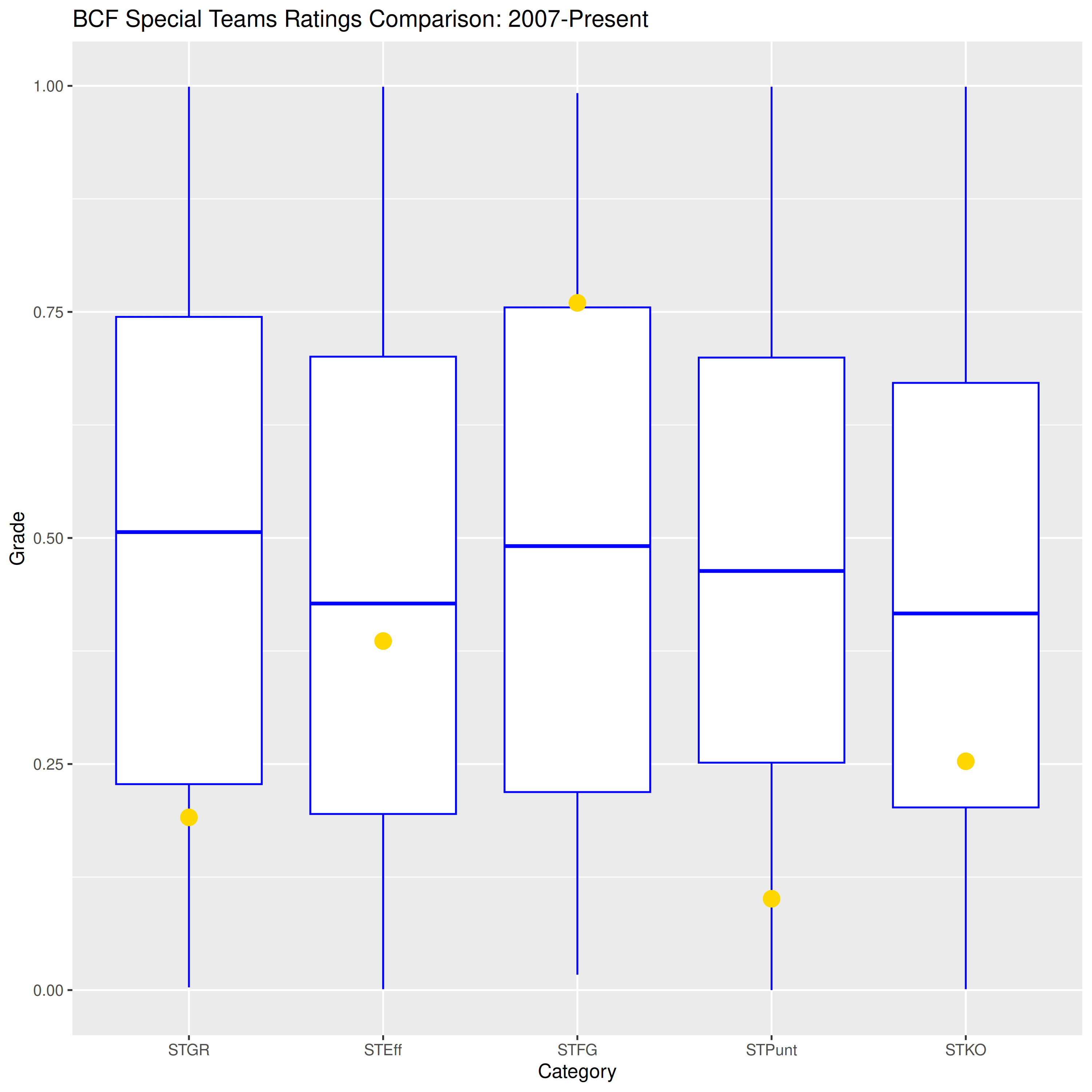
This was a mixed bag, as usual. Cal did decently well on field goals by converting two medium-range kicks (37 and 41 yards) compared to SMU’s lone, close-range FG (29 yards). Punting greatly favored SMU; although they only punted twice, they averaged 47.5 yards and surrendered 9.5 yards per return. Meanwhile Cal averaged 40.2 yards and surrendered returns of 26 yards and -2 yards. The kickoff rating was not great, and that’s finally not due to Cal’s woeful tendency to return kicks out to the 15. Rather, that’s a function of SMU’s 35-yard kickoff return that set up their first score of the game.
Cluster Analysis
At this point in the season, we’re mostly trying to figure out where in The Bad the performance will fall…
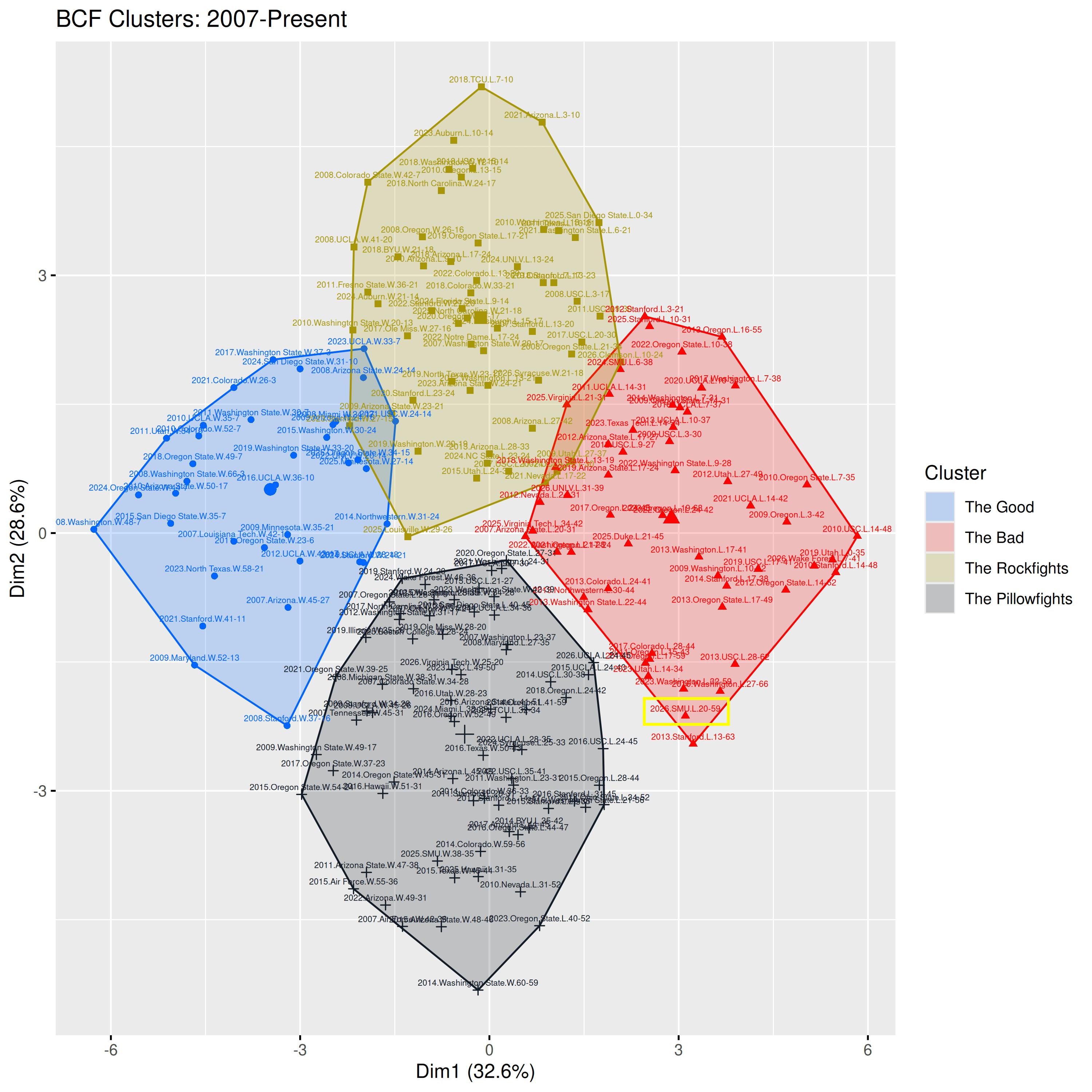
And there it is, nestled among some blowout losses featuring long scoring droughts from Cal coupled with ridiculous scoring runs from the opponent. Speaking of which…
Deja Vu
I scoured the data for the game most similar to this one, and the result may be the most demoralizing Cal football game I have ever seen: the 13-63 Big Game loss in 2013. Like this one, a huge run turned a potentially competitive game into an utter disaster. After a somewhat competitive first quarter, LSJU went on a 42-3 run. Jared Goff’s injury exacerbated things, but Cal was already down 22 and Andy Buh’s defense showed no signs of slowing down the Lobsterbacks. The drive stats look similar from each game: SMU had 8 TDs on 11 possessions (only 1 TD on the first 4 possessions, however) while LSJU had 9 TDs on 13 possessions. Cal slowed down considerably in both games, with 4 scores (2 TDs, 2 FGs) on the first 5 possessions against SMU and nothing on the next 7, and a TD on the first possession in 2013 and no TDs on the subsequent 12 possessions. Both games ended with large segments of the fanbase wondering if Cal had made a grave mistake hiring their first-year head coach…
The first half was encouraging; the second half was in a nasty very bad cluster all it's own. I am going to tune in to the morning game for a bit this Saturday. A couple more home games and then its a wrap I guess.
I'm mildly optimistic that we can get to 6-6 and a bowl. Besides, it is supposed to rain on Saturday morning so why not wake up with my coffee and the Golden Bears? I wish that I had more to say but such is the current state of Cal Football. Sigh......